
Short Bets Against US Equities Hit Record as AI Risks Mount
- Bearish bets across US stocks are surging to a record in the face of market gains, reflecting anxiety about the staying power of a rally.
- Short interest in S&P 500 Index stocks is sitting steps away from an all-time high, and short interest in the Russell 3000 companies has recently climbed to a record.
- The elevated bearish interest is likely offset by investor purchases of stocks, which has kept stocks drifting sideways over the past month.
Bearish bets across US stocks are surging to a record in the face of market gains, reflecting anxiety about the staying power of a rally that has seen the S&P 500 jump 18% from late March.
Short interest in S&P 500 Index stocks is sitting steps away from 3.79% of free float, an all-time high in data tracked by S3 Partners LLC going back to 2010. For the Russell 3000 companies, the figure has recently climbed to 6.3%, a record.
While betting against stocks has generally been a losing proposition this year, short sellers are sticking to their guns as worries about the payoff from artificial intelligence investments keep rattling the markets. Concerns about AI-related spending and competition from China sent the S&P 500 down 1.6% last week.
“Short selling has increased and the breadth of names shorted has increased,” said Ihor Dusaniwsky, manager of predictive analytics at S3 Partners.
A nearly four-year bull run in US equities has suffocated short sellers, pushing many of them to hedge their bearish positions with net-long bets. Investors have roughly twice as much invested in long bets than in short positions, S3 Partners’ data show.
Still, bears’ persistence in amassing short positions signals worries about the market that until early June went nowhere but up.
Short interest in the stocks listed on the New York Stock Exchange has been rising since February and reached 9% of shares outstanding in late June, a record, data compiled by Reynolds Strategy LLC show. That compares with 5% during the Global Financial Crisis and about 6% during the Covid-19 pandemic.
Short interest has recently “gone vertical,” according to Brian Reynolds, chief market strategist at the firm.
To Reynolds, the elevated bearish interest is likely offset by investor purchases of stocks. Those two offsetting forces have kept stocks drifting sideways over the past month, which has washed out some speculative excesses that may pave the way for a rally.
“We continue to believe that retail investors will persist in taking stocks to new highs over time, and that buybacks will accelerate on any downturn, helping to lift stocks off their lows,” he said in a Thursday note to clients.
Hedge funds have been going in the opposite direction lately, covering short interest in single stocks in the US at the fastest pace in three months, data compiled by Goldman Sachs Group Inc. show.
To be sure, even if investors haven’t turned a profit on the average bearish bet so far this year, some of the most heavily shorted stocks have provided them with solid returns.
Names with the highest short interest in the Russell 3000 — the likes of Hertz Global Holdings, Eos Energy Enterprises Inc., Once Upon a Farm PBC and Dave & Buster’s Entertainment Inc. — have dropped 15%, on average, this year, compared with a nearly 21% gain for the all the other stocks in the index, according to Bespoke Investment Group. The Russell 3000 is up 9.3% so far in 2026.
Some of those heavily shorted names, including Hertz, have been highly profitable shorts. The car rental provider has dropped 65% so far this year and roughly 79% of its shares have been sold short.
The same dynamic is playing out across the largest stocks in the market. The S&P 500 has climbed 9.3% and the stocks that have accumulated the largest short interest in dollar value include the Magnificent Seven group of technology giants and chipmakers including Micron Technology Inc. and Broadcom Inc., S3 Partners data show.
Major exceptions include those whose short interest make up a large percentage of their float. Space Exploration Technologies Corp. was the ninth-most shorted stock in the US market before Friday’s drop, with $25 billion in bets against it, representing nearly 29% of its float. SpaceX shorts are up nearly 28% or $4.8 billion in mark-to-market profits so far this year, according to S3 data.
“The increase in level of short interest is a sign of investor worry,” said Joseph Saluzzi, partner and co-head of equity trading at Themis Trading LLC. “Concerns about AI spending and huge moves in the semiconductor sector have increased investor skepticism” even as “fear is contained” in the broader market for now. “Earnings season and geopolitical concerns will be big factors for the rest of this month.”
https://www.briefing.com/the-big-picture
The cost of concentration
Briefing.com Summary:
*Rotation away from growth stocks reinforced why diversification within an equity portfolio remains an essential risk-management tool.
*Diversification across sectors, styles, and market capitalizations can help cushion losses when market leadership changes.
*Successful investors prepare for market rotations rather than trying to predict them.
The stock market provided investors a tuition-free lesson this week, even if it might not have been a cost-free experience for everyone.
That lesson: diversification still matters.
Shift Work
Every bull market creates the temptation to abandon diversification. When one group of stocks consistently outperforms, concentration appears rewarding. Until it isn’t.
The past week was not kind to high-beta stocks or growth stocks in general. It was not kind to the mega-cap cohort any more than it was kind to the micro-cap cohort.
Investor sentiment shifted quickly, although exactly why remains open to debate.
There were several possible catalysts, including an unwinding of momentum trades in semiconductors, hawkish commentary from Federal Reserve officials, rising oil prices, concerns about increasingly speculative positioning, including leveraged ETFs, and contrarian sentiment indicators suggesting positioning had become overly optimistic.
Whether any one explanation deserves the most credit is almost beside the point. Objectively speaking, the market stopped rewarding the same growth-oriented leadership that had dominated for months.
The numbers tell the story. The VanEck Semiconductor ETF (SMH) dropped 8.9% and sliced through its 50-day moving average. The Invesco S&P 500 High Beta ETF (SPHB) declined 5.7% and sliced through its 50-day moving average. The Russell 3000 Growth Index was down 3.4% and tested support at its 200-day moving average, while the Vanguard Mega-Cap Growth ETF (MGK) fell 2.5% and slipped below its 50-day moving average.
The technical damage isn’t catastrophic, but it serves as a reminder that leadership can change much faster than investors expect.
Perspective is important, too. Even after this week’s decline, the SMH remains up roughly 90% over the past year. Recent weakness doesn’t erase outstanding long-term performance, but it does illustrate how quickly gains can retrace when positioning becomes crowded.
Losing Hurts
Still, it is natural to feel worse about losing money than it is to feel good about making it. It is a phenomenon referred to as “loss aversion,” where the pain of losing money feels roughly twice as strong as the joy felt in winning the same amount.
Investors who entered the week heavily concentrated in growth stocks are likely feeling the recent volatility more acutely than investors with broader equity exposure. That is precisely where diversification proves its worth.
The Russell 3000 Value Index was up 0.5% this week and remained comfortably above its 50-day moving average. Likewise, several defensive sectors substantially outperformed the broader market. Exposure to those areas would have cushioned the decline, with the degree of protection depending on each investor’s allocation.
The objective isn’t to avoid every decline. It is to avoid relying on a single investment style, sector, or market theme. When leadership rotates—as it inevitably does—strength in one area can offset weakness in another.
Diversified equity portfolios rarely eliminate declines, but they often reduce the damage when market leadership changes. Leadership rotation is one of the stock market’s defining characteristics. Few investors can consistently predict those rotations correctly, which is precisely why diversification remains valuable.
Briefing.com Analyst Insight
Diversification within equities, however, extends beyond growth and value. It also includes exposure across sectors, industries, market capitalizations, and investment styles, all of which respond differently as economic conditions evolve.
Earnings expectations change. Interest rates fluctuate. Valuations expand and contract. Leadership changes with them.
Diversification within an equity portfolio cannot eliminate market risk, but it can reduce company-, industry-, and style-specific risks while positioning investors to benefit as leadership broadens over time.
For active investors, diversification should not be viewed as settling for average returns. It should be viewed as risk management that preserves the flexibility to capitalize as sentiment shifts, economic conditions evolve, and market leadership changes, because it always does.
—Patrick J. O’Hare, Briefing.com
Where will our markets end this week?
Higher
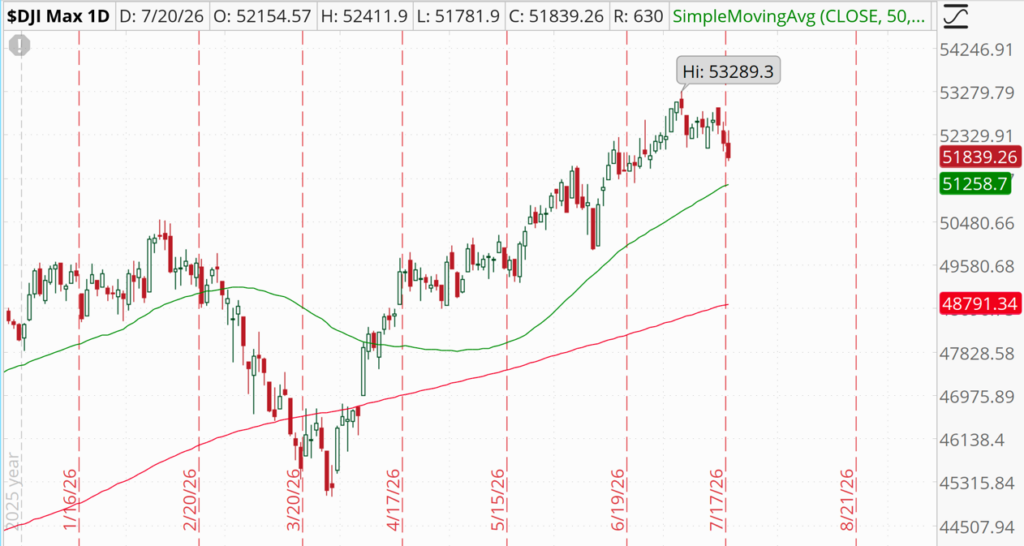
DJIA – Bullish
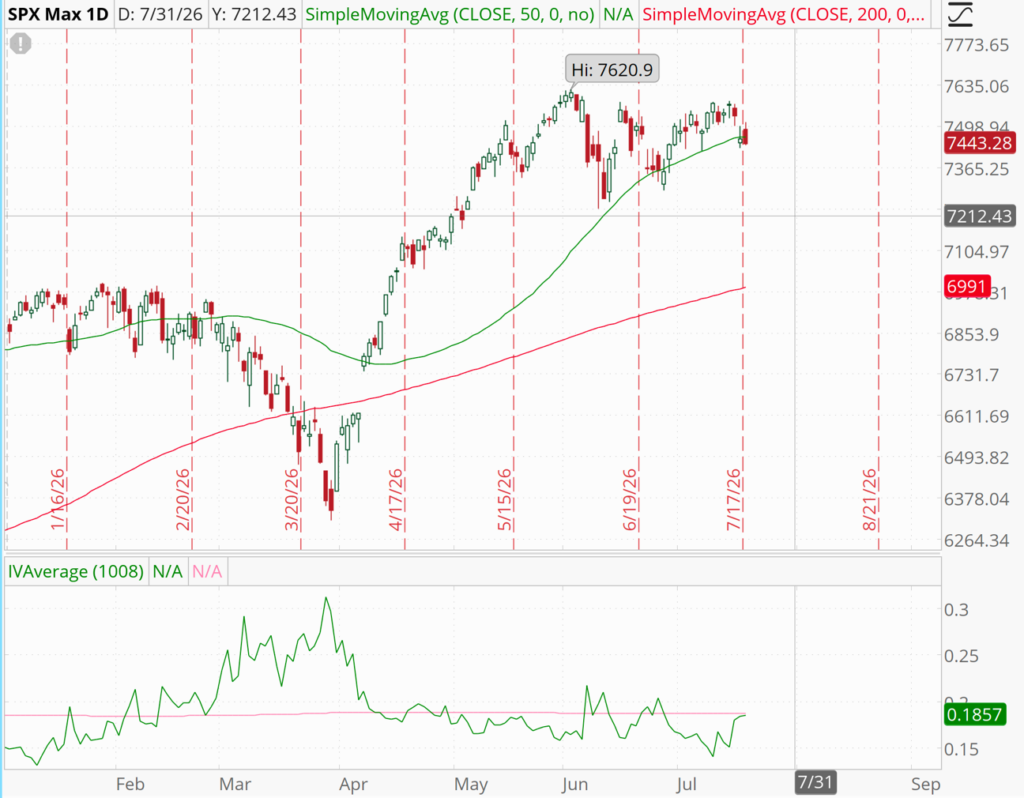
SPX – Bullish
COMP – Bullish

Where Will the SPX end July 2026?
Lower to Unchanged
07-20-26: -0.9%
07-13-26: +1.5%
07-06-26: +1.5%
Earnings:
Mon: ZION
Tues: CB, KEY
Wed: GOOGL, MCO, PM
Thur:TSCO, UNP
Fri:
Econ Reports:
Mon:
Tue:
Wed: MBA, Atlanta Fed Business Inflation Expectations, EIA Petroleum Status
Thur: Jobless Claims, Chicago Fed National Activity Index, EIA Natural Gas Report, Kansas City Fed Manufacturing Index, Fed Balance Sheet
Fri: PMI Composite Flash, New Home Sales
How am I looking to trade?
www.myhurleyinvestment.com = Blogsite
info@hurleyinvestments.com = Email
Questions???
