


We got called out of 340/450 Bull Calls
Maz Return $110 and we exited at $108
CB = $32 / 108 Reward = 296% ROI
ALSO Some of the 350/450 Jan 27 got called away
Max = $100 and we exited at $99
CB = $29 / 99 = 296% ROI
What is next years expectation ?
Depends on the mid-term election
US again = Tech, Finance = Banks
https://www.briefing.com/the-big-picture
The Big Picture
Last Updated: 25-Sep-26 16:25 ET | Archive
A September to remember–and forget
Briefing.com Summary:
*The S&P 500 has gained in September, but weakness across equal-weighted, small-cap, mid-cap, and most sector indexes revealed narrow leadership.
*Surging Treasury yields and expectations for additional Fed rate hikes weighed heavily on rate-sensitive stocks and the broader market.
*Mega-cap and semiconductor strength masked widespread weakness, reinforcing that headline S&P 500 performance did not reflect the average stock.
The month of September is winding down, and it has been a better-than-feared month—or has it?
When September was approaching, the business media was awash with references to how September has historically been the worst month of the year for the S&P 500. Morningstar, citing Dow Jones Market Data, reported that the average decline for the S&P 500 since 1928 has been 1.1%.
Well, we’re pleased to report that the S&P 500 is up 0.8% for the month, led by its mega-cap and semiconductor components. The Vanguard Mega-Cap Growth ETF (MGK) is up 3.9%, with Meta Platforms (META), up 31%, serving as its muse; meanwhile, the State Street SPDR S&P Semiconductor ETF (XSD) is up 11.5%.
That’s pretty much where the good performance news stops. What has happened in the market cap-weighted S&P 500 has stayed in the market cap-weighted S&P 500.
The equal-weighted S&P 500, down 3.8% for the month, has lived up to September’s advance billing and then some.
A Bear Flattener
What has gone wrong for the rest of the market? Simply put, little has gone right on the interest rate front.
The Treasury market has been upended by a recalibration of the monetary policy outlook, which itself has been upended by stubbornly high inflation and the persistence of high energy prices. Other sources of upset have been the increased debt issuance (both government and corporate), the shadow of the growing national debt, and a batch of economic data that have conveyed real strength in the U.S. economy (the Atlanta Fed GDP Now real GDP estimate for Q3 currently sits at 5.0%).
In other words, the basis for the jump in Treasury yields hasn’t been all bad.
Still, higher rates are generally less friendly to stocks. They reduce the present value of future cash flows, increase financing costs, and provide investors with a more attractive risk-free alternative.
More unsettling has been the speed of the move. The 2-yr note yield has soared 53 basis points in September to 4.88%, while the 10-yr note yield has surged 44 basis points to 5.18%, its highest level since 2007.
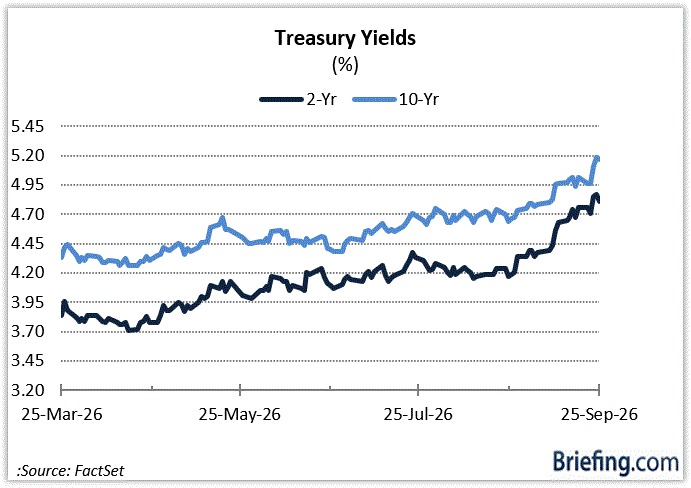
That “bear flattener” reflects a market increasingly concerned that stubborn inflation and economic strength will force the Fed to raise rates further.
The current target range for the fed funds rate is 3.75-4.00%, yet the 2-yr yield sits at 4.88%. The fed funds futures market is currently pricing in three more rate hikes before the April 2027 FOMC meeting. A lot can happen before then, but several Fed officials have already teased the possibility of at least one more rate hike before year end.
Empirical Proof
Rising rates have been the broad market’s biggest problem, but they haven’t been its only problem. A new AI-driven threat to established business models has added another layer of uncertainty.
The Muse AI agent from Meta is an agent that can handle personal tasks behind the scenes, 24/7, at the direction of its owner. That carries obvious benefits for consumers in terms of saving time, money, and aggravation. What may be good for the consumer, however, may not be as good for the businesses built around direct consumer interaction.
The term “disintermediation” has quickly become a part of the market narrative, used to explain how the agent takes over as a middleman to disrupt the traditional approach of a person interacting directly with the business and its consumer platform. That can reduce impulse purchases, diminish cross-selling opportunities, and steer business elsewhere.
In brief, it could hurt the earnings prospects for some businesses. Online travel agencies and financial companies got caught in those presumptive crosshairs this past week.
One wouldn’t know it from the market cap-weighted S&P 500, but the empirical data speaks for itself. This has been a September to remember, or forget, depending on one’s positioning:
- The Dow Jones Transportation Average is down 8.0%.
- The Dow Jones Utility Average is down 4.9%.
- The Russell 2000 is down 4.0%.
- The equal-weighted S&P 500 is down 3.8%.
- The S&P MidCap 400 is down 2.8%.
- The Dow Jones Industrial Average is down 2.5%.
- Eight of the 11 S&P 500 sectors are down, with losses ranging from 1.8% to 5.9%. Communication Services (+5.7%), Information Tech (+4.8%), and Health Care (+0.4%) are the three winners.
- Consumer Staples (-1.8%)
- Energy (-2.1%)
- Industrials (-2.5%)
- Consumer Discretionary (-4.6%)
- Financials (-4.7%)
- Materials (-4.9%)
- Real Estate (-5.1%)
- Utilities (-5.9%)
Briefing.com Analyst Insight
When September began, the equal-weighted S&P 500 was leading the market cap-weighted S&P 500, up 14.5% versus 12.3% year-to-date. Those positions have now been flipped.
As of today, the market cap-weighted S&P 500 is up 13.1%, while the equal-weighted S&P 500 is up 10.2%. There is nothing wrong with either gain, but the reversal is a reminder that the headline index doesn’t always tell the market’s full story.
September has been a winning month for the S&P 500, but it hasn’t been a winning month for the stock market.
That distinction matters. Rising interest rates have exposed a market riding on the shoulders of a relatively small group of mega-cap and semiconductor stocks. Beneath them, the weight of higher rates has been much harder to bear.
Maybe September’s reputation wasn’t wrong after all. It just needed to be viewed through an equal-weighted lens.
The good news is that September is almost over. The more important question is whether the forces that made it difficult for most stocks—higher rates, tighter financial conditions, and narrowing leadership—are almost over, too.
—Patrick J. O’Hare, Briefing.com
Earnings –
AAPL 10/29 est
BA 10/27 BMO
BABA 11/24 est
BIDU 11/18 est
COST 12/10 AMC
CVS 10/28 est
DIS 11/12 BMO
F 10/28 AMC
LULU 12/10 est
META 10/28 est
MSFT 10/28 est
MRVL 12/01 est
MU 12/23 est
NVDA 12/17 AMC
O 11/02 AMC
PLTR 11/02 est
QCOM 11/04 AMC
ROKU 11/05 est
SPCX 11/03 est
UAA 11/05 est
V 10/27 est
WMT 11/19 BMO
Where will our markets end this week?
Higher
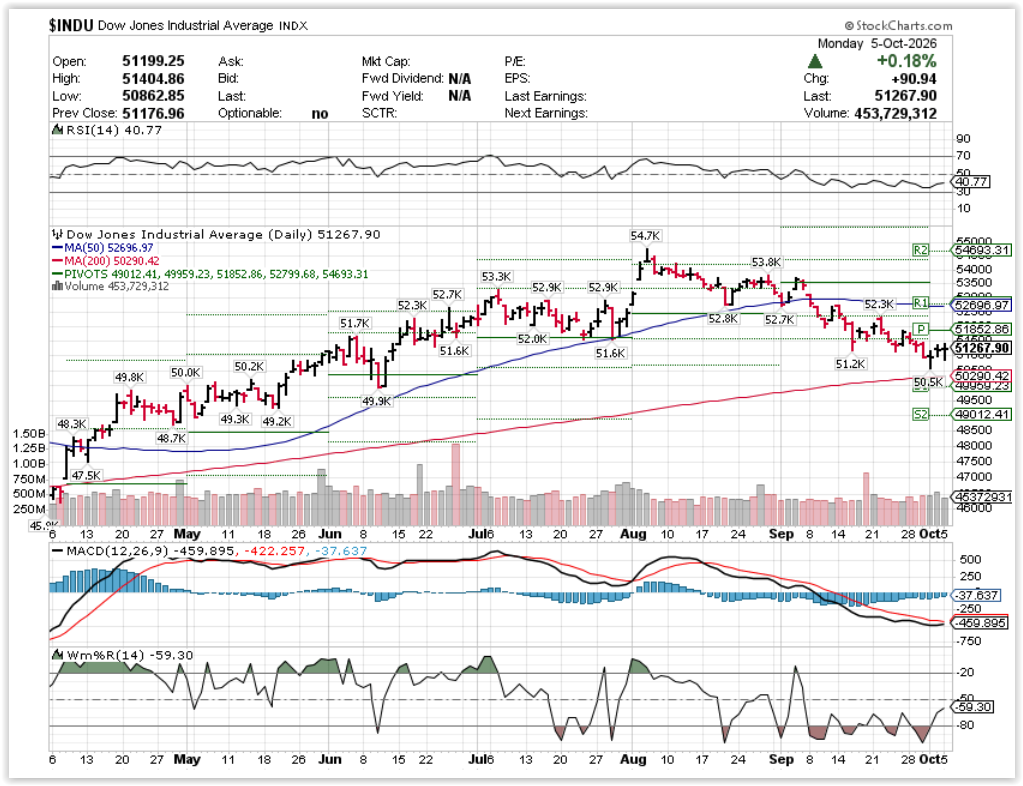
DJIA – Bearish
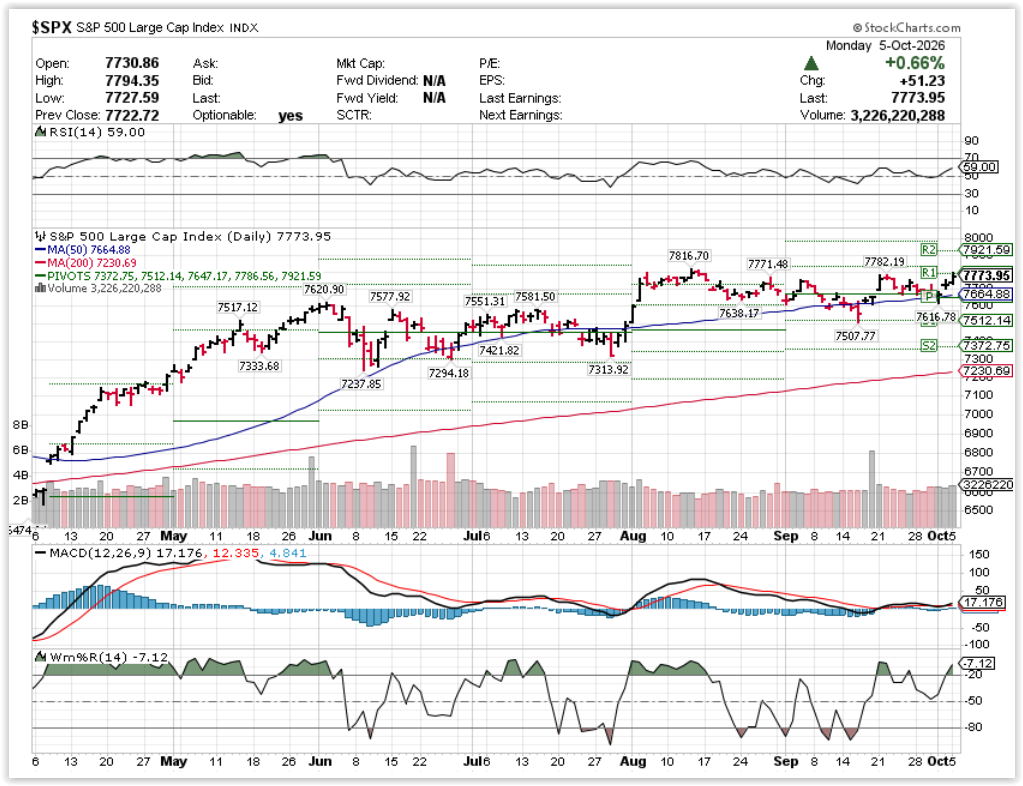
SPX – Bullish
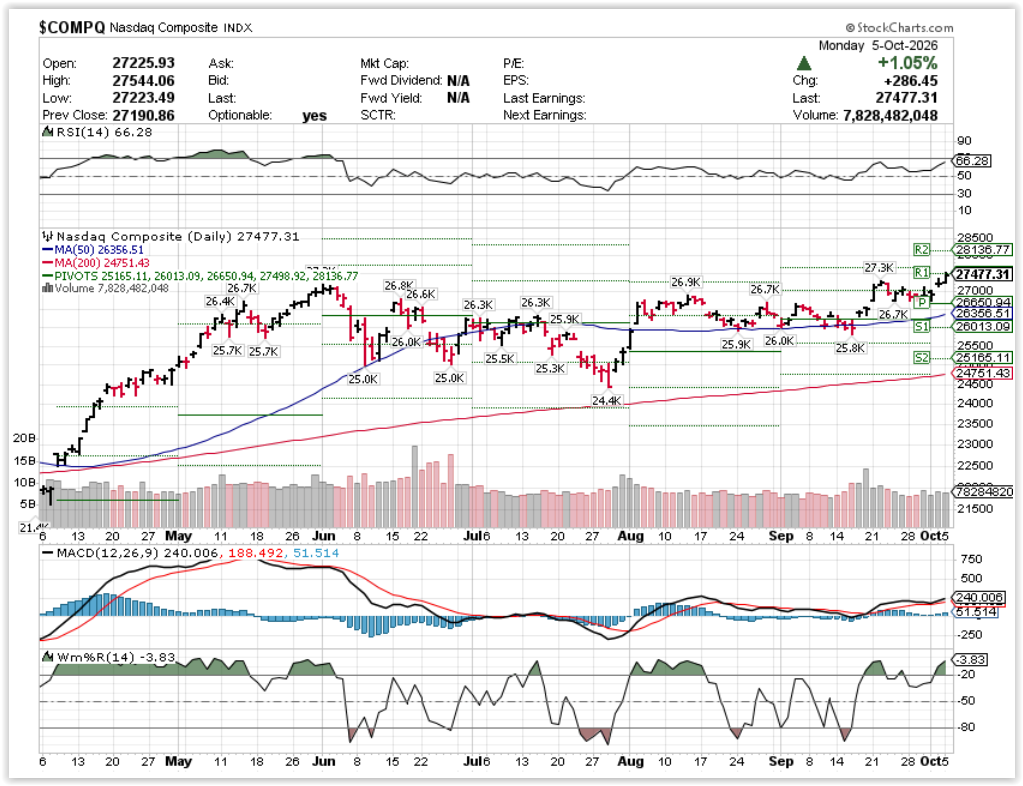
COMP – Bullish
Where Will the SPX end October 2026?
10-05-2026 +1.00%
Earnings:
Mon:
Tues:
Wed: LEVI,
Thur: PEP,
Fri: DAL,
Econ Reports:
Mon: ISM Services,
Tue: Trade Balance,
Wed: MBA, Consumer Confidence, FOMC Minutes
Thur: Initial Claims, Continuing Claims, Wholesale Inventories
Fri: Michigan Sentiment,
How am I looking to trade?
We might add puts a little early for the top of the range S&P 500 Index
www.myhurleyinvestment.com = Blogsite
info@hurleyinvestments.com = Email
Questions???
Stocks had a great day on the surface. But something alarming occurred not seen since 1999
Published Mon, Sep 21 20264:26 PM EDT
Updated Mon, Sep 21 20265:20 PM EDT
- The S&P 500 rose more than 1% on Monday and stands less than 1% below a fresh high.
- Yet, more stocks in the index scored new 52-week lows during the session than notched 52-week highs.
- The last time that occurred for the S&P 500 was in December 1999.
The stock market just posted a banner day by nearly any measure on Monday. The Nasdaq Composite surged 2% to a new record. The broader S&P 500 jumped about 1.5% and now sits less than 1% below a new high.
But traders are buzzing about something unhealthy that occurred under the surface.
More stocks fell to new 52-week lows on Monday than rose to 52-week highs in the index. More specifically, 30 S&P 500 stocks hit new lows, while only seven reached fresh highs.
The last time the index advanced at least 1% to within 1% of a new 52-week high as new lows outnumbered new highs was Dec. 21, 1999, a few months before the Dotcom Bubble top. That’s according to Jason Goepfert, who founded SentimenTrader and now serves as an adviser at NextGen News.
Prior to that, the only other time in history this dynamic has played out was July 23, 1929, he noted in a post on X.
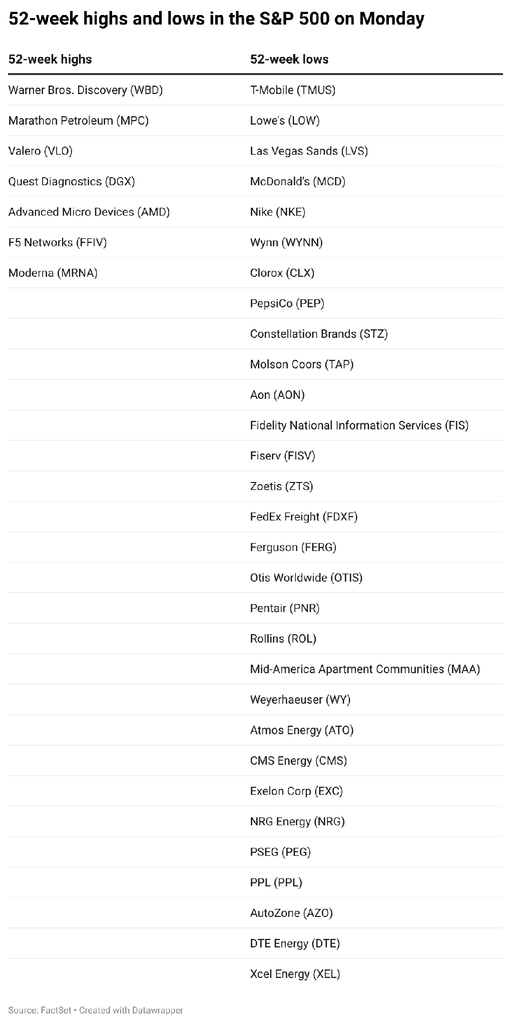
FactSet
For Monday’s trading action, it all comes to where the leadership is coming from exactly, according to Art Hogan, chief market strategist at B. Riley Wealth.
The S&P 500′s gains were led by communication services, information technology and consumer discretionary, and while information technology stands less than 1% from a fresh 52-week high, communication services and consumer discretionary sit much farther back at 4% and 7% below their respective highs.
“The leadership’s battling against weaker performance in the near term, and what’s selling off has been selling off, so the creation of new lows has an easier glide path than the creation of new highs with today’s leadership,” he said.
Hogan added that the market could experience more trading days like this sporadically over the coming months if sentiment remains subdued amid tensions in the Middle East.
“We’re not going to make new highs in this market if the war persists, energy prices remain stubbornly high and the Fed has to continue to hike rates,” he said.
The S&P 500 has risen more than 13% in 2026. It’s also gained more than 19% in the last six months.
— CNBC’s Christopher Hayes contributed to this report.
Here’s what happens to the economy when Treasury yields soar like they are now
Published Wed, Sep 23 20263:41 PM EDTUpdated Fri, Sep 25 20269:48 AM EDT
Jeff Cox@jeff.cox.7528@JeffCoxCNBCcom
Key Points
- Treasury yields surged Wednesday, signaling potential broader impact on the U.S. economy, particularly for consumers.
- Rates along the curve hit highs not seen in years, with implications for longer- and shorter-term borrowing costs.
- The moves came amid heightened expectation that the Fed will approve another rate hike in October.
Soaring Treasury yields aren’t just bad for the government and its $40 trillion debt. They also threaten to raise borrowing costs, hitting everyone from homeowners to credit card users, while providing limited help to savers and potential benefits to banks.
Government debt costs leaped higher this week, the product of multiple factors including a fresh report revealing heightened inflation pressures, surging expectations for a Federal Reserve rate hike in October and an auction for 5-year notes showing that Treasury demand was weak. Competition from hyperscaler debt issuance also is seen as an aggravating factor.
Yields responded by jumping more than they have in nearly a year and a half, dating back to April 2025 when President Donald Trump first announced so-called reciprocal tariffs against U.S. trading partners. Recent market liquidity efforts pushed by Treasury Secretary Scott Bessent have had no impact so far, with rates surging higher despite intensified buyback efforts on longer-dated debt.
The 10-year note, a benchmark for mortgages and other longer-term borrowing, saw its yield hit 5.19%, a level not seen since before the global financial crisis. Similarly, the 2-year note, which typically responds to Fed rate expectations and signals rates for home equity, auto loans and other debt, climbed more than 13 basis points past 4.9% as traders priced in a strong possibility that the central bank would follow its hike last week with another in October.
One basis point equals 0.01% and yields move opposite prices.
Such moves generally portend higher borrowing rates that hit the U.S. economy where it hurts the most — consumers, who drive almost 70% of all economic activity and hold nearly $19 trillion in total debt.
While savers will benefit with incrementally higher rates on their bank savings accounts, it’s unlikely to offset the pain they’ll feel elsewhere, said Dan North, senior economist with Allianz Trade North America.
“The consumer’s the most important part of the economy,” North said. “They’re going from little tiny yields on savings to ever slightly bigger tiny yields on savings. So I don’t think that really yet helps the consumer that much. But it sure does crush housing, and it [impacts] on all those personal consumer loans, the credit cards and so forth.”
Main message to take away today is the broadening effect in the economy, says PIMCO’s Schneider
Indeed, the interest rate on plain-vanilla savings accounts is around 0.37% and has been on a modest decline since the Fed enacted three quarter-point cuts late in 2025, according to Federal Deposit Insurance Corp. data.
Mortgage rates, though, have been on an entirely different trajectory and are likely to continue rising. A typical 30-year mortgage is now at 7.26%, up more than a quarter percentage point in just the past couple of weeks and nearly a full point over the past year, according to Mortgage News Daily.
Credit card interest rates have been fairly steady over the past few years, but also are unlikely to stay that way if current trends hold up.
How it works
When the Fed hikes, it feeds directly into the prime rate, which is used as a baseline for adjustable-rate credit and most recently was at 7%, after rising a quarter point off last week’s Fed move.
Taken together, the factors make it more expensive for consumers to borrow and less likely that they’ll seek the loans and credit that fuel a lot of the activity in the $32 trillion U.S. economy.
“You raise the fed funds rate, rates in the short term and effectively all along the curve go up,” North said. “If it makes it harder for somebody to buy a car, then there’s less demand for cars and there’s less demand for auto workers, and the economy slows down. That’s sort of basic economics, but that’s how it works.”
There are some positives from the higher rates.
Aside from whatever gains savers get, banks can benefit. The industry’s model is based on a variety of factors that can benefit in times of higher rates. This includes what banks charge their borrowers and the margin these institutions earn, as well as the interest they pay to depositors.
However, even bank stocks were mostly lower Wednesday as dramatically higher yields could slow loan demand and broader economic activity, which otherwise has been solid. The Atlanta Fed is tracking GDP growth of 5.1% for the third quarter, another element that could be factoring into higher yields.
Persistently higher yields, though, pose dangers to that growth picture.
“Smaller and medium enterprises are going to be suffering the worst because they have less ability to borrow,” North said. “Less availability of credit makes it more difficult.”
Mark Zuckerberg debuts $1,299 Meta VR Glasses and Muse Charm pendant as part of AI agent push
Published Wed, Sep 23 20268:45 PM EDT
Updated Thu, Sep 24 20267:13 PM EDT
Jonathan Vanian@in/jonathan-vanian-b704432/
Key Points
- Meta CEO Mark Zuckerberg is continuing his metaverse bet centering on virtual reality while pushing forward on AI agents.
- The Facebook co-founder revealed the $1,299 Meta VR Glasses and a handheld device called the Muse Charm that works with the company’s recently released Muse AI personal agent.
- “We’ve packed a lot of technology with this little guy,” Zuckerberg said about Muse Charm.
First look at Meta’s new VR glasses
Meta CEO Mark Zuckerberg is continuing his metaverse while simultaneously pushing forward on AI agents.
At Meta Connect, the Facebook co-founder revealed on Wednesday the Meta VR Glasses, a smaller and slimmer device compared to the company’s older Quest-branded family of VR headsets, and a handheld device called the Muse Charm that works with the company’s recently released Muse AI personal agent. He revealed the products while speaking on stage at the annual Connect conference for developers.
Zuckerberg shared few details about what Muse Charm can do, only to say that people will be able to speak to the gadget to interact with their Meta AI agents “without having to unlock a phone or open an app.” He didn’t say how much it would cost, but said that Meta needs to “finalize laying out the components” and is “planning to have this ready to ship in time for the holidays in December.”
“We’ve packed a lot of technology with this little guy,” Zuckerberg said. “So, if you’re not wearing glasses, this is going to be by far the fastest way to talk to your Muse and to show it what’s going on around you.”
First impressions of Meta’s new camera-free Ray-Ban Audio glasses
The Meta VR Glasses are slimmer and lighter than the company’s older Quest-branded VR headsets, but they are also more expensive, costing $1,299 when they go on sale in spring 2027. They represent Meta’s first VR device since 2024, when the company debuted the $299 Quest 3S.
The Meta VR Glasses are powered by an external puck that houses a Qualcomm processor and battery, allowing it to function as a mini-computer that also helps reduce the glasses’ overall weight and size. The glasses are able to display better visuals than the older Quest headset, and contain sensors that track users’ eyes and hand movements, which reduces the need to use controllers to interact with the device.
“We have built a new kind of VR device that delivers the same magical feeling of presence and immersion, high-resolution displays and views of the world around you in a form factor that is a pair of glasses for the first time,” Zuckerberg said.
https://www.cnbc.com/2026/10/01/how-muse-could-be-coming-next-for-apples-golden-goose.html
How Muse could be coming next for Apple’s golden goose
Published Thu, Oct 1 20261:07 PM EDT
Meta’s new consumer artificial intelligence agent, Muse, is expected to play havoc with online subscriptions.
Now Wall Street thinks it could be coming next for Apple’s revenue streams.
Analysts see Apple’s entire application exchange platform as a target of potential AI “disintermediation,” allowing agents to interfere with regular payment streams and developer incentives.
The revenue hit to Apple could be as much as $10 billion, analysts at Needham conjectured on Thursday.
“We calculate that, if 40% of AAPL’s $123 [billion] of services revs in FY26A were App Store revs, and just 20% of App Store revs moved to META’s 0% fee Muse Connectors platform, AAPL’s revs would fall by $10B and EBITDA would fall by $7.5B, which would threaten AAPL’s growth rate and valuation multiple (since annuity revenue streams command higher valuation multiples than hardware),” Laura Martin at Needham wrote.
Meta could also siphon off developers from Apple’s ecosystem, Martin said.
“META stated that it received [more than] 1,500 developer applications within 168 hours of launching its Muse Connectors platform, and we believe AAPL will face developer defections unless it improves its economics for developers,” she said.
Online subscription reviews by AI agents such as Muse could save consumers – and cost businesses – a lot of money, analysts say.
“Agents that actively audit subscriptions and recommend cancellations could make it easier for consumers and small businesses to eliminate low engagement software products that may have previously been forgotten about,” analyst Tal Liani at Bank of America wrote Thursday. “If consumers and small businesses adopt personal AI agents at scale, it could introduce incremental churn headwinds.”
That’s especially true because consumers tend to forget about apps and services that they’ve subscribed to but use infrequently.
U.S. adults waste an average $252 a year, or $21 a month, on unused subscriptions, technology publication CNET found in its most recent annual subscription survey.
https://www.cnbc.com/2026/10/02/nvidia-is-a-best-in-breed-stock-on-sale-heres-why-im-buying.html
Nvidia just hit a record high. Here’s why the stock still looks cheap to me
Published Fri, Oct 2 202612:36 PM EDT
Updated Fri, Oct 2 202612:55 PM EDT
Nvidia is cheaper than it looks. Here’s why I’m buying the stock
Company snapshot with chart
I started buying Nvidia back in July when the stock was around $200. I liked it a lot then. I like it even more today. It’s just the kind of setup I look for: a best-in-breed company on sale.
The Santa Clara-based chipmaker is at the center of the AI boom. Its graphics processing units, or GPUs, provide the computing power behind many of the world’s most advanced AI systems, while its software and computing platforms help customers build and run AI applications.
Key points
- Nvidia has dramatically underperformed the broader semiconductor sector despite its dominant position in the industry.
- The stock is trading at its cheapest valuation in at least a decade.
- Nvidia’s business is still growing at an extraordinary rate.
Nvidia shares are up this year, but they have badly lagged the rest of the semiconductor sector. I see this as an opportunity.
The business continues to grow at an extraordinary rate. And on Sept. 28, Nvidia added $150 billion to its share repurchase authorization, bringing the remaining total to $235 billion, which it expects to execute through fiscal 2028.
It’s the largest increase to its buyback authorization in company history.
Why I’m buying
A best-in-breed stock is on sale
Nvidia has underperformed the Philadelphia Semiconductor Index by 55% year to date and 75% over the past year.
The stock’s performance looks especially disconnected from the strength of the underlying business. Nvidia remains the dominant player in server GPUs, with roughly 97% market share.
To me, this is a chance to buy the leader while the stock is underperforming its peers.
The valuation is compelling
Nvidia’s underperformance has also left the stock trading at a much cheaper valuation than it has historically.
The stock trades at about 16.7 times forward earnings, compared with an average of roughly 35 times earnings over both the past five and 10 years.
The company also increased its share repurchase authorization by a record $150 billion this week, bringing the remaining total to $235 billion through fiscal 2028. That’s roughly 4% of Nvidia’s market value, similar in scale to Apple’s then-record $110 billion buyback authorization in 2024.
And I think the valuation could become even more compelling as earnings grow. I see Nvidia generating roughly $22 per share in earnings in fiscal 2028. At the current share price, that would put the stock at only about 10.7 times those earnings.
For a company with Nvidia’s growth and dominant market position, that’s an attractive valuation.
Nvidia, YTD
Still growing at an extraordinary rate
The stock’s underperformance hasn’t been matched by a slowdown in the business. Nvidia’s revenue jumped 106% from a year earlier in its latest quarter, and management expects roughly 70% revenue growth in fiscal 2028. Nvidia has also said demand is exceeding supply through 2028.
Nvidia also has more going for it than its current generation of GPUs. Its proprietary software platform has become an industry standard, while newer computing platforms including Blackwell and Vera Rubin are expanding its capabilities. It’s also moving further into the CPU market.
Demand across the industry remains exceptionally strong. Micron reinforced that point Wednesday evening, saying on its earnings call that memory demand continues to exceed available supply as AI infrastructure spending grows.
In my view, gross margins have also been derisked at around 72%.
Why now?
Nvidia shares are near their 52-week high, but the valuation chart tells a different story. At about 16.7 times forward earnings, the stock is trading at its cheapest multiple in at least a decade.
The recently expanded share buyback provides another reason to like the setup at these levels. That’s why I still consider Nvidia to be on sale at its current valuation.
Bottom line
Nvidia remains the dominant player in AI computing, and the business is still growing at an extraordinary rate. Its leadership in GPUs, software and next-generation computing platforms gives it multiple ways to benefit as AI investment expands.
I see a company with tremendous earnings power that the stock’s current valuation simply doesn’t reflect. That’s why I’m still buying.
Stephanie Link is the Chief Investment Strategist at Hightower Advisors, where her division manages $8.5 billion in assets (as of June 4, 2026). She has 35 years of experience managing money and serves on KKR’s investment council. She earned a B.S. in finance from Boston College.
Disclosures: Link owns in Hightower Advisors.
All opinions expressed by the CNBC Pro contributors are solely their opinions and do not reflect the opinions of CNBC, or its parent company or affiliates, and may have been previously disseminated by them on television, radio, internet or another medium. This content is provided as part of our editorial output for informational purposes only and does not constitute financial, investment, tax or legal advice or a recommendation to buy any security or other financial asset. The content is general in nature and does not reflect any individual’s unique personal circumstances. The above content might not be suitable for your particular circumstances. Before making any financial decisions, you should strongly consider seeking advice from your own financial or investment advisor.
THIS CONTENT IS PROVIDED FOR INFORMATIONAL PURPOSES ONLY AND DOES NOT CONSTITUTE FINANCIAL, INVESTMENT, TAX OR LEGAL ADVICE OR A RECOMMENDATION TO BUY ANY SECURITY OR OTHER FINANCIAL ASSET. THE CONTENT IS GENERAL IN NATURE AND DOES NOT REFLECT ANY INDIVIDUAL’S UNIQUE PERSONAL CIRCUMSTANCES. THE ABOVE CONTENT MIGHT NOT BE SUITABLE FOR YOUR PARTICULAR CIRCUMSTANCES. BEFORE MAKING ANY FINANCIAL DECISIONS, YOU SHOULD STRONGLY CONSIDER SEEKING ADVICE FROM YOUR OWN FINANCIAL OR INVESTMENT ADVISOR.
Click here for the full disclaimer.
History shows financial calamities occur when rates rise rapidly like this: ‘Something always breaks’
Published Thu, Sep 24 20264:57 PM EDT
Key Points
- The 10-year yield saw its most rapid one-day increase since early 2025 on Wednesday. It reached the highest since July 2007 on Thursday.
- John Roque of 22V Research found that during 16 instances of rapid increases in the 10-year yield since 1970, a financial crisis occurred.
- “We should be prepared or forewarned that rates are rising and something is going to break,” Roque warned.
The yield on the 10-year Treasury note is rising to levels not seen in years. But it’s not necessarily the outright level that’s most concerning for those on Wall Street, it’s the speed of the move.
When rates climb at such a rapid pace, history tells them something bad tends to happen.
The 10-year yield saw its most rapid one-day increase since April 7, 2025, on Wednesday, rising further on Thursday to top 5.17%, quite a move considering two weeks ago it was below 4.8% and at one point in August, it was below 4.6%.
“Something always breaks,” proclaimed a recent note from John Roque, head of technical analysis at 22V Research.
Roque pointed out on a chart of the 10-year Treasury yield going back the last five decades 16 instances where it experienced a rapid advance like it is now. During each and every move, some sort of financial calamity resulted. While the scale of the crises varied in their market impact (from the jarring-but-short-lived Silicon Valley Bank failure of 2023 to the 1987 stock market crash), the jump in yields almost always led to some sort of disruption to financial markets that weighed on risk assets.
“As sure as day follows night, when the 10-year Treasury yield rises, something gets knocked out,” Roque remarked to CNBC. “It just pays to be cautious.”
The 10-year Treasury yield is a benchmark for borrowing costs across the economy. Everything from mortgage rates to sophisticated hedge fund trades can become contingent on a stable 10-year yield. When it soars quickly, it can unravel risky plans by companies or investors that were counting on a stable borrowing rate.
What will crack this time around? It’s usually not evident until it is too late and it is not always directly related to borrowing costs on the surface. The Dotcom Bubble burst was because of a multitude of reasons, mostly unrealistic valuations for many tech businesses earning zero profits. But higher rates played their part. During the housing crisis, rising rates directly exposed the lax lending standards by banks as borrowers using floating-rate debt increasingly couldn’t pay.
This time around, traders often cite the booming (and opaque) private credit market and AI datacenter plans funded too much by debt — some of it off balance sheet — as likely breaking points.
Watch the regional banks
Regional banks will be particularly important to pay attention to this time around, Roque believes, as they must perform well for the market to maintain its footing, he said. The State Street SPDR S&P Regional Banking ETF (KRE) has already fallen nearly 10% below its recent high, just a hair away from correction territory. Looking at the past mishaps sparked by high rates, the banking sector is typically punished the hardest.
“It is incumbent that the regional banks especially remain firm or have a minimal or not problematic decline,” he said. “If regional banks continue to go down, and then of course banks in general, you cannot have a strong market. You cannot.”
Cracks are also starting to show in utilities and homebuilders, the analyst pointed out. In the past week alone, the S&P 500 utilities sector has fallen more than 4%, becoming far and away the biggest laggard out of the index’s 11 groups.
“It’s taken some work for the bond market to do to convince people that rates are rising because we collectively have been conditioned to believe that rate rises are only temporary, but I think that this is different,” Roque said. “This is a secular rate rise for bond yields and a secular bond bear market.”
“We should be prepared or forewarned that rates are rising and something is going to break,” he stressed.
JPMorgan’s trading desk in a Thursday note that investors should “keep an eye on bond [volatility],” because that is usually a “bigger” headwind to stocks than their absolute levels.
Jamie Dimon has a plan to revive the West: A ‘big, beautiful’ deal with Europe
Published Tue, Sep 29 20268:39 AM EDT
Updated Tue, Sep 29 20261:34 PM EDT
- The U.S. should offer Europe “one big, beautiful economic and free-trade agreement” as an incentive for long-awaited reforms such as completion of its capital markets and banking single market unions, JPMorgan CEO Jamie Dimon said in a Wall Street Journal op-ed.
- Europe also urgently needs to bolster its defense capabilities and reduce its strategic dependencies so it can stand alongside the U.S. “in the face of autocratic pressure,” Dimon said.
- The impassioned argument for free trade, which Dimon said could be expanded to allies including Canada, Mexico, Japan, South Korea, Australia and the Philippines, comes as the Trump administration pursues protectionist tariff policies.
JPMorgan Chase boss Jamie Dimon is pitching his vision for the Western world’s future — and it hinges on Europe rebooting its sluggish economy and strengthening its defense capabilities.
“I believe the U.S. should offer Europe a major inducement: If it executes meaningful economic and military reforms, including everything that we consider crucial for security and resiliency, the U.S. will negotiate one big, beautiful economic and free-trade agreement with Europe,” Dimon wrote in an opinion piece in The Wall Street Journal published Monday.
“Many of the current disputes between Europe and the U.S. are minor compared with this agreement’s size and benefits. This pact could be extended to friendly democracies including Canada, Mexico, Japan, South Korea, Australia and the Philippines,” Dimon said.
Seamless trade ties would be a “game changer” for the U.S. and its allies, allowing them to “set the global rules on trade” and binding them together “in the face of autocratic pressure,” he added.
The free trade approach advocated by Dimon stands in contrast to the more protectionist policies currently pursued by the Trump administration.
Washington’s relationship with some of its biggest trade partners, including the European Union and Canada, have soured amid President Donald Trump’s rollout of tariffs and combative negotiating tactics.
Dimon’s Journal op-ed singled out the European Union’s need to complete its long-awaited Capital Markets Union and Banking Union in order to boost its competitiveness; fulfilling the recommendations of the Draghi report; and ensuring the bloc’s defense, manufacturing and energy independence.
“A Europe that can mobilize capital, scale innovative companies, consolidate defense production, reduce strategic dependencies and generate stronger growth would be a more capable security partner, a more resilient economic partner and a stronger counterweight to Beijing’s economic power,” he said.
It is not the first time the banking chief has taken aim at Europe’s dearth of globally important companies, stuttering economic growth and lack of sovereignty in key spaces. Last year, he told European business and political leaders at an event in Ireland that, compared with the U.S. and Asia, “you’re losing.”
Dimon also wrote this week that the U.S. must take steps to ensure it remains the world’s preeminent military and economic power, and reinvigorate “the American dream and American values, which are weakening for too many of our fellow citizens.”
“A renewed commitment to American values and alliances coupled with bold reforms by Europe would be a geopolitical and economic home run, guaranteeing the Western world’s strength for the next 250 years,” he said.
