

In layman’s terms – What is the opportunity with Hurley Investments? = Returns the stock market is impossible of giving to you
More Education on your money through webinar
Tries, and mostly succeeds, of protecting capital
Defined strategy, outside returns
End of the year and through March 2027 we are taking “huge” profits!!!!
We are exiting leap stock replacement strategies trying for long term capital gains tax consequences




What are we seeing into the future for 2027 opportunities?
AI is going to continue to run, Chips are still going to be very profitable, Financials
What can I do to get these type of returns?= The process needs a year or more, WE can make more when we have more
Earnings –
COST 09/24 AMC
MU 09/30 AMC
NKE 10/01 AMC
Where will our markets end this week?
Higher
DJIA – Bearish

SPX – Bullish

COMP – Bullish
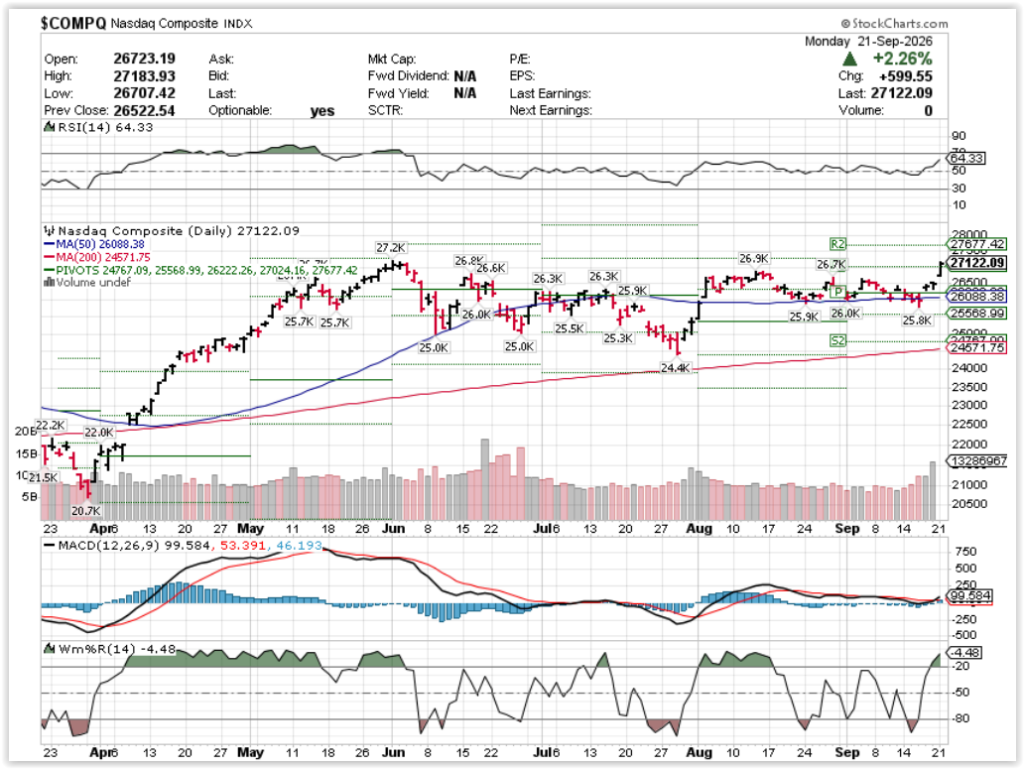
Where Will the SPX end September 2026?
08-31-2026 -1.50%
09-07-2026 -1.50%
09-14-2026 -1.50%
09-21-2026 +1.00%
Earnings:
Mon:
Tues: AZO, KBH
Wed: CTAS, GIS, FUL
Thur: DRI, BB, COST
Fri:
Econ Reports:
Mon:
Tue:
Wed: MBA,
Thur: Initial Claims, Continuing Claims, New Home Sales,
Fri: Durable Goods, Durable goods ex-trans, Michigan Sentiment
How am I looking to trade?
Adding Covered Calls to positions for the summer doldrums
www.myhurleyinvestment.com = Blogsite
info@hurleyinvestments.com = Email
Questions???
U.S. auto market predictions for 2030: More hybrids, no Chinese entrants
Published Tue, Sep 15 20266:00 AM EDT
Key Points
- Automotive analyst John Murphy is releasing his latest outlook for the U.S. auto market on Tuesday.
- Despite growing speculation that it won’t be long until Chinese autos are sold in the U.S., Murphy said he believes there is little appetite among U.S. lawmakers to allow that to happen.
- Murphy said he expects demand for gas-electric hybrids to surge over the next four years, eventually accounting for 34% of the market by 2030.
A new report casts serious doubt on whether a wave of Chinese cars and SUVs will hit the U.S. by 2030, let alone well into the next decade.
“I think the near-term dynamics are relatively low, relatively unlikely to support an entry to the U.S. market,” said automotive analyst John Murphy, who is releasing his latest outlook for the U.S. auto market on Tuesday.
Despite growing speculation that it won’t be long until Chinese autos are sold in the U.S., Murphy said he believes there is little appetite among U.S. lawmakers to allow that to happen, mainly because of the impact it could have on U.S. automakers and domestic auto production.
“I think an entree of the Chinese with unfettered access in the U.S. market would be incredibly disruptive, even if they produced here in the U.S.,” he told CNBC.
Vehicles built in China and imported into the U.S. currently face a 100% tariff under the Trump administration’s trade policies. That has effectively kept almost all Chinese brands from selling their vehicles in the country.
Starting next year, the Commerce Department has said it will ban automakers from importing and selling vehicles in the U.S. that contain technology developed or manufactured by Chinese companies.
Beginning this fall, a small number of Chinese automakers, including BYD and Geely are expected to begin selling vehicles in Canada.
In part as competition from Chinese automakers grows worldwide, Murphy says he predicts that between five and 10 auto brands currently sold in the U.S. could disappear over the next decade. There are currently 38 auto brands in the U.S.
Murphy said he believes the industry’s shifting landscape means no brand is 100% safe, but some face a greater risk of dropping out of the U.S. than others.
The latest Murphy Automotive Product Pipeline lists Polestar, Maserati, Alfa Romeo, Jaguar and Fiat as five brands most at risk of being eliminated from sale in the U.S.
Polestar, which is owned by Geely, will no longer be able to sell new vehicles in the U.S. starting in 2027 due to the connected-car rules issued by the Commerce Department. The four other brands have not indicated they are considering pulling out of the market.
Meanwhile, Murphy said he expects demand for gas-electric hybrids to surge over the next four years, eventually accounting for 34% of the market by 2030.
“A regular hybrid that doesn’t need to be plugged in [and] gets great fuel economy is being very well received by most mainstream consumers,” said Murphy.
More than 18% of vehicles sold in the U.S. this year through July were hybrids, according to the automotive research firm J.D. Power.
As for pure electric vehicles, Murphy said he sees the segment growing slightly in the U.S. through 2030. The industry is still adjusting to the dramatic shift in plans and the billions in capital it committed to new EV models that have been scrapped since the Trump administration ended federal tax breaks for the sale of the vehicles.
Murphy said the quick course correction explains the decline in vehicle rollouts between 2026 and 2028 — what he called “the worst three years on record” and a “product desert.”
“And I really do think it’s a significant function, or directly a function, of the EV head-fake that the industry fell for,” he said.
Santoli: One key tech ETF may signal whether this bull market can keep marching on
Published Tue, Sep 8 20267:42 AM EDT
Updated Tue, Sep 8 20265:20 PM EDT
Michael Santoli@michaelsantoli
Key Points
- The winds have shifted back in favor of AI consumption plays over AI construction proxies. This ETF could be the tell on the bull market.
- Not all bad: Higher yields may make bonds an effective buffer against any sudden, unexpected down moves for stocks.
- A look back at my Barron’s cover story after the wrenching first trading week following the Sept. 11 terrorist attacks.
Wall Street emerges from the summer respite with its resolute commitment to stocks validated, for now.
The S&P 500 has done just enough to preserve its upward path, last week’s brief and modest pullback approaching but never breaching the top of its May-July range, the index forgoing several excuses to retreat more fully while keeping the corrections stealthy below the surface.
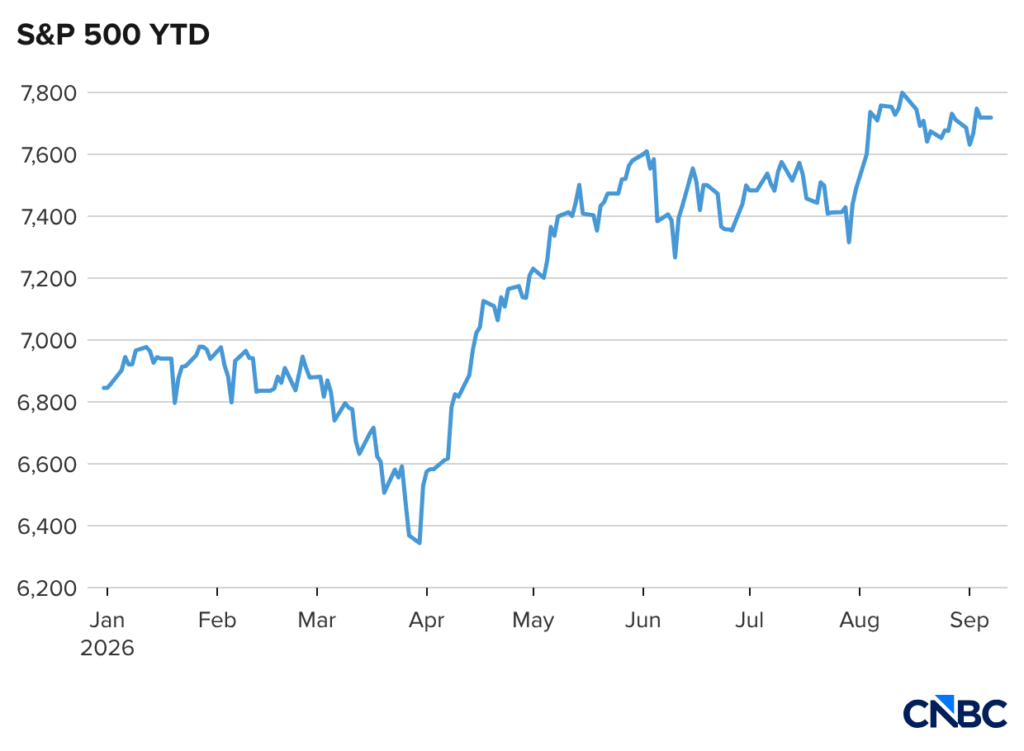
The steadiness at the index level reflects full sponsorship of equities by professional investors, who appear undaunted by the ubiquitous warnings of weak post-summer seasonal patterns. Or perhaps they’re simply encouraged that any such September-October accidents tend to be cleaned up later in the fourth quarter.
Measures of equity exposures and risk appetites from Goldman Sachs, State Street, National Association of Active Investment Managers and Bank of America agree that asset allocators are “stocked up” for the fall.
Leuthold Group maintains a Courage/Fear Ratio, which has climbed to around an 18-year high. It tracks a Courage portfolio (small caps, emerging markets, commodities and cyclical S&P 500 sectors) against a Fear basket (U.S. dollar, gold, S&P low-volatility stocks and 10-year Treasurys).
Barclays equity strategist Venu Krishna noted last week that individual investors’ aggression has calmed somewhat: “Retail participation has softened in recent weeks, suggesting the latest wave of FOMO has been driven primarily by institutional investors rather than individual traders.”
It tracks with the pros’ discipline of chasing earnings growth, which has been the single strongest bullish input, even if the risk that big companies are “over-earning” due to AI-capex pulling profits forward is quite real. A Cboe S&P 500 Volatility Index (VIX) below 15 – appropriately if not sustainably low – also instructs some big-money quant models to keep the risk tachometer pinned in the red.
It’s true, too, that a couple of paramount worries have failed to crystallize. Concern over wobbly U.S. macro conditions that would render any Federal Reserve rate hike a mistake was eased by a firm run of data last week culminating in a strong payroll report.
And the growing, rational unease with the pace and sustainability of the AI-investment supercycle found little tangible support throughout earnings season, with the “spenders” upping capex projections and the “vendors” raising guidance, all the way through Dell and Broadcom last week.
Higher yields not all bad?
Of course, both these dynamics – solid economic growth and unceasing AI capex intentions – are feeding what remains a key anxiety and preoccupation of investors: Rising bond yields.
The march higher in 10-year Treasury yields toward 4.8% is still probably best viewed as a “normalization shock,” in which rates find their way back to their pre-global-financial-crisis range and revert to their pre-2000 relationship with equities (rising yields correlating negatively to stock prices).
As noted here last week, the absolute yield levels are fully compatible with sturdy equity markets. But because we got to 4.7% 10-year Treasury yields this time from below 1% six years ago, it’s experienced differently than the similar level was 25 years ago, which was reached on the way down from 8% in 1994.
Today’s 4.7% yields mean that most debt issued in recent years trades below its issue price and has made investors wary of fixed-income – at exactly the moment when bonds are again providing a decent cushion through yield income.
Jim Reid, Deutsche Bank head of global macro and thematic research, concedes, “It’s getting harder to get outright negative returns in government bonds over the medium-term. So, while the news flow will likely continue to be negative, at least bonds are being bonds again.”
Bonds were also bonds in the 1990s, the last time yields and equities mostly moved counter to one another over short time frames.
Far from undermining the case for a 60/40 stock/bond sort of portfolio today, the 60/40 Vanguard Balanced Index Fund from March 1990 to March 2000 (the tech-bubble peak) posted a total return of 14.8% annualized. That was more than 69% of the annualized return delivered over that span by the S&P 500 alone.
Over the past ten years, when bond prices were generally seen countering any weakness in stocks, the Vanguard Balanced fund has imposed a higher opportunity cost, capturing just 61% of S&P returns – mostly because starting yields were far lower than they are today.
Things can surely get uglier for bonds from here, on a trading basis. We’re ten days from the next Fed meeting with market-implied odds of hike-vs.-hold uncomfortably close to 50-50, with this week’s inflation data somewhat miscast as a likely swing factor. Oil prices are again jumpy, Japan might be selling Treasuries to defend the yen and, at least psychologically, global fiscal imbalances encroach.
But when one starts with more yield, it can buffer against sudden, unexpected moves, in case the waters turn a bit rougher than professional investors’ fully invested stance assumes.
Market Temperature Gauge
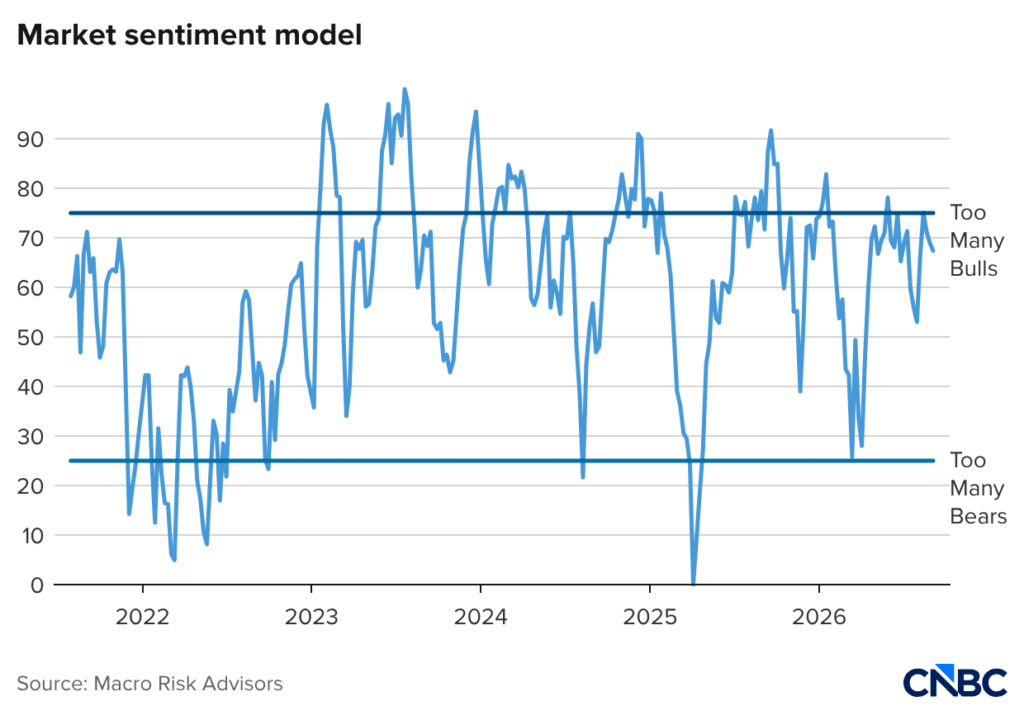
This indicator from John Kolovos of Macro Risk Advisors uses several data points to reflect both what investors are saying and what they are doing.
Around the Street
— Despite striking the heart of America’s financial capital, the market impacts of the Sept. 11, 2001, terrorist attacks were far subordinate to the human, geopolitical and cultural toll. But they were significant all the same.
The longest closure of the New York Stock Exchange since the Great Depression was followed by a reflex 11% drop in the S&P 500 the week of Sept. 17, striking a market that had already been down 28% over the prior 18 months from the Tech Bubble peak.
After that first, wrenching week of trading, I wrote the Barron’s cover story for the issue dated Sept. 24, 2001, which asserted “It’s Time to Buy Stocks Now.” The piece was well-timed, a matter both of luck and basic contrarian impulses. The S&P from there went on to jump 24% over the next ten weeks, in one of the most ferocious bear-market rallies on record.
With the clarity of hindsight, I’d argue that this rebound probably prolonged the 2000-2003 bear market somewhat, forestalling the full reckoning of technology over-investment, reduced earnings power and accounting scandals that would ravage stocks through late 2002, where they bottomed 18% below the Sept, 21, 2001, post-attacks low.
— For common-sense dispatches from the frontier of ETF proliferation and smart portfolio construction, check out the X account and research pieces of Morningstar Research’s Jeffrey Ptak.
His observations have a spoilsport quality that I appreciate, suspicious of over-engineered fund structures and too-good-to-be-true promises.
Here Ptak quantifies the cumulative losses experienced by investors in the Defiance Daily Target 2x Long OKLO ETF (the average dollar invested down about 95.8% annualized).
Credit to him, too, for flagging a newly registered Defiance ETF built to capture private startups’ value through a baroque derivatives-of-derivatives mechanism: “The Adviser intends to allocate approximately 80% of the Fund’s portfolio to the Pre-IPO Leaders Sleeve primarily through swap agreements referencing perpetual futures contracts.”
Market on Close
As noted above, there has been no quit in the AI-capex blitz, at least from the companies involved. What’s evolving in hard-to-predict ways is the way this AI trade is being expressed.
Since June 30, Nvidia has outpaced the broad semiconductor group by 35 percentage points after it had lagged pathetically for the prior 11 months. Software has recovered 70% of the “SaaSpocalypse” sell-off that ran from October to April.
With Nvidia’s acquisition of AI-model distribution/development platform Hugging Face last week and with Meta Platforms finding traction with its latest open-source AI release, the winds have shifted for a moment in favor of AI consumption plays over AI construction proxies.
Sure, memory stocks are showing early signs of cracking above their multi-month downtrend. And perhaps the AI-levered industrials dependent on several years’ worth of order backlogs are starting to look washed out.
But the real reason the key indexes have stayed so close to record highs is the revival in the shares of several of the largest tech platforms.
The iShares Nasdaq Top 30 Stocks ETF captures this well, better than the more limited Magnificent 7 cluster.
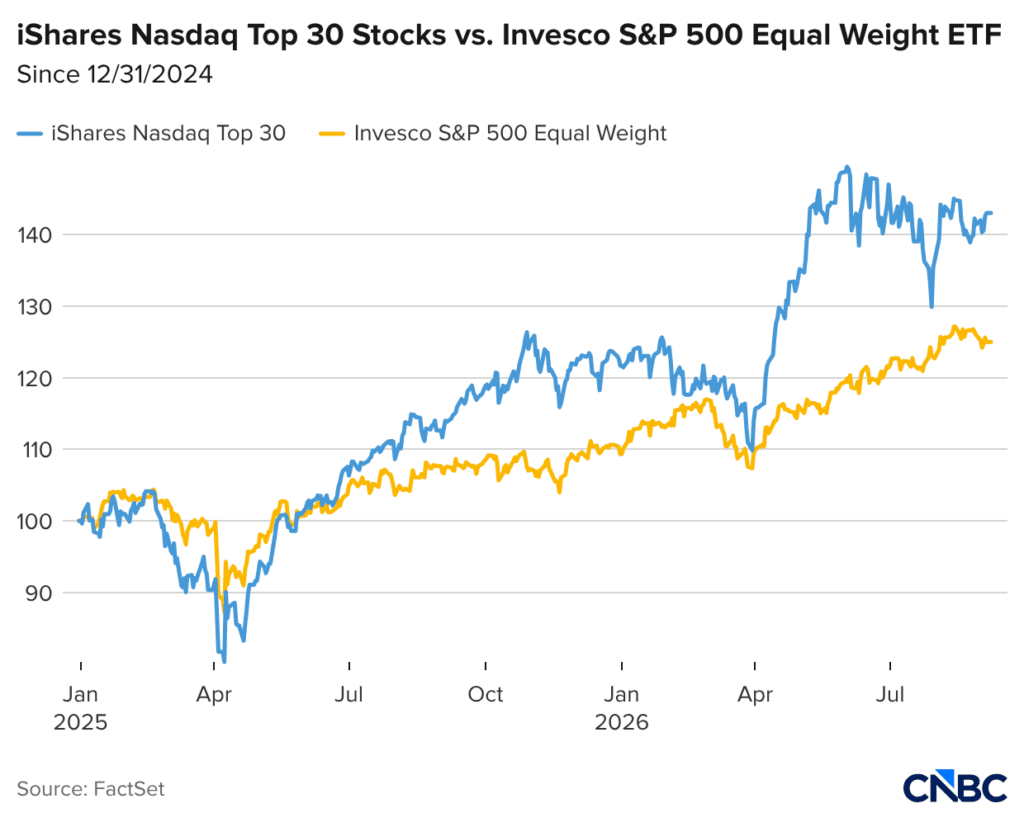
‘QTOP’ encompasses Mag7 plus most relevant semis and other big non-tech AI-using corporate giants. It peaked on a relative basis in the May-June runup to the SpaceX IPO, retrenched dramatically with the momentum collapse and has made headway through earnings season.
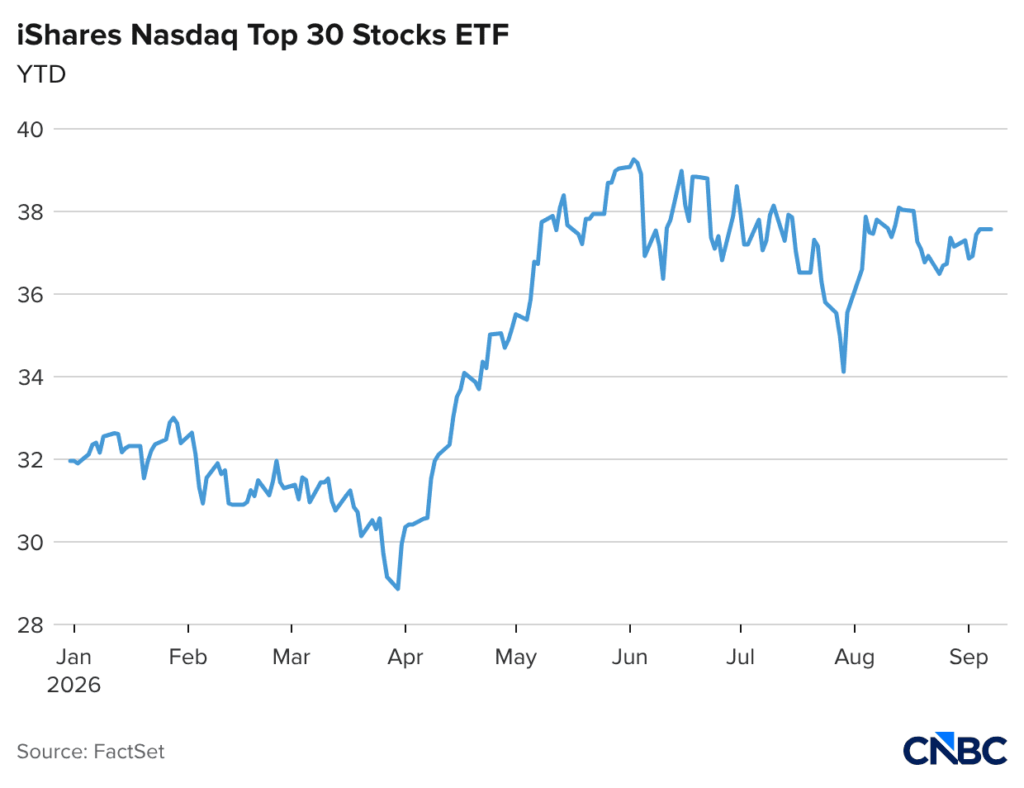
It remains almost 5% below the peak reached three months ago. If it can’t start printing new highs relatively soon, the locomotive of this AI bull market could turn out to be leaking steam.
Correction: This article has been updated to reflect that Morningstar Research’s Jeffrey Ptak said in a tweet about the Defiance Daily Target 2x Long OKLO ETF that the average dollar has lost about 95.8% per year. A previous version misstated the percentage.
Santoli: The youthful phase of AI is over. What it means for investors
Published Tue, Sep 15 20268:28 AM EDT
Michael Santoli@michaelsantoli
Key Points
- The AI narrative has flipped to a focus on the risks with the tech unpopular with the public and projections of order backlogs beyond a few quarters now suspect.
- But there may be a silver lining for investors revealed in the AI slowdown.
- Bank of America’s wealthy clients have stock exposures at quarter-century highs. Buying opportunity for bonds now offering healthy yields?
“We’ll never laugh again,” said a young admirer of John F. Kennedy in 1963 as she mourned his sudden death.
“We’ll laugh again,” answered the JFK aide Daniel Patrick Moynihan. “It’s just that we’ll never be young again.“
At the risk of seeming to conflate a president’s assassination with an investment motif, this is where the AI theme sits right now.
There will be cheer and thrills and profits generated by the burgeoning technology in the years to come. But the youthful phase of AI – when promise was unlimited and winners were easy to spot and vastly outnumbered losers – is over.
This reality predates the past week’s litany of ominous pronouncements about the destructive potential of AI models and the industry’s professed desire for some restraint on the velocity of development.
Semiconductor shares were already 20% off their June highs prior to Monday’s 4% slide. The tech sector of the S&P 500 has seen its forward price/earnings multiple contract from 29 to 21 in the past year with the market unwilling to extrapolate the profit surge in the absence of a clear path back to reaping oodles of free cash flow. Data centers have a lower approval rating than Congress – to the point where it’s hard not to assume the overheated ire will burn itself out after the election.
Perhaps not much will change in terms of AI policy, model training or the demand for computing capacity. But in markets, narratives matter quite a bit in the near term.
And for the moment, the AI narrative has become more fixated on risks than opportunities. Right or wrong, the breathless talk of throttling the buildout makes it marginally tougher to argue that 2027 earnings projections – enormously dependent on semiconductors – are too low.
And anyone already worried that the eyelash-singeing profit growth of the second quarter represented plenty of pulled-forward demand and temporary margin expansion will find only their bias confirmed.
AI is unpopular with the public, projections of order backlogs beyond a few quarters are now suspect and investors might be dialing back their assessment of how quickly a whole class of entrenched businesses will be displaced by the automated hive mind.
There are positives here. If a year ago the most-cited concern was that an AI bubble was forming and speculative exuberance was frothing over, that’s been taken care of. The savage purge since June of high-momentum stocks – dominated by AI hardware and related industrials – has sapped the bullish aggression of traders, helping to reset tactical sentiment toward a more neutral level.
Monday’s perky action in shares of the huge tech platforms doing most of the AI capex – Microsoft, Alphabet, Meta – reveals a silver lining from a possible slowdown, allowing these companies to take a beat before accelerating their capital raising and deployment further still.
The market has already shown a voracious appetite for companies demonstrating copious free cash flows at a time when it’s become scarce. Here’s the VictoryShares Free Cash Flow ETF, which for two years tracked the Mag 7-dominated S&P 500 until leaving it in the dust the past few months. This ETF is jammed with software, healthcare and energy stocks that look cheap, at least cosmetically, on FCF yield metrics.
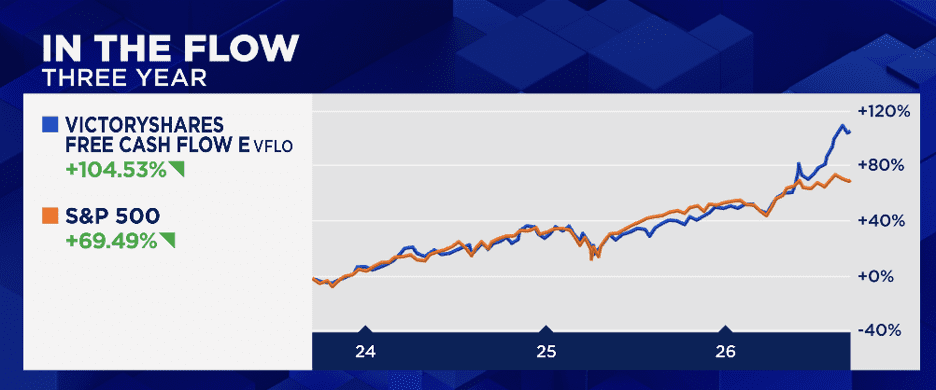
Any dialing-down of “AI maximalist” speculative fervor also prevents the current cycle from building excesses that would merit straight comparison with those of the end of the 1990s tech boom.
Which helps, because from a macro perspective, the echoes of 1999 continue to redound in the background. Consider:
The Federal Reserve is now poised this week to begin lifting interest rates as 10-year yields top a boldfaced threshold (5%) and a tech-capex boom threatens to overheat parts of the economy, having cut rates three times late last year to counter an economic-growth scare as inflation ebbed. In June 1999, the Fed began hiking rates as 10-year Treasurys surged to a key round number (6%) and a tech-capex boom raged, having cut rates three times late the prior year in response to a deflationary growth scare.
The Fed would hike a full percentage point into early 2000, when Fed Chair Greenspan testified that he was surprised the economy hadn’t slowed much. He would jack rates another 75 basis points as stocks would peak before a lost decade and the economy slid toward recession.
I prefer to avoid suggesting this cycle will hew too closely to that one, doubting that the exuberance will carry so far in quite the same manner. But that doesn’t mean a “lower extreme” won’t be reached this cycle, ahead of a payback phase.
Many observers invoke the ’90s pattern to suggest it’s still “early” in the AI bull trend. Bespoke Investment Group has plotted the Nasdaq Composite since ChatGPT was released against the index following the introduction of Netscape in 1994. It’s tracked pretty well, coincidence or not. I’ve always thought that was too forgiving, given that tech was already ascendant to a degree it wasn’t in 1994 and the market enthusiasm for AI kicked in instantly, while it was a slower boil after Netscape’s 1995 IPO.
Evercore ISI strategist Julian Emanuel has gone so far as to cast the June 2026 IPO of SpaceX as akin to the Netscape IPO rather than as a culmination of AI enthusiasm that coincided with a severe tech hangover since.
I get it, we all want to claim we’re younger than we seem, which doesn’t make it so.
One bullish argument for the market’s ability to shake off 5% 10-year Treasury yields is that the 1999 bubble ramp happened with yields between 5-6%.
This is true, but not a one-for-one match. Yields then were down from 7%-8% five years earlier, rather than up from 1% over the past five years. And the ’99 bubble also happened with corporate tax rates at 35% against 21% now, and with retail-brokerage firms charging $15 commissions per trade.
Would today’s market avoid a hiccup if we quickly reverted to those conditions?
Market Temperature Gauge

This indicator from John Kolovos of Macro Risk Advisors uses several data points to reflect both what investors are saying and what they are doing.
“Bullish sentiment is moderating but has yet to reach contrarian extremes, despite the persistent underperformance of beta, last week’s spike in the VIX, and the growing number of stocks breaking below their 50-day moving averages,” said Kolovos.
Around the Street
-Bending Spoons, an Italian-based rollup of aging Internet businesses which went public on the Nasdaq in June, got an old-fashioned forensic-accounting rinse by the Wall Street Journal. The piece questions the company’s focus on alternative earnings metrics excluding amortization and its squishy customer retention.
-Credit to Bloomberg News for chronicling the vast wealth accrued to finance entrepreneurs who built massive technological scale to stay a half-step ahead of a hyperspeed equity market. This includes profiles of the founder of Hudson River Trading, a lesser-known market maker comparable to Jane Street and Susquehanna, and of Millennium Management, Izzy Englander’s vastly successful multi-manager hedge-fund firm now approaching $100 billion in assets under management.
Market on Close
The S&P 500′s months-long sideways churn reflects a tape that continues to rescue itself through alacritous rotation. Monday saw 10% of the S&P 500 fall 4% or more, about 10% of the index climb at least 4%, netting out to a 0.5% decline.
The S&P 500 has gone nowhere since June 1, but hasn’t slipped more than 3% from a record high over that span. It has spent nearly the entire time since Aug. 4 inside the range of that single day’s rally to a record high.
Market breadth has eroded, but that also means internal oversold conditions are building. Seasonal tendencies are challenging, though everyone knows this. Institutional positioning has moderated by most measures.
Yet one explanation for the way the market rotates money from pocket to pocket rather than making outright progress is the fully committed positioning of the household investing sector.
Bank of America plots the asset allocation of its wealthy private clients weekly. Equity exposures are at quarter-century highs. Bonds and cash are scraping historic lows.
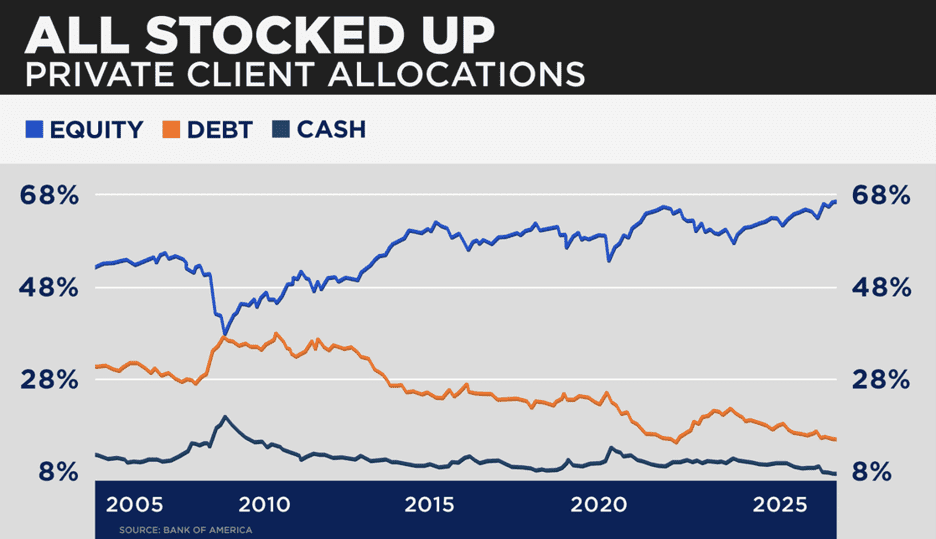
Much of this is merely a matter of equity-market appreciation, though investors are allowing stock exposures to climb without rebalancing. Somewhat ironic and cause for pause, given that, finally, bonds are providing some yield cushion to those willing to take it.
Trump calls AI fears a ‘hoax’, Treasury yields surge, Moynihan’s warning and more in Morning Squawk
Published Tue, Sep 15 20268:33 AM EDT
This is CNBC’s Morning Squawk newsletter. Subscribe here to receive future editions in your inbox.
Happy Tuesday. It’s the first day of the Federal Reserve policy meeting, but don’t get too excited: The interest rate decision won’t come until tomorrow.
Stock futures are in the red following a losing day on Wall Street.
Here are five key things investors need to know to start the trading day:
1. Cutting losses
The stock market battled back from lows in yesterday’s session, closing only modestly lower as investors weighed concerns that an artificial intelligence slowdown could be a speed bump for Wall Street.
Here’s what to know:
- The Nasdaq Composite lost just over half of a percentage point after technology stocks regained ground from being down 1% earlier Monday.
- AI-linked stocks such as Micron and Nvidia dropped on AI industry fears, but rallies in other pockets of tech such as cybersecurity provided a cushion.
- Some investors wrote off the growing chorus of concern around AI, saying the doomsday talk is a political tactic to encourage government regulation.
- Stocks also got a boost yesterday when the 10-year Treasury yield backed off from highs not seen in almost three years. But the benchmark note restarted its ascent overnight, hitting its highest level since 2007.
2. ‘Hoax Buster’
President Donald Trump on Monday fiercely dismissed calls for an AI slowdown. In a salvo of social media posts, the president repeatedly called pushback to AI and data centers a “hoax” and “scam,” at one point taking a swipe at Anthropic CEO Dario Amodei.
Trump said the reason for the outpouring of AI concerns “is because the United States is leading, by a lot, every other country.” He called Jensen Huang as the Nvidia CEO was speaking at a summit yesterday and reiterated his view that the backlash to the technology and data centers is a hoax.
Meanwhile, Microsoft posted a provisional code of conduct that would place restrictions on its future AI models. The move comes after leading AI firms Anthropic and OpenAI — both of whose models are incorporated into Microsoft’s Copilot assistant — called for a slowdown in the advancement of AI.
3. Fee fate
Bank of America CEO Brian Moynihan warned analysts yesterday that investment banking fees would likely fall by more than 10% in the third quarter compared with a year prior. That would mark a steep reversal from the 50% growth the bank reported in its second quarter.
Moynihan cited Dealogic data that he said shows that the investment banking market has slid 10% across the board. Because Bank of America is “not as well positioned” as competitors that have “more activity,” he said, the bank will probably end up down “a bit more than that.”
As CNBC’s Hugh Son and Ritika Shah write, Moynihan’s weak outlook could be a sign that the AI-driven advisory and trading boom on Wall Street is waning. Bank of America shares tumbled just over 5% in Monday’s session.
Get Morning Squawk directly in your inbox
CNBC’s Morning Squawk recaps the biggest stories investors should know before the stock market opens, every weekday morning.
Subscribe here to get access today.
4. Power plays
Ukrainian President Volodymyr Zelenskyy said yesterday that he’s open to halting attacks on Russia’s energy targets, provided Moscow does the same.
Zelenskyy’s comment came about an hour after Trump claimed on social media that the two countries had agreed to stop striking one another’s energy targets. Trump attributed the recent increase in diesel prices to the Russia-Ukraine war, rather than the U.S. conflict with Iran.
Oil prices rose yesterday and are higher again this morning.
5. Spreading out
Philadelphia is releasing three new cream cheese flavors today, including Mike’s Hot Honey whipped cream cheese, salted caramel and cranberry orange. The 154-year-old brand is expected to launch 10 new iterations over the next two years, a significant ramp-up from its historical average.
As CNBC’s Amelia Lucas reports, the rollout is part of a broader effort by parent company Kraft Heinz to invest in its brands and get products back into shopping carts. Jerome Drolet, Kraft Heinz’s president of taste elevation, said the company has the goal of “creating some excitement” in the cream cheese category, which is dominated by Philadelphia in the U.S.
The Daily Dividend
In an exclusive interview with CNBC’s Annika Kim Constantino, Novo CEO Mike Doustdar discussed the pharmaceutical company’s recent rebrand and its strategy in the obesity drug market. See what he said here.
Novo CEO talks about rebrand, corporate changes amid fight for obesity market share
— CNBC’s Sean Conlon, Samantha Subin, Tobias Burns, Lee Ying Shan, CJ Haddad, Kevin Breuninger, Jordan Novet, Hugh Son, Ritika Shah, Spencer Kimball, Caleigh Keating, Amelia Lucas and Annika Kim Constantino contributed to this report.
Josephine Rozzelle edited this edition.
https://www.cnbc.com/2026/09/18/irs-offers-in-compromise.html
IRS tax debt agreements have plummeted: ‘I’ve never seen a number that low,’ taxpayer advocate says
Published Fri, Sep 18 20268:15 AM EDT
Key Points
- The number of “offers in compromise” accepted by the IRS has fallen 57% since 2023. Meanwhile, taxpayer requests have increased 29%.
- It’s unclear why that divergence — falling acceptances amid more taxpayer demand — is happening, experts said.
- The OIC program lets taxpayers settle a tax debt for less than the full amount owed. It’s for those who can’t pay their debt, or who would suffer a financial hardship by doing so.
- Trump administration cuts to the IRS workforce are likely at least partly responsible for the drop in accepted offers, experts said.
The Internal Revenue Service has been accepting far fewer deals from taxpayers trying to dig themselves out of tax debts, federal data shows.
The IRS accepted about 5,500 “offers in compromise” during the 2025 fiscal year — a 57% decline from 2023, when the agency accepted about 12,700 offers, according to agency data.
The IRS offer in compromise program allows taxpayers to settle their tax debts for less than the full amount owed. On IRS.gov, the agency describes it as a “legitimate” option for those who can’t pay their debt or who would suffer financial hardship doing so.
Meanwhile, the number of compromise offers submitted to the IRS by taxpayers increased 29% over that time period, to about 38,800 in fiscal year 2025.
In other words, more people are applying for offers, but far fewer are successful, experts said.
“I’ve never seen a number that low,” Nina Olson, the executive director of the Center for Taxpayer Rights, said of the accepted offers. “That’s terrible.”
Olson served as National Taxpayer Advocate at the IRS from 2001 to 2019.
Experts said the sharp decline in acceptances by the IRS may burden more taxpayers — especially those in lower-income households, who tend to rely more heavily on the OIC program — at a time when there’s a broader affordability crisis in the U.S.
The trend — likely partly attributable to deep cuts to the IRS workforce during the second Trump administration — could also lead to lower tax revenues collected by the federal government, depending on how aggressively it tries to recover debts through other collection measures, experts said.
The financial amount of offers in compromise has steadily declined alongside the total number of accepted offers: OICs accepted by the IRS in fiscal year 2025 were worth $98.1 million, less than half the $214.5 million in 2023, data shows.
“These numbers are alarming,” said Leslie Book, a law professor at Villanova University and director of the school’s Tax Clinic, which provides free legal representation to low-income individuals in tax disputes.
The result is “crushing and stressful debt,” largely for lower-income taxpayers who are seeking a “fresh start” through the OIC program, Book said.
However, he and other experts said it’s unclear why the IRS has been accepting fewer offers.
“I feel like that’s the question we all ask,” said Emily Yaun, director of the Philip C. Cook Low-Income Taxpayer Clinic at Georgia State University.
“It’s just more difficult than it used to be” to get offers accepted, she said.
An IRS spokesperson declined to comment on why the total number of offers accepted has fallen.
IRS program is a ‘win-win’
The federal government’s authority to reach a compromise with taxpayers on their tax debts predates the modern income tax: Congress has allowed the IRS to compromise tax liabilities since 1864, according to a Tax Notes blog co-authored by Keith Fogg, who founded the Tax Litigation Clinic at Harvard University, and his research assistant Shane Rice.
Today, that authority takes the form of an offer in compromise, they wrote.
The goal is to reach an agreement “that suits the best interest of both the taxpayer and the agency,” according to an IRS Tax Tip release from 2021.
The IRS accepts or rejects a taxpayer’s offer based on their “reasonable collection potential,” which measures their ability to pay a tax debt. It assesses income, expenses and assets like a home, cars and bank accounts.
Low-earning households living “hand to mouth” often benefit from the OIC program, Fogg said in an interview with CNBC.
“It’s pretty easy to get an offer [accepted] if you don’t have anything: If you don’t make much money or have many assets, you’re a good offer candidate,” said Fogg, who worked for more than three decades in the IRS Office of Chief Counsel.
It can be easier to rack up an insurmountable tax debt than people might think, he said.
For example, a taxpayer may make an innocent mistake on a tax return — perhaps a low-income single parent who claims a refundable tax break for children who lived with them for only five months instead of the requisite six months, Fogg said.
Or perhaps the taxpayer was laid off and needed to tap a 401(k) account to make ends meet — and then found they couldn’t afford the associated income taxes and penalties, he said.
Interest on a tax debt can quickly make an innocent mistake snowball into something much bigger, experts said.
“It’s not always that you’re some horrible person” who’s dodging taxes on purpose, Fogg said.
The average compromise offer accepted by the IRS in 2025 was about $18,000, according to federal data. It’s unclear what the average tax debt was before a compromise.
IRS audit rate for high earners falls: Here’s what to know
The IRS generally doesn’t accept offers if a debt can be paid another way, such as through an installment agreement, according to the agency.
The taxpayer must meet certain requirements, such as not being in bankruptcy proceedings. They must also be current on filing all required federal tax returns, even if they can’t pay all the associated taxes. They must also have made all required estimated tax payments for the current year.
Indeed, tax compliance is a major incentive for the federal government to accept legitimate offers, experts said.
Aside from being current on tax filings, taxpayers whose OICs are accepted must pay their taxes on time for the next five years — otherwise, the offer is undone, and the prior tax debt springs back into existence, they said.
“A big part of the program is getting people back into the tax system and doing what they’re supposed to do,” Fogg said.
In this way, the government collects revenue it may not have otherwise, and taxpayers can get over an insurmountable financial hurdle, Book said.
It’s a “win-win,” Book said.
IRS workforce shrinks 28% during Trump administration
The work of assessing an offer in compromise is often manual and labor-intensive, Book said.
That’s because accepting or rejecting offers depends on analyzing the specific facts and circumstances of a taxpayer’s case, which is generally difficult to automate, experts said.
Agency staff must assess taxpayer financials, vet application forms and review taxpayers’ prior tax compliance, for example, they said.
A complete offer investigation can take up to 24 months, depending on inventory levels, case complexity and taxpayer circumstances, according to a frequently asked questions page on the IRS website.
The number of IRS workers has fallen significantly since January 2025 due to Trump administration efforts to reduce the federal workforce, according to a report published in June by the Treasury Inspector General for Tax Administration, a federal watchdog.
I’ve never seen a number that low. That’s terrible.
Nina Olson
executive director of the Center for Taxpayer Rights and former National Taxpayer Advocate
The IRS workforce shrank by about 31,000 people — or 28% — from the beginning of 2025 to January 2026, the inspector general report found. Specific roles within the agency, such as tax examiners and revenue agents, saw even higher reductions of about a third each.
The report said staffing shortages pose “elevated operational risks” for the agency.
“There are no employees to do this kind of work,” said Olson, of the Center for Taxpayer Rights. “There needs to be a human being looking at this,” she added.
The IRS workers who remain may be under pressure to reject more applications, Fogg said.
“It’s easier to say no than it is to say yes,” he said.
The IRS declined to comment on whether agency staffing has played a role in the lower number of OIC acceptances.
IRS chief Frank Bisignano testified before Congress in March that he “feel[s] good about the number of employees [he] has right now” at the agency. In April before the Senate Finance Committee, he denied that the agency was understaffed.
‘It’s got to be their training’
But lower OIC acceptances can’t be fully explained by Trump administration workforce reduction measures, since a noticeable decline started during the Biden era, too.
Experts said other theoretical explanations could explain the drop in OIC acceptances.
For example, the applications can be cumbersome and technical for taxpayers, Fogg said.
The IRS sometimes returns an application if there’s a mistake or missing information — rendering it unable to be processed — rather than accepting or rejecting it outright.
It’s possible that more OICs are being submitted with errors, meaning fewer applications make it to the stage where they’re able to be accepted or rejected, experts said.
The IRS hinted at this possibility, at least for fiscal years 2025 and 2026. The federal fiscal year runs through Sept. 30.
“The acceptance rate for offer in compromise cases that reached an acceptance or rejection determination has remained stable in fiscal year 2026 compared with fiscal year 2025,” the IRS said in an emailed statement.
About 53% of those cases resulted in an acceptance in fiscal year 2026, compared with approximately 51% during the same period in fiscal year 2025, it said.
Get this delivered to your inbox, and more info about our products and services.
By signing up for newsletters, you are agreeing to our Terms of Use and Privacy Policy.
The agency declined to share data on the total number of offers in compromise cases accepted during the current fiscal year. The agency also declined to elaborate on why acceptances have dropped in recent years, or whether IRS criteria for vetting the applications have changed.
There hasn’t been any public disclosure of such a change in criteria or formula, Fogg said.
“I think a lot of it is up to [IRS] discretion, and they’re just less willing” to accept offers, said Yaun, with Georgia State University. “It’s got to be their training: They’re being told, ‘Offers are not our preferred method.’”
For example, the IRS may instead prefer to keep taxpayers in a status called “currently not collectible,” Yaun said. With this status, the IRS temporarily delays collecting on a tax debt because an individual can’t afford to pay it on top of their basic living expenses.
However, the IRS can still garnish a person’s tax refunds, place a lien on their property and continue charging interest and penalties while they are in that status — in contrast with some aspects of the OIC program.
Tax season myths vs. facts: Here’s what to know
Perhaps the IRS believes it will collect more revenue by keeping taxpayers in “currently not collectible” status than by accepting an offer in compromise, Yaun said.
In her work with clients, Yaun has noticed a tweak in the IRS approach with elderly taxpayers.
For example, to receive an OIC acceptance in recent years, the agency has been requiring Social Security-age homeowners to have received a reverse mortgage denial from lenders, Yaun said, referencing her experience with clients. It appears the IRS wants to see that taxpayers are unable to tap their home equity via a reverse mortgage, she said.
By contrast, a few years ago, the agency was generally satisfied if seniors had been denied for a home equity line of credit, Yaun said. Now, it wants to see both — and many taxpayers haven’t been willing to go that route, she said.
The home may be a low earner’s only asset, and the taxpayer often wants to leave it to their children — something that may not be possible with a reverse mortgage, Yaun said.
The IRS declined to comment on whether it has updated its OIC policy to seek a reverse mortgage denial in more circumstances.
