

“Some people are not actually emotionally or psychologically fit to own stocks. If you are going to do dumb things because your stock goes down, you shouldn’t own the stock at all.”-Warren Buffett
What Are dumb things?= Buy and sell in the same day, sell at the bottom, FOMO, Panic, Tip trading, refusing to be back in the market when it is recovering, GURU following, Following an educational newsletter,
Fear, Greed, NOT booking a profit
HI Goal to fight Fear and Greed = Making the best “educational decision” at that time = 1 second
Kevin can you please explain your exit strategy for stock ownership?
We want to be in the initial investment amount of shares for one year and one day = LONG TERM capital taxes
BUT we also add shares along the way which may be sold for short term capital gains taxes IF the stock reaches a HI fully valued prices
Kevin Explain your stock replacement strategy?= Long Call Option, Leap Bull Call Option Spread
We primarily enter these strategies after we’ve book a 25% to 100% return on the big capital spend
AND we try to use no more than 10%-25% of these profits
This is the OH NO we were wrong the stock can still go higher
Long Call = The right to buy a stock at a certain price for a certain period of time
This is the pure stock replacement strategy once we’ve book a profit BUT is it the high risk, high reward, low probability
Leap Bull Call Spread = Long Call with a short call = Long term capital gains, the short call acts as protection, the spread makes money both ways, can be adjusted, cheaper to get into to than the straight long call
Kevin where have the 220/300, 350/450 MU spreads gone too?
The 220/300 got called away giving us a Sale price of $78.50
78.50 – 24 = $54.50 Profit on an $80 move or 200% ROI
350/450 = $98.00 Sale price
98- 32.40 = $65.60 profit or 202% ROI
Most recently you will notice 800/900 Leap MU Bull Call Spreads =
We still believe the stock can go higher with a $900 level of support
Last week we finish up 0.08% after withdrawals.
IF you add the withdrawals back in we were up 0.54% ON a down -0.80 S&P 500
Earnings –
COST 09/24 AMC
MU 09/30 AMC
NKE 10/01 AMC
Where will our markets end this week?
Lower
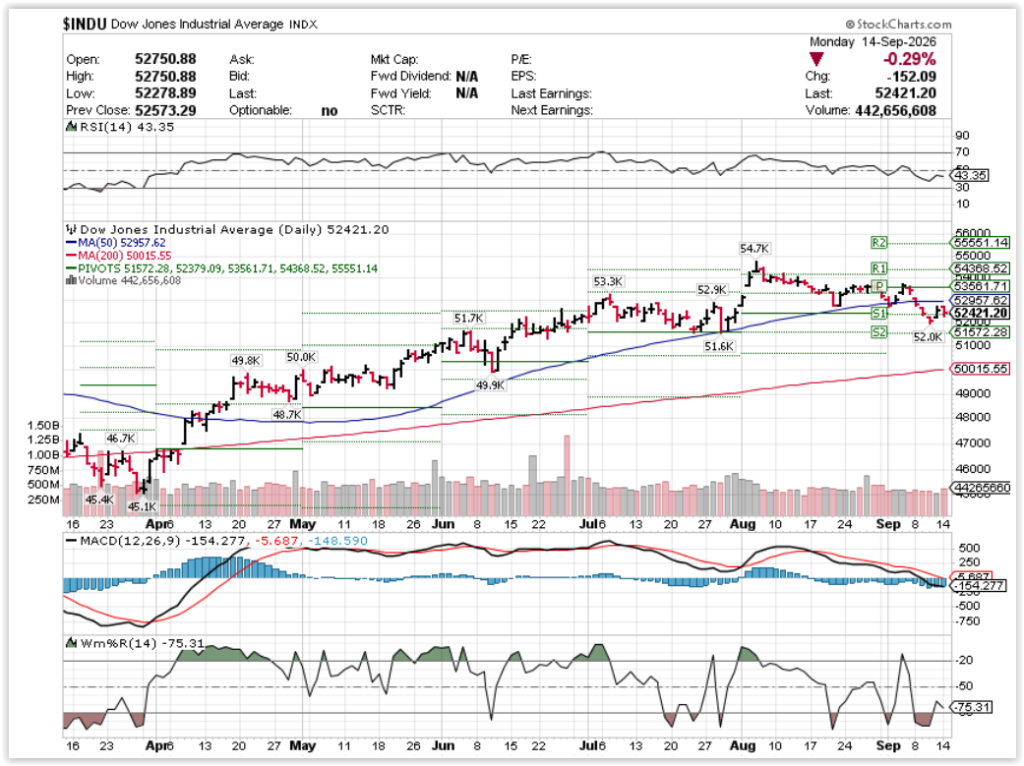
DJIA – Bearish
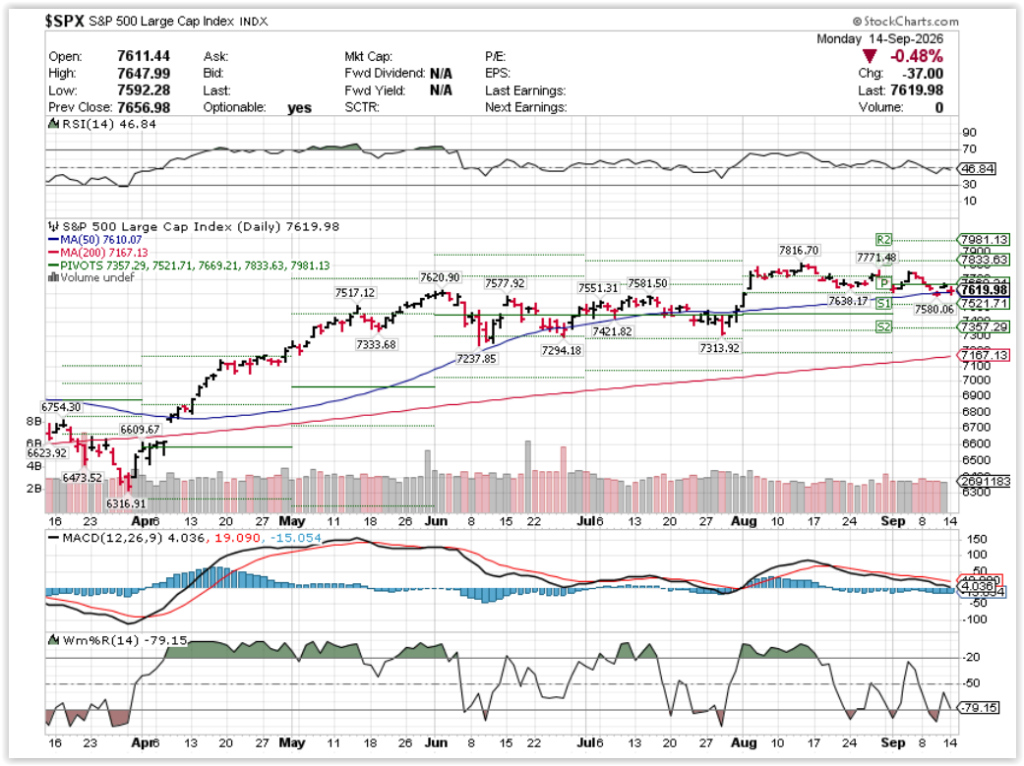
SPX – Bullish
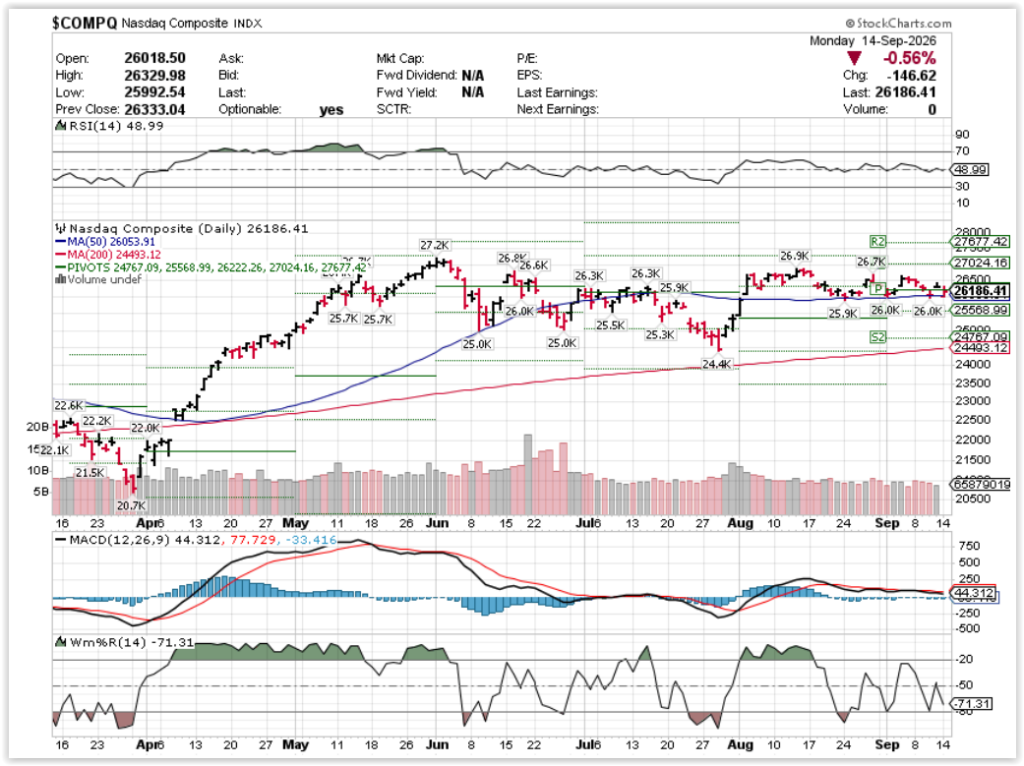
COMP – Bullish
Where Will the SPX end September 2026?
08-31-2026 -1.50%
09-07-2026 -1.50%
09-14-2026 -1.50%
Earnings:
Mon: PLAY,
Tues: TCOM,
Wed: LEN,
Thur:
Fri:
Econ Reports:
Mon:
Tue: Empire Manufacturing,
Wed: MBA, Import, Export, NAHB Housing Price Index, Net Long Term TIC Flows, FOMC Rate Decision
Thur: Initial Claims, Continuing Claims, Phil Fed, Pending Home Sales, Housing Starts, Building Permits,
Fri: Industrial Production, Capacity Utilization,
How am I looking to trade?
Placing ATM puts for warnings that we’ve mostly kept in place
Adding Covered Calls to positions for the summer doldrums
www.myhurleyinvestment.com = Blogsite
info@hurleyinvestments.com = Email
Questions???
Bond but more importantly Treasury rates at 5% IN THE PAST have been the magic rush to bond number
https://www.shopify.com/news/rural-commerce-growth
Entrepreneurship has no zip code
June 2, 2026
by Shopify Data Science
Shopify’s data shows rural entrepreneurs are building a global export economy worth billions. The geographic barrier to commerce has collapsed.
Every story about ambition used to have the same opening scene. A small-town dreamer leaves home, suitcase in hand, for a place with a glittery skyline.
There’s a new story now.
The things that once made cities the most viable launchpad are available to entrepreneurs anywhere. Last year, rural merchants in the US, Canada, the UK, Germany, France, Italy, Spain, Australia, and Japan generated billions in sales, outpacing the growth rate of urban merchants in these countries.
On every measure Shopify tracks, the geographic gap is closing. Location used to be a ceiling. Now it’s just a pin on a map.
“The extent of the market”
There’s a reason small towns couldn’t sustain every type of business in the past.
In 1776, Adam Smith, the father of modern economics, named the problem in The Wealth of Nations. Specialization is the engine of economic prosperity, but only when the market is big enough to support it. A village may keep a blacksmith in business, but not a bejeweled, small-batch, nickel-free, boutique swordsmith in business. The swordsmith’s success is limited by what Smith called “the extent of the market.” Some trades, Smith wrote, “can be carried on nowhere but in a great town.”
For most of history, this meant the same thing for anyone with a specific, specialized ambition: leave for the city. Cities had the population density to sustain a specialist butcher, a specialist tailor, a specialist anything. The bigger your ambition, the bigger the market you needed.
The internet expanded who entrepreneurs could reach. And the commerce infrastructure to act on that has now caught up. Today, an entrepreneur making something specific, once limited to a hundred local customers, can sell to millions of them anywhere in the world.
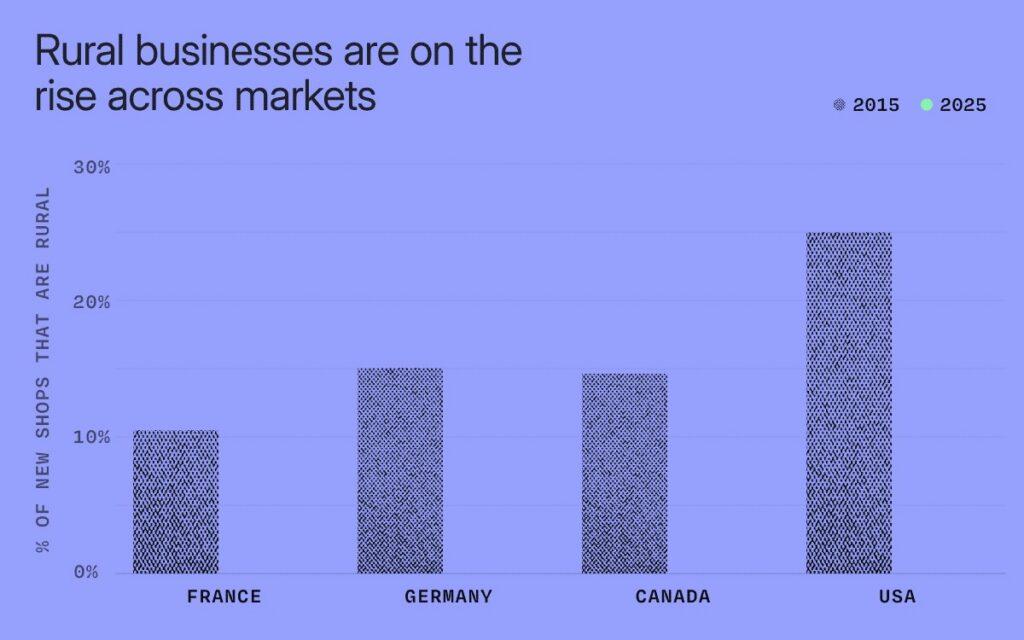
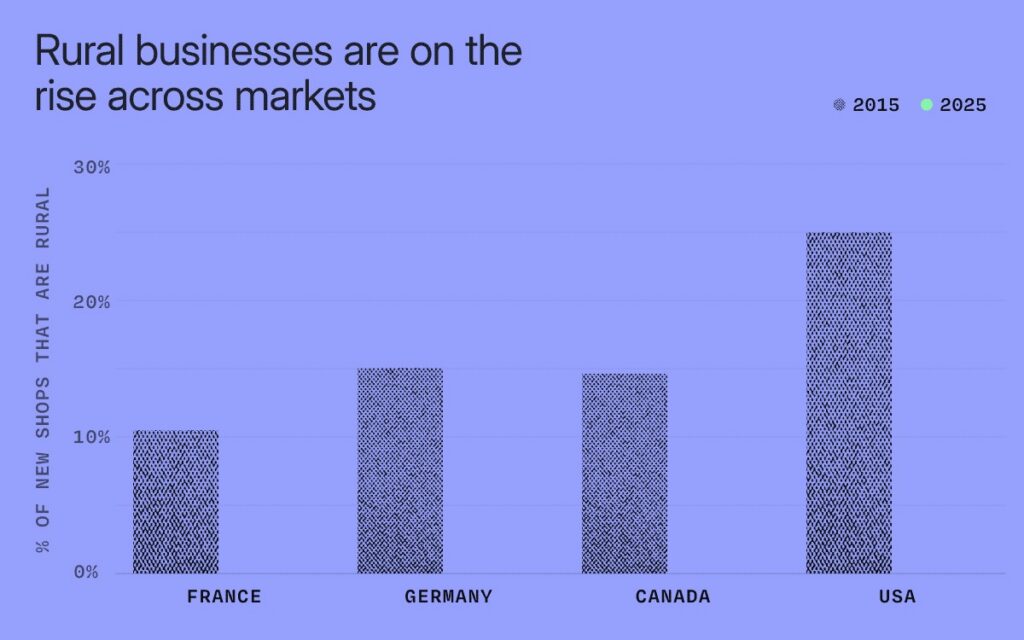
Rural’s share of new Shopify shops, 2015 vs. 2025. In every market we measured, that share has grown.
More founders are starting outside cities
The popular narrative about rural towns is one of contraction, with residents leaving, opportunities thinning, and Main Streets fading from view.
But across major economies, major sellers are thriving outside of metropolitan areas. They defy the pull of cities and run competitive businesses from somewhere quieter. Small town has changed from a constraint into an edge: lower overhead, room to grow, and access to a worldwide market from anywhere.
And a growing share of the next generation is choosing rural. The proportion of shops that are run from rural areas is accelerating in every country. In the US, it rose from 25% in 2015 to 30% in 2025. In France, from 11% to 19%. In Canada, from 14% to 20.5%. COVID-19 accelerated ecommerce broadly, but it didn’t create the structural shift this data describes. The trend predates the pandemic and has continued well past it. More founders are choosing to operate outside urban centers, and choosing it more often, year over year.
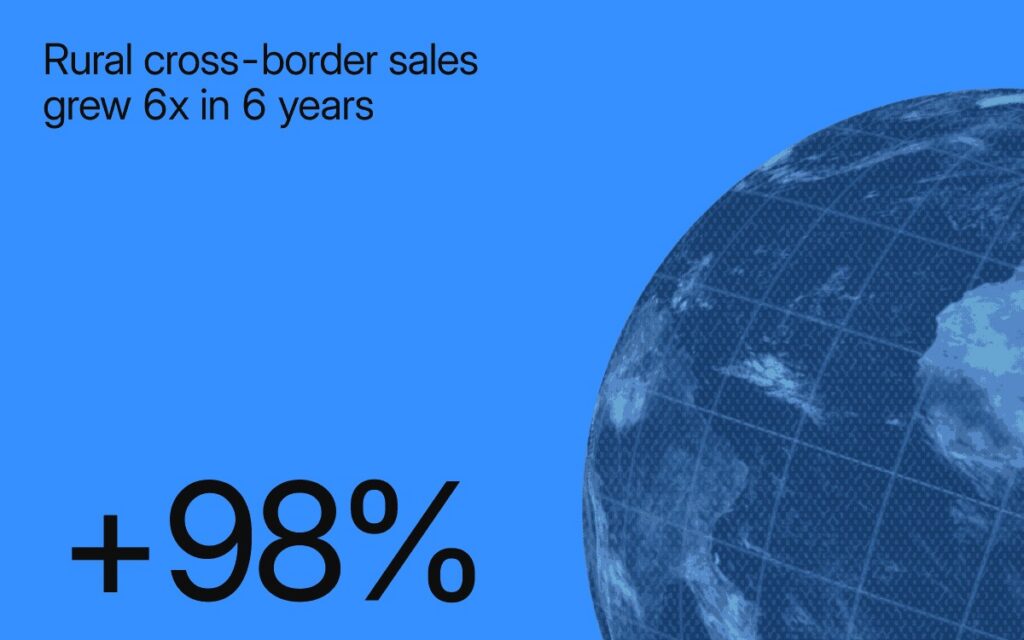
Total annual cross-border sales by rural Shopify merchants, 2019 vs. 2025. The volume grew more than four-fold.
…And their reach is global
The economy of small towns is its own export engine, and it moves billions a year. The most striking number in the data is what these entrepreneurs ship and where it lands. Across the nine countries we studied, rural merchants generated $2.9 billion in cross-border sales in 2025, up from $655 million in 2019. That’s a 342% increase in six years.
Previously, small-town entrepreneurs built local-first businesses that took years to expand, but today’s rural entrepreneurs can go global from day one. In some markets, 47% of rural merchants shipped internationally last year. The first sale and the hundredth sale can now go to the same place: anywhere.
J.Q. Dickinson Salt Works, in Malden, West Virginia, ships to high-end restaurants in Tokyo and Copenhagen. Nova Scotia Fisherman, a skincare brand in rural Nova Scotia, stocks shelves in eight countries. Mill Scale Metalworks, in Lockhart, Texas, sends custom-built smokers to barbecue obsessives across three continents. These products are often niche, specific, and made viable by global reach.
The economics of trade predict this shouldn’t happen. For as long as commerce has existed, businesses have mostly sold to people who lived nearby. The farther your customers are, the fewer of them you should have. Economists call this the gravity model, because like gravity, the pull of a business should weaken with distance. Entrepreneurship in 2026 rewrites that model.
An order from a rural merchant travels 1,799 kilometers on average. From an urban merchant, 1,870. Effectively the same. It’s proof that whether you’re a rural or urban business, your reach is now far beyond local.
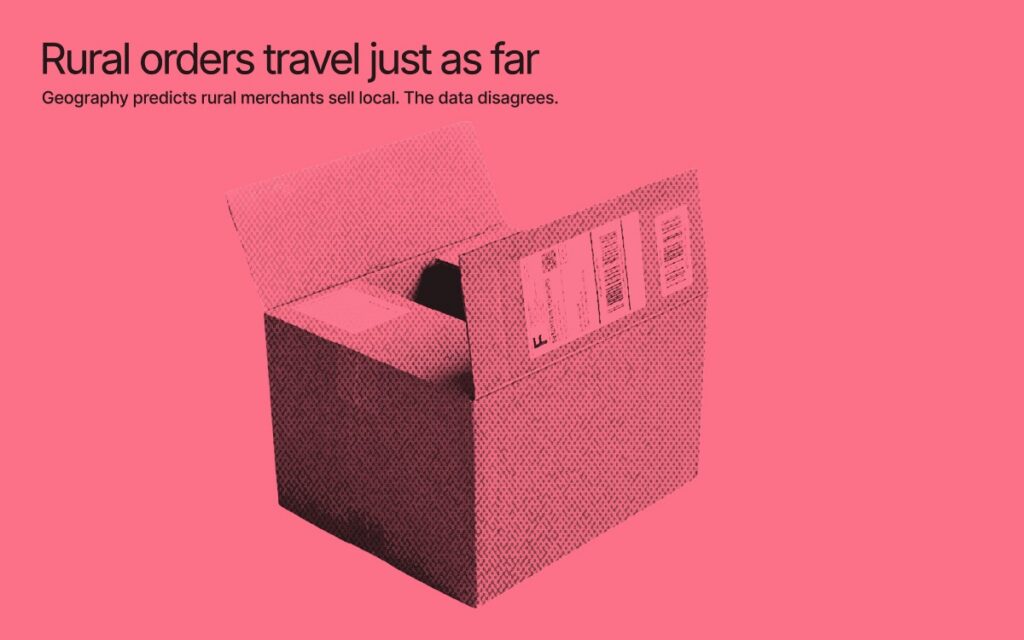
The average distance a Shopify order travels from merchant to customer. Rural and urban merchants reach roughly the same distance.
And European rural merchants are posting some of the steepest cross-border growth in the data.
In Germany, rural cross-border sales, (rural merchants that sell to buyers in other countries) have grown 1571% in five years. In Spain, 1844%. In France, 1114%. The continent’s rural economies—small towns in Bavaria, villages in Andalusia, towns in the French countryside—are exporting at an urban pace.
The infrastructure lives wherever the founder is
Founders in a rural town can operate with the same sophistication as someone in a sprawling metropolis—payments that clear in any currency, shipping that automates customs paperwork, and AI tools that can draft product descriptions and translate them into six languages. Capital has caught up, too. A rural entrepreneur can access funding based on their sales velocity instead of their proximity to traditional lenders.
This didn’t happen all at once. Easier online store creation arrived in the late 2000s, automated international shipping matured in the 2020s, and AI-powered tools became standard in the last two years. Each layer compressed what a rural founder required to succeed.
The result is a symmetry that didn’t exist a decade ago. A founder in a small town can run a global business at a fraction of the operating cost of an urban one. The infrastructure lives wherever the founder does.
A new geography of building
For rural entrepreneurs, leaving home is no longer the prerequisite for creating something meaningful. The kid with a specific obsession, the maker with a niche craft, the founder with a small market in mind can all build where they are and still reach the world. The extent of the market is now the extent of the internet.
Methodology
Merchants are classified as rural or urban using the OECD Degree of Urbanisation (DEGURBA) framework, applied via the JRC Global Human Settlement Model (GHS-SMOD R2023A, epoch 2025) — a 1km² grid that classifies land as urban centre, town/suburb, or rural based on population density and contiguity. Merchant locations are derived from business addresses provided during registration, validated against Who’s on First geographic boundaries where possible. The gravity model measures the median GMV-weighted great-circle distance from each merchant’s business location to their order destinations, capturing how far each dollar of commerce travels.
Trump’s $1 trillion-plus ‘dividend’ plan meets immediate bipartisan pushback
Published Thu, Sep 10 20264:39 AM EDT
Updated Thu, Sep 10 20262:52 PM EDT
Kevin Breuninger@KevinWilliamB
ShareShar
Key Points
- President Donald Trump promised a $5,000 check for U.S. voters if Republicans win both the House and the Senate in the looming midterm election.
- Such a payout could cost more than $1 trillion and break federal law.
- The promise follows Trump’s proposed “DOGE dividend” and “tariff rebates.”
Facing an uphill battle in the final weeks of an affordability-focused midterm election, President Donald Trump on Wednesday night made an audacious promise: Every adult American citizen will receive a $5,000 “dividend,” but only if Republicans are victorious in November.
While extremely light on details, the proposal quickly drew heat from critics on both sides of the aisle, including some of Trump’s own supporters. And it spurred questions of whether it would be illegal as a payment incentive to influence votes.
“I am hugely in favor of winning the midterms, and love much about this admin, but am strongly against bread and circus bribes,” Palantir co-founder and Republican donor Joe Lonsdale said on X.
At face value, the plan would be staggeringly expensive. There are roughly 245.3 million U.S. adult citizens, according to 2024 Census data. Giving them $5,000 apiece would cost north of $1.2 trillion.
That’s significantly more money than was distributed as part of Covid-era stimulus packages that have been blamed for exacerbating U.S. inflation, a top issue in the midterms. Less than a month ago, U.S. debt passed the $40 trillion mark for the first time.
“I would like to know how they would plan to pay” for the proposal, Rep. Chip Roy, R-Texas, a leader of the fiscally conservative Freedom Caucus, told Politico.
Crunching the numbers on Trump’s $5K midterm ‘dividend’
Some conservatives slammed the policy as an example of exactly the kind of socialism that Trump and the GOP warn Democrats will usher in if they regain power.
“Will post-conservative Republicans also try to defend Trump’s $5K ‘dividend’ socialist vote-buying scheme that would cost nearly $1 trillion?” former House Freedom Caucus Chair Bob Good said on X.
Also unclear is why Trump plans to withhold the promised payments until after the midterms, rather than just sending them out as soon as possible.
Asked in a Fox News interview to explain that decision, Trump said, “Because the Democrats can’t do it.”
“Because with them, it’s negative growth,” he said in a clip that aired Thursday afternoon. “With us, it’s so positive.”
Trump added that his tariff policies enabled the dividend plan, claiming they have helped bring $21 trillion in U.S. investment. That figure, and similarly huge numbers that Trump has claimed represent total investment in the U.S. during his presidency, have been repeatedly fact-checked as false. The investment tally cited on the White House’s own website, which has also been disputed, is nearly $10 trillion below Trump’s claim.
Vice President JD Vance also defended the proposed dividends by asserting that Trump’s tariffs have made them possible.
Tariffs “have generated a lot of revenues. They’ve helped us pay down debt,” Vance told Fox on Wednesday after Trump’s speech at the GOP midterm convention in Dallas. “What the president is just saying is, if you keep it going, to the American people, if you keep us in power and allow us to continue to do these things, then you’re gonna share in some of the benefit of this incredible wealth that we’re creating.”
Tariffs are taxes on imports that are paid by importers, not foreign entities. Importers generally pass along the costs to their customers. And the amount of revenue created by Trump’s heavy-handed tariff policies wouldn’t come close to covering the new dividend proposal.
The Penn Wharton Budget Model estimates Trump’s import duties have brought in around $300 billion in total between January 2025 and July 2026. But more than $100 billion of that has been refunded since February, when the Supreme Court struck down a swath of Trump’s tariffs as illegal.
Vance also told Fox the direct payments would be “for the American middle class,” seemingly adding parameters to the dividends that Trump had not mentioned.
Ballooning debt
The potential payout compares with the nearly $1.3 trillion the U.S. government has already spent on interest on the national debt in the fiscal year to date, and the almost $1.4 trillion committed to defense spending in 2026 with more requested due to the Iran war that Trump started.
The U.S. national deficit, which occurs when the federal government’s spending exceeds its revenues, is nearing $1.8 trillion for the fiscal year to date.
The government has spent more than $6 trillion between October and July, putting the deficit at around 5.8% of gross domestic product.
Meanwhile, U.S. government borrowing costs have risen sharply in recent weeks, amid concerns about sticky inflation, government Treasury buybacks and elevated national debt, which stood at 122.6% of GDP in the first quarter of the year.
What Trump said
Trump’s announcement, which came on Night 1 of the first-of-its-kind Republican midterm convention, included no explanation of how the plan would be financed.
“Here is my promise: if the Republicans win the House of Representatives and the United States Senate, both of them … because of our tremendous strength and success economically, I will issue a dividend to every adult citizen in the United States of America for $5,000,” Trump said.
He noted that “warrior dividend” checks totaling $1,776 were sent to U.S. military members last year, and also compared the new plan with Trump Accounts for babies.
But the military payments came from a congressionally approved military housing supplement, and the Trump Accounts were authorized in the massive tax-cutting and spending package Congress approved last year.
Trump also said in Wednesday’s speech that the $5,000 payments “must be spent in the United States of America,” a seemingly unenforceable condition.
Past presidential payments promised
The announcement also prompted critics to resurface other instances when Trump has floated doling out blanket payments to Americans.
Early into his second term, Trump backed the idea of a $5,000 “DOGE dividend.” The idea was to disburse savings achieved by cuts enacted by the now-defunct so-called Department of Government Efficiency — then led by Elon Musk — to the U.S. population, but it never materialized.
Trump’s proposed “tariff rebate,” a $2,000 payout funded by tariff revenue, also never came. The idea unraveled following the Supreme Court’s tariff ruling.
Legal questions
Trump’s latest announcement also quickly raised questions about whether such a policy — essentially, the promise of money in exchange for a preferred political outcome — would constitute a bribe under U.S. law.
“If the Republicans win, you win with us, and you get $5,000,” the president said in his Dallas speech.
Under U.S. federal law, offering or making a payment to induce someone to vote, withhold their vote, or vote for or against a candidate is a criminal offense, punishable by a fine, up to one year in prison, or both. A willful violation can carry up to two years’ imprisonment.
CNBC contacted the White House for clarification on the legal implications of Trump’s dividend proposal.
In July, a bipartisan panel found Musk likely broke state law by giving $1 million checks to voters in the 2025 Wisconsin Supreme Court election. The Wisconsin Elections Commission referred two complaints to the Brown County district attorney’s office. Prosecutors decided not to charge Musk.
Musk handed out checks in an effort to flip majority control of the court, spending millions backing Republican candidate Brad Schimel, who ultimately lost to Democrat-backed Susan Crawford.
Correction: More than $100 billion of Trump’s import duties has been refunded since February. An earlier version misstated the figure.
Trump doubles down on threat to halt trade with top partners unless Fed cuts rates
Published Fri, Sep 4 20269:56 AM EDT
Updated Fri, Sep 4 20263:48 PM EDT
Kevin Breuninger@KevinWilliamB
Key Points
- President Donald Trump demanded that the Federal Reserve slash interest rates or else he will cut off trade with countries with which the U.S. maintains trade deficits.
- He doubled down in the Oval Office later Friday, saying, “we should be paying the lowest interest rate in the world.”
- Trump has urged the central bank and its chairman, Kevin Warsh, to “get smart” and cut rates.
- The U.S. has large deficits with dozens of countries, including its top trading partners.
Trump tells Fed to slash rates or he’ll end trade with countries with U.S. surpluses
President Donald Trump on Friday doubled down on his threat to cut off trade with countries that have surpluses with the U.S. unless the Federal Reserve cuts interest rates.
“What I’m saying, very simply, is that we should be paying the lowest interest rate in the world,” Trump said in the Oval Office.
He had been asked about his Truth Social post earlier in the day declaring, “LOWER THE RATE OR I’LL STOP TRADING WITH COUNTRIES WITH WHICH WE HAVE A DEFICIT.”
Trump issued that sweeping ultimatum after urging the Fed and its chairman, Kevin Warsh, to “get smart” and cut rates following a much-stronger-than-expected monthly jobs report.
Read Trump’s full post:
Great jobs number just announced, breaking all estimates (except mine!) by double and triple – And you haven’t seen anything yet! EMPLOYERS ADDED 162,000 JOB IN AUGUST. Lower the interest rates because the U.S.A. is a much stronger credit than it was just a short time ago! A STRONG COUNTRY MEANS A LOWER INTEREST RATE – IT’S A BETTER CREDIT…Very simple! We should have the LOWEST RATE of any country in the World, like “the old days.” Without the United States agreeing to allow them their big surpluses, and we could stop that immediately, they would no longer be considered financially ELITE! LOWER THE RATE OR I’LL STOP TRADING WITH COUNTRIES WITH WHICH WE HAVE A DEFICIT, which the U.S. Supreme Court, in its ridiculous and very costly Tariff decision, strongly acknowledged “the President” has an absolute right to do. IT’S BETTER THAN TARIFFS! The Fed Board, with its great new leader, must get smart – BE PATRIOTS for a change. High interest rates put the U.S.A. at a very unfair disadvantage, and I won’t allow that to happen! President DONALD J. TRUMP
The Fed declined to comment on Trump’s post. The White House did not respond to CNBC’s request for additional information.
Taken at face value, the threat to end trade with deficit-harboring countries is extreme: The U.S. has large deficits with dozens of countries, including its top trading partners.
Trump has long sought lower interest rates and frequently complains about U.S. deficits with other countries. But many economists say trade deficits themselves are not necessarily good or bad. In fact, deficits can occur when a country has more purchasing power to buy more goods.
What’s more, the countries that have trade surpluses with the U.S. will often use the dollars they receive to buy U.S. Treasurys, putting that money back into domestic circulation. The U.S. has reported trade deficits in the tens of billions of dollars each month for decades.
But in the Oval Office on Friday afternoon, Trump once again portrayed deficits as a zero-sum game in which other countries are taking advantage of the U.S.
“We have a big deficit with a lot of countries that should never have been allowed to happen,” Trump said.
“We have the right to take a so-called financially elite country that’s paying a much lower interest rate … Some countries are paying a half a point, and we’re paying four points, and yet we’re a much stronger credit than they are,” he said.
“If we’re not going to be treated properly, we’re going to do that,” Trump said. “And all we have to do to cut our trade deficit with the country is not trade with them.”
He named Canada — which is currently locked in a trade and tariff feud with the U.S. — as an example.
“If we were playing hardball, all we’d do is say we’re going to do no trading with Canada. If we did no trading with Canada, we’d save 90 billion dollars,” Trump claimed.
“And so what I’m saying, very simply, is that we should be paying the lowest interest rate in the world,” he said. “Each point in interest in this country that we pay costs us $650 billion. We should be at 1 percent or a half a percent. We shouldn’t be at 4 percent.”
Trump cranks heat on Warsh
Friday’s comments show Trump resuming his pressure campaign against the Fed, which had eased since the appointment of Warsh, his handpicked successor to Jerome Powell.
The post and later comments arrived two months before the midterm elections, where Americans’ unhappiness with persistent high inflation has been a dominant theme.
A week earlier, Warsh suggested in a speech that rate hikes could soon be on the table. The Fed chair said he is committed to bringing the inflation rate back down to the central bank’s 2% target, “Short-term interest rates are the predominant tool to achieve the dual mandate.”
On Thursday, Vice President JD Vance called for lower rates, arguing it would be the “proper and responsible” response to recent U.S. inflation data.
National Economic Council Director Kevin Hassett, asked about interest rates on CNBC on Friday morning, said, “the Fed will do what it wants to do. We respect their independence, but I think the argument for holding steady would be pretty strong.”
Venezuela grants U.S.-backed oil firm NABEP 100-year concessions for 17 oil fields, White House says
Published Mon, Aug 31 20268:47 PM EDT
Updated Wed, Sep 2 202610:07 AM EDT
Anniek Bao@in/anniek-bao-460a48107/@anniekbyx
Key Points
- Venezuela has granted a U.S.-backed oil producer 100-year concessions for 17 oil fields, with proven reserves of about 65 billion barrels.
- The U.S. has about 46 billion barrels in proven oil reserves, according to official figures.
- Analysts expressed doubt that the landmark oil deal could bring down gas prices for Americans in the near term.
Venezuelan interim authorities have granted U.S.-backed North American Blue Energy Partners, or NABEP, 100-year concessions for 17 oil fields, with proven reserves of about 65 billion barrels, the White House said on Monday.
NABEP is the second-largest private oil producer in Venezuela. The company has granted the U.S. Department of War’s Office of Strategic Capital an equity stake of 35% in its corporate parent, according to the White House, representing up to “hundreds of billions in value and dividends for the United States.”
President Donald Trump announced Friday a deal with Caracas that would give the U.S. majority control over 65 billion barrels, or about 20% of the South American nation’s massive oil reserves. The U.S. had about 46 billion barrels in proven oil reserves as of end-2024, according to official figures.
In a fact sheet published Monday evening stateside, the U.S. government said it would enjoy the right to purchase, at production cost, a guaranteed 20% of the off-take from all current and future fields NABEP will operate, as part of an effort to facilitate refilling the U.S. strategic petroleum reserves.
The U.S. government also has the “right of first refusal” to purchase the remaining 80% of NABEP’s production, making Washington the prioritized buyer for its energy reserves.
Analysts, however, remained skeptical that the landmark oil deal could meaningfully boost the U.S. energy production and bring down gas prices for Americans in the near term. Huge investments are needed to extract the rich resources in Venezuela, whose oil output remains at a fraction of its capacity due to decades of mismanagement, lack of investment and sanctions.
NABEP also planned to invest up to $100 billion in new oil infrastructure in Venezuela to scale production, the White House said. Under the agreement, the company is expected to pay $200 billion in royalty and tax payments to Venezuelan governments over the first 25 years.
https://www.cnbc.com/2026/09/12/trump-sees-iran-war-ending-very-soon-oil-prices-then-falling.html
Trump sees Iran war ending soon after mid-term elections, predicts oil prices will then fall sharply
Published Sat, Sep 12 20269:02 AM EDT
Key Points
- Trump said he expects the Iran war to end shortly after November’s mid-term elections and oil prices to fall afterward.
- Oil prices pulled back Friday but posted sharp weekly gains as Brent settled above $104 a barrel and WTI above $100.
- Regional tensions remain high, with attacks on Saudi oil infrastructure and Houthi advances threatening key shipping routes.
The war in Iran will likely end soon after November’s mid-term elections, President Donald Trump said Saturday, and predicted that energy prices would fall sharply once that happens.
“I think very soon, I think it’ll be right after the mid-terms, actually,” Trump said on a trip to Ireland when asked by reporters when the Iran war is likely to end. “I would say shortly, and oil will come tumbling down when that happens,”
Oil prices retreated on Friday, but notched sharp weekly gains after soaring above $100 a barrel for the first time in months.
Brent crude oil futures, the global benchmark, settled down 2.8% at $104.61 a barrel. U.S. West Texas Intermediate was down 2.4% to settle at $100.05 per barrel. On Thursday, Brent crude peaked at around $108 a barrel, while WTI hit more than $104.
The price decline came after Iranian state media said Tehran will meet with Gulf states in Oman to discuss the Strait of Hormuz, indicating some diplomacy is taking place despite a week of sharp escalation.
MS NOW quoted a senior government official and a Gulf diplomat as saying that Iranian and Gulf officials will meet in Oman’s capital, Muscat, on Monday to sign an agreement that will establish an Iran-Oman shipping route through the Strait of Hormuz.
But Iranian President Masoud Pezeshkian said his country will not surrender, adding that it has resisted aggression from the U.S. and Israel.
“Iran has successfully stood against Israel and the U.S.,” Pezeshkian said late Friday as he addressed a gathering of Indian religious leaders in New Delhi. “Since we are seeking truth and justice, we will not yield in front of bullying arrogance.”
Pezeshkian’s comments ahead of the BRICS Summit in India over the weekend came on the heels of Trump’s assertion earlier this week that Iran would have wiped out Israel and the Middle East, and started hitting U.S. cities, if Washington had not taken military action against Iran.
Saudi pipeline attack
Trump also said Saturday that Iran was likely responsible for attacks on Saudi Arabia’s crucial East-West crude oil pipeline.
“Well, I think they are. Probably, they are,” he said in response to a reporter’s question about the attack.
Saudi Arabia said Friday that it shut down the pipeline as a precautionary measure after multiple attacks by drones launched from Iraq.
The drones targeted the pipeline in the Riyadh and Medina regions Thursday morning causing fires and some damage, the Saudi government said. Several people were injured in the attacks, it said.
Brent crude oil price, U.S. dollars per barrel
The Saudis have relied on the East-West pipeline to shift crude oil exports away from Persian Gulf as the U.S. and Iran battle for control over the Strait of Hormuz. The pipeline, which has a capacity of 7 million barrels per day, runs across the kingdom to export terminals on the Red Sea.
Emergency teams were deployed to secure the pipeline and assess its safety after Thursday’s attacks, the Saudi Energy Ministry said.
Trump said he spoke with Saudi Crown Prince Mohammed bin Salman following the attack.
Houthis “don’t want to fight with us”
The U.S. president also said that Yemen’s Iran-backed Houthi rebels have been in contact with his administration.
“The Houthis called us and they don’t want to fight with us,” Trump said. “They let us know, they don’t want to fight with us. They don’t want me to go after them.”
The Houthis reportedly advanced to Yemen’s strategic Perim Island on Friday, delivering a major boost to the militant group’s push to take control of one of the world’s most important shipping choke points.
The capture of Perim Island, which was reported by several news agencies, citing multiple Yemeni government sources, comes just one day after the Houthis seized Yemen’s port city of Mokha on the Red Sea coast. CNBC could not independently confirm the report.
The rapid ground offensive is seen as a severe setback to Saudi Arabia and the Yemeni forces it backs and puts Iran and its proxies on course to exercise control over two critically important oil choke points on either side of the Arabian Peninsula: the Bab el-Mandeb Strait and the Strait of Hormuz.
Perim Island is a small and rocky area of land that divides the Bab el-Mandeb Strait, a waterway that connects the Red Sea to the Gulf of Aden and to global markets.
There are concerns that the Houthis’ advance toward the Bab el-Mandeb Strait could have significant ramifications for global trade, particularly if the militant group ratchets up threats or attacks on Red Sea shipping.
The Houthi advance prompted Saudi Arabia’s crown prince to personally press Trump for U.S. military intervention, MS NOW reported later Friday, according to a person familiar with the conversations.
