
HI Market View Commentary 08-03-2026
The real question comes down to this again – IS the AI trade dead and what firms will be profitable from the huge collapse coming?
Let’s look at the Mag 7 stocks we are in and what their charts are telling us: misunderstood and the professionals are NOT working the numbers
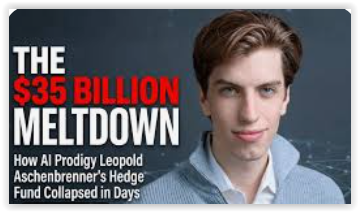
Leopold Aschenbrenner – Situational Awareness – AI based Hedge Fund
Hi Kevin,
Below you will find a summary of Goldman Sachs Asset Management’s resources, market perspectives, and updates for the week ending July 31st.
NEW Stat of the Week: US equities fell the week of July 24th as oil prices surged amid escalating tensions in the Middle East. Renewed concerns about the return on AI investment also weighed on US equities, with the S&P 500 ending the week down –0.60%. European equities were close to flat, initially rising due to a rally in energy and defense stocks before falling back as higher oil prices stoked inflation fears. The STOXX 600 ended the week up 0.50%. Japanese equities benefited from a rebound in semiconductor-related stocks before losing ground later on. The TOPIX still ended 2.35% higher.
Market Updates:
- Market Monitor: When we compare the current AI boom to the 1990s dot-com bubble, we still see few signs of the macro imbalances that signaled the end of the dot-com boom. At the same time, AI investment has accelerated meaningfully over the past few months and is now comparable to peak investment levels during the 1990s. We believe that AI investment can continue to rise and fuel further equity upside, but markets are also vulnerable to any news that challenges increasingly optimistic assumptions about AI adoption and productivity gains, underscoring the case for diversification.
- Is the Surge in US IPOs a Warning Sign for Investors?: US IPO issuance has surged to a record high in 2026. But this resurgence raises two concerns for the equity market: whether it is flashing a late-cycle warning sign and whether the market can digest so much new issuance. Jay Ritter of The IPO Initiative and Owen Lamont of Acadian Asset Management discuss whether the IPO surge is a red flag for markets. This episode explores the latest Top of Mind report.
- Are Hedge Funds Still Bullish on AI Stocks?: Tech stocks been buffeted by a reversal of momentum in US equities, but hedge funds are still fundamentally bullish on AI stocks, according to Vincent Lin, co-head of Prime Insights and Analytics in Global Banking & Markets. In this conversation with Chris Hussey, he explains why the greatest cumulative selling of tech stocks in the history of his data set looks more like a “healthy reset” amid crowded trades and high volatility rather than a loss of conviction in the AI trade.
- Arun Gupta on Bringing Silicon Valley’s Spirit to Public Service: The NobleReach Foundation taps into leaders across sectors – technology, science, government, academia – who have a penchant for national service and a desire to bridge the gap between a flourishing private sector career and large-scale public problem-solving. Arun Gupta, NobleReach’s CEO, joins John Mallory, co-head of Wealth Management at Goldman Sachs, to describe careers that are rich in “hidden capital”—trust, learning, and mission—and that align personal ambition with civic responsibility amid rapid AI disruption and geopolitical change.
- Jon Winkelried on Lessons from Goldman Sachs and TPG’s Next Chapter: TPG has evolved into one of the world’s leading alternative asset management firms, with over $300 billion in assets under management. Jon Winkelried, CEO of TPG and a Goldman Sachs alum, joins Matt McClure, global co-head of Investment Banking, to reflect on his career journey. From his early days as a summer analyst to serving as Goldman Sachs’ co-president and co-COO, Winkelried discusses the pivotal moments that shaped the firm across decades, as well as his role in TPG’s IPO, strategic expansion, and approach to navigating the AI landscape.
- IPO Surge – A Red Flag for Markets?: After several relatively quiet years, the US IPO market has reopened in a big way in 2026, with issuance to date rising sharply to a new record high. But this resurgence has raised two key concerns for the equity market: whether it’s flashing a late-cycle warning sign, and—even if it isn’t—whether the market can comfortably digest so much new issuance. So, how worried should investors be?
- Balancing the Risks to Portfolios from an Innovation Boom and Inflation: Investment portfolios face two key challenges: With the boom in capital expenditures on artificial intelligence (AI), there is a growing risk that tech stock profitability slips before the benefits of the new technology start to kick in. At the same time, inflation volatility and fiscal risks have risen, meaning bonds may provide less of a buffer for investors, according to Goldman Sachs Research.
Equities Updates:
- Europe’s Consolidated Stock Market Tape Could Invigorate Trading and Boost Investment: Plans to publish live equity market data in Europe—known as a consolidated tape—are set to bolster the region’s stock markets by making it easier to trade and boosting equity listings, according to Goldman Sachs Global Banking & Markets.
- Three New Stock Themes Are in Focus as the AI Trade Gyrates: A jump in volatility in stocks related to artificial intelligence (AI) infrastructure has triggered renewed interest in investment themes outside of the emerging technology. Goldman Sachs Research highlights three investment ideas that are unrelated to AI and have minimal correlation to those stocks: consumer-experience companies, “compounders,” and candidates for mergers and acquisitions.
Alternatives Updates:
- Evergreen Funds – Redefining Access in Private Markets: Join Stephanie Richards, Head of EMEA Alternatives for Third Party Wealth, Emily Reagan, Global Head of Evergreen Products for Alternatives Capital Formation, and Guillaume Schils, Americas Head of Alternatives for Third Party Wealth, for a discussion on evergreen alternative investment funds, exploring their open-ended structures, key investor considerations, and private market accessibility.
- Investing in the Architects – The Strategic Evolution of GP Stakes: Robert Hamilton Kelly, Co-Head of Petershill, explains how this asset class can bridge the gap between private equity and yield-oriented strategies, offering a combination of stable, fee-related earnings and long-term enterprise value growth. Speakers analyze the structural shifts driving this market, including the “staying private longer” trend and the increasing professionalization of mid-market firms.
- Finding Opportunities in Real Estate: Equity and Debt: Dirk Degenaars, CEO and President of Goldman Sachs Real Estate Income Trust, Steve Pack, CEO and President of the Goldman Sachs Real Estate Finance Trust, and Emily Reagan, Global Head of Evergreen Products for Alternatives Capital Formation, will discuss what lies ahead for real estate investors and the secular trends driving opportunities in both equity and debt.
- Why Investors are Expanding Beyond the 60/40: Stephanie Richards, Head of EMEA Alternatives for Third Party Wealth, discusses the reasons behind the growing investor interest in alternative investments and why more individual investors may consider incorporating alternatives into their portfolios today.
- How Private Markets Can Help Meet Client Goals: Guillaume Schils, Americas Head of Alternatives & Third Party Wealth, discusses how different alternative investment strategies can potentially be used to meet client goals including return enhancement, inflation mitigation and income.
- Understanding the Secondaries Market: The session will provide a broad overview of the secondaries market, dive deeper into the expansion of evergreen markets, and explore new opportunities for liquidity. This webinar will highlight portfolio construction, an overview of secondaries transactions, the evolution of the secondaries market, and the expansion of the private equity market.
Alex
(801) 995-8036
Alex Darrow
Vice President | Regional Director
Investment Management Division
__________________________________________________________
Goldman Sachs Asset Management
Cell: (801) 995-8036
E-mail: Alex.Darrow@gs.com
Charlie Pigatto
Regional Consultant
Americas Client Business
Goldman Sachs Asset Management
71 S. Wacker Dr., Chicago, IL 60606
Office Tel: 312-384-3155
Email: Charlie.Pigatto@gs.com
General Disclosures
This email may be considered advertising under federal law.
Company names and logos, excluding those of Goldman Sachs and any of its affiliates, are trademarks or registered trademarks of their respective holders. Use by Goldman Sachs does not imply or suggest a sponsorship, endorsement or affiliation.
Please see links above for important risks and additional disclosures.
Goldman Sachs Asset Management leverages the resources of Goldman Sachs & Co. LLC subject to legal, internal and regulatory restrictions.
Past performance does not guarantee future results, which may vary.
Views and opinions expressed are for informational purposes only and do not constitute a recommendation by GSAM to buy, sell, or hold any security. Views and opinions are current as of the date of this presentation and may be subject to change, they should not be construed as investment advice.
Although certain information has been obtained from sources believed to be reliable, we do not guarantee its accuracy, completeness or fairness. We have relied upon and assumed without independent verification, the accuracy and completeness of all information available from public sources.
Economic and market forecasts presented herein reflect a series of assumptions and judgments as of the date of this presentation and are subject to change without notice. These forecasts do not take into account the specific investment objectives, restrictions, tax and financial situation or other needs of any specific client. Actual data will vary and may not be reflected here. These forecasts are subject to high levels of uncertainty that may affect actual performance. Accordingly, these forecasts should be viewed as merely representative of a broad range of possible outcomes. These forecasts are estimated, based on assumptions, and are subject to significant revision and may change materially as economic and market conditions change. Goldman Sachs has no obligation to provide updates or changes to these forecasts. Case studies and examples are for illustrative purposes only.
This material is provided for educational purposes only and should not be construed as investment advice or an offer or solicitation to buy or sell securities.
This communication is confidential and intended only for a select audience. If you are not the intended recipient, please advise the sender immediately and delete this message. See https://www.goldmansachs.com/disclaimer/email for further information on confidentiality and the risks inherent in electronic communication.
Your Personal Data: We may collect and process information about you that may be subject to data protection laws. For more information about how we use and disclose your personal data, how we protect your information, our legal basis to use your information, your rights and who you can contact, please refer to: http://www.gs.com/privacy-notices.
This information discusses general market activity, industry, or sector trends, or other broad-based economic, market or political conditions and should not be construed as research or investment advice. This material has been prepared by Goldman Sachs Asset Management and is not financial research nor a product of Goldman Sachs Global Investment Research (GIR). It was not prepared in compliance with applicable provisions of law designed to promote the independence of financial analysis and is not subject to a prohibition on trading following the distribution of financial research. The views and opinions expressed may differ from those of Goldman Sachs Global Investment Research or other departments or divisions of Goldman Sachs and its affiliates. Investors are urged to consult with their financial advisors before buying or selling any securities. This information may not be current, and Goldman Sachs Asset Management has no obligation to provide any updates or changes.
THIS MATERIAL DOES NOT CONSTITUTE AN OFFER OR SOLICITATION IN ANY JURISDICTION WHERE OR TO ANY PERSON TO WHOM IT WOULD BE UNAUTHORIZED OR UNLAWFUL TO DO SO.
Confidentiality
No part of this material may, without Goldman Sachs Asset Managements prior written consent, be (i) copied, photocopied or duplicated in any form, by any means, or (ii) distributed to any person that is not an employee, officer, director, or authorized agent of the recipient.
If you no longer want to receive marketing emails from Goldman Sachs Asset Management you can unsubscribe here.
© 2026 Goldman Sachs. All Rights Reserved.
Compliance Code: 525383-OTU-2584730
FOR FINANCIAL INTERMEDIARIES AND INSTITUTIONAL USE ONLY – NOT FOR USE AND/OR DISTRIBUTION TO THE GENERAL PUBLIC OR THE MEDIA
We collect and process information about you that may be subject to data protection laws and monitor engagement with our emails to help ensure they are working properly, gauge campaign success and contact recipients who show an interest in our content. For more information about how we use and disclose your personal data, how we protect your information, our legal basis to use your information, your rights and who you can contact, please refer to the Goldman Sachs Asset Management privacy notice.
Earnings –
BABA 8/28 est
BIDU 8/19 est
COST 9/24 AMC
CVS 8/05 BMO
DIS 8/05 BMO
LULU 9/03 est
MRVL 8/27 est
MU 9/23 est
NKE 9/29 est
NVDA 8/26 AMC
O 8/05 AMC
PLTR 8/03 AMC
SPCX 8/04 AMC
UAA 8/07 BMO
WMT 8/20 BMO
https://www.briefing.com/the-big-picture
The Big Picture
The risk of the market getting carried away
Briefing.com Summary:
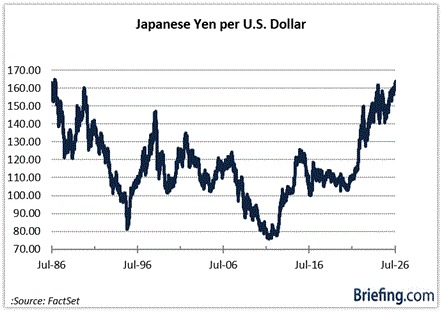
*The yen’s 40-year low increases the risk of another carry-trade unwind that could trigger sharp, short-term volatility in global equity markets.
*Japanese policy action to support the yen could spark forced deleveraging as investors unwind yen-funded carry-trade positions.
*A carry-trade unwind is more likely to create a temporary market disruption than a systemic financial crisis, based on the August 2024 experience.
Kenny Chesney tells us in his country song “Don’t Blink” that 100 years goes by faster than you think. With your author nearly midway through his fifth decade of life, those words ring truer each year.
Some experiences feel like a long time ago. Most, though, feel like they happened only yesterday. Going back 40 years isn’t much of a stretch. It isn’t even half a blink.
Financial markets have recently taken us back to 1986–the last time the New York Mets won the World Series and the last time the Japanese yen was this weak against the dollar.
That milestone isn’t just a historical curiosity. It raises the market risk of another yen carry-trade unwind similar to the one that briefly rattled global markets in August 2024.
A Tourist Trap?
A weaker currency has its benefits. It boosts the earnings of Japanese multinationals generating revenue abroad in U.S. dollars and makes exporters more price-competitive internationally.
For Japan itself, a weaker currency is a boon for tourism, and it has also helped Japan emerge from a longstanding deflation environment.
For investors and speculators, the weaker yen has been a popular funding currency for carry trades, whereby investors borrow yen at low interest rates and invest the proceeds in higher-yielding currencies or assets, aiming to profit from the spread.
The U.S. has been a popular destination for carry-trade “tourists” thanks to its highly liquid markets, higher interest rates, and high returns for stocks (the S&P 500 is on pace for a fourth consecutive year of double-digit returns).
Those tourists had a painful experience in August 2024. First, the Bank of Japan surprised everyone with a rate hike on July 31, and then the U.S. released a weak employment report on August 2 that fomented recession worries. Investors suddenly anticipated a widening policy divergence, with the Bank of Japan tightening while the Federal Reserve appeared poised to ease policy.
Sure enough, the yen appreciated sharply against the dollar with short-covering activity in play alongside an unwinding of the suddenly less attractive carry-trade positions, a portion of which were presumably juiced with added leverage.
In the blink of an eye, the yen went from 152.78 against the dollar on July 30 to 141.69 on August 5. Over the same period, the CBOE Volatility Index went from 17.69 to as high as 65.73. The fallout in global equity markets was pronounced.
Between July 30 and August 5, the S&P 500 declined as much as 5.8%, the STOXX Europe 600 dropped as much as 6.7%, and Japan’s Nikkei plummeted 19.1%, punctuated by a 12.4% decline on August 5 that marked the largest single-day point loss in its history.
The speed and magnitude of those moves illustrated just how quickly a carry-trade unwind can spread across global financial markets.
Briefing.com Analyst Insight
The unwinding of yen-funded carry trades spilled quickly into global equity markets, triggering a sell-first-ask-questions-later response fueled by fears of forced liquidation.
We aren’t revisiting this situation now to be fearmongers. On the contrary, we are highlighting it as a market risk, knowing that:
- The yen is hovering at its weakest level against the dollar in 40 years.
- Japan’s finance minister has made it known that Japan stands ready to take “decisive steps” to support the currency if needed.
- The Bank of Japan isn’t expected to raise rates at its July policy meeting, making a surprise hike all the more impactful for the yen, and
- The U.S. dollar continues to strengthen with inflation concerns pushing up interest rates in the U.S., which is exerting even more pressure on the yen that threatens to drive up inflation in Japan and to invite some more aggressive policy action from the Bank of Japan.
In brief, the incentive for Japanese policymakers to act is increasing. Whether that comes through currency intervention, an unexpected BOJ rate hike, or both, the result could be another rapid unwinding of yen-funded carry trades.
Such a move could trigger sharp, short-lived losses. The good news is that it appears more likely to be a market risk than a systemic risk, assuming there isn’t some unforeseen exposure to broadly leveraged positions.
The distinction matters. Systemic risks threaten the functioning of the financial system itself and often have lasting economic consequences. Market risks, while painful, are typically driven by positioning and forced liquidations that eventually run their course. That was the case in August 2024.
The S&P 500 and STOXX Europe 600 recovered the entirety of the losses noted above approximately two weeks later. It took the Nikkei a little over a month. If you blinked, you might have missed that.
Don’t blink now, though. The ingredients for another carry-trade unwind are beginning to fall into place, and if August 2024 taught investors anything, it’s that these episodes can unfold in the blink of an eye.
—Patrick J. O’Hare, Briefing.com
(Editor’s Note: The next installment of The Big Picture will be published the week of August 3)
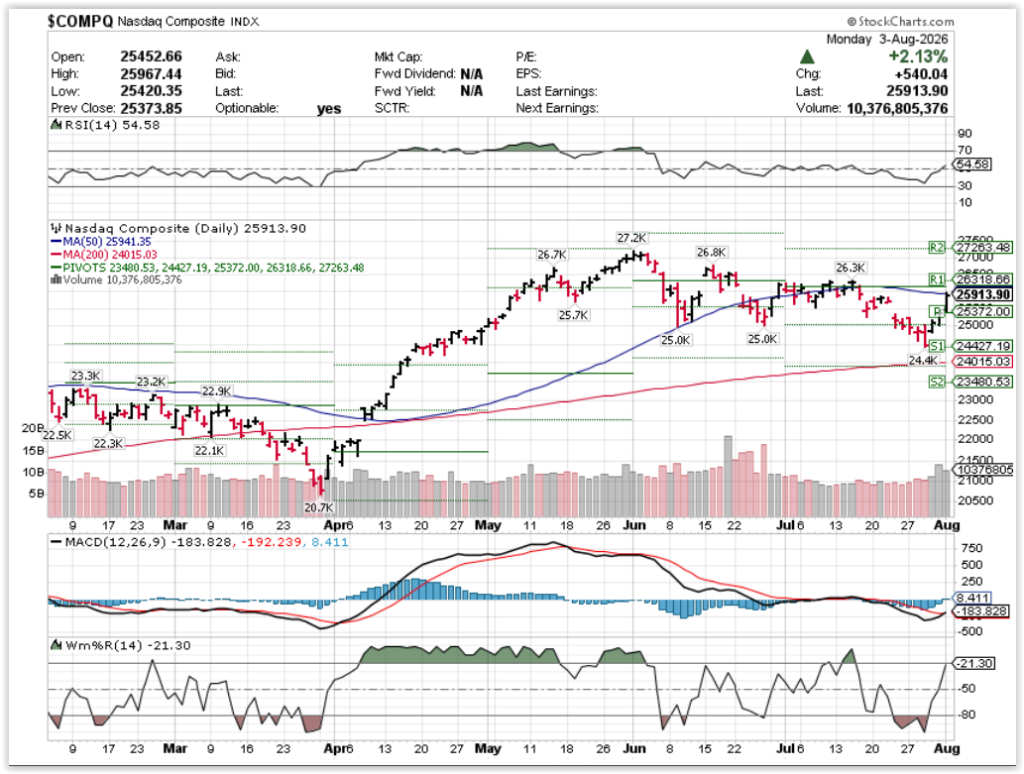
Where will our markets end this week?
Higher
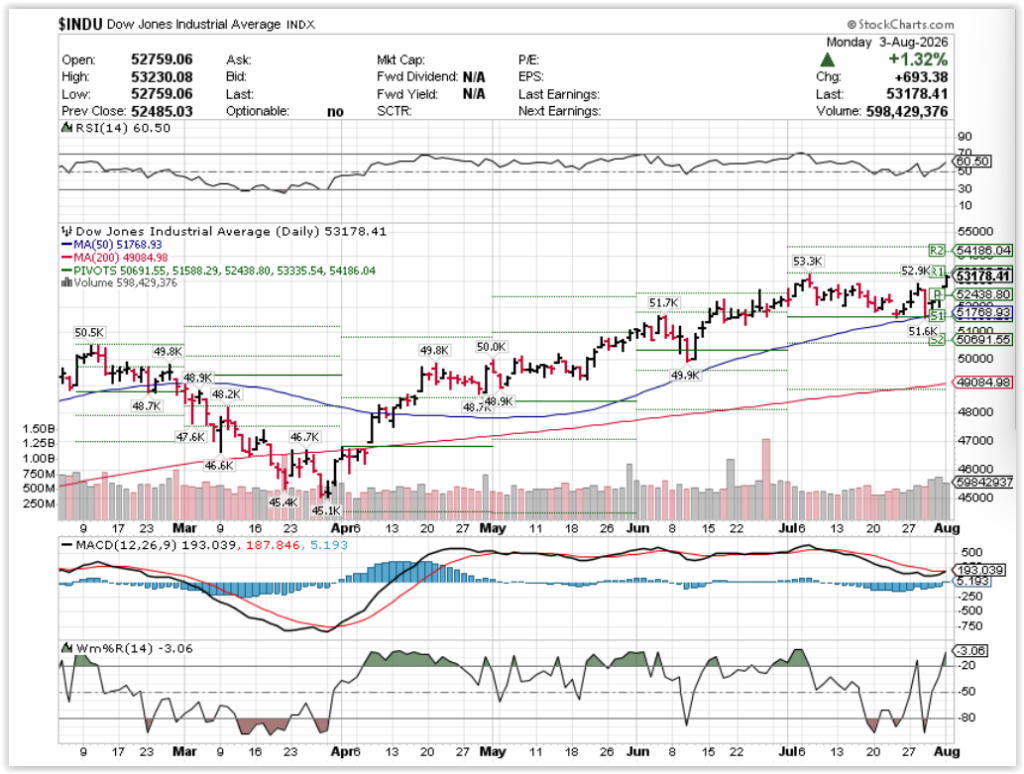
DJIA – Bullish
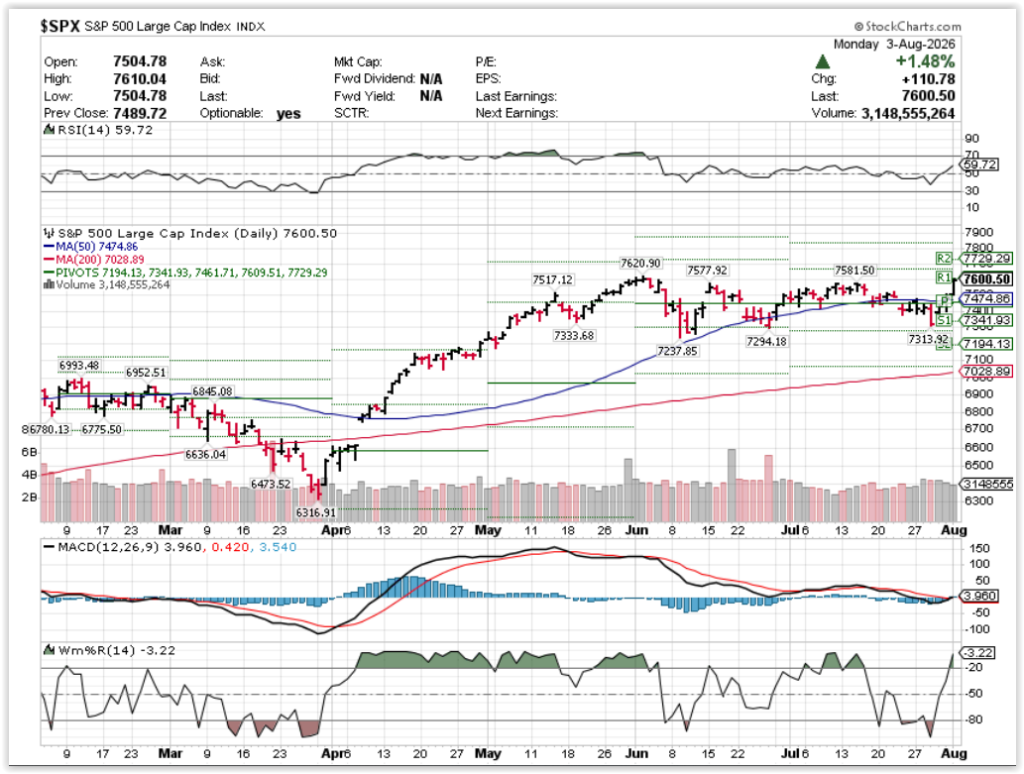
SPX – Bullish
COMP – Bullish
Where Will the SPX end August 2026?
08-03-2026 +1.50%
Earnings:
Mon: MAR, CLX, PLTR
Tues: BALL, BP, CAT, CMI, DUK, DD, KMB, MCD, MRK, SHOP, SPOT, AMGN, DVN, MAT, MOS, UPST, WYNN, PFE, SPCX,
Wed: LLY, KHC, PSX, SHAK, UBER, XYZ, BMBL, CF, DASH, EBAY, GT, MUR, SNDK, ZG, DIS, O, HUBS,
Thur: LNG, COP, HTZ, KDP, VAC, PZZA, PTON, RL, ABNB, DKNG, ROKU, TWLO, TAP, MNST,
Fri: FLR, WEN, UAA
Econ Reports:
Mon: Construction Spending, ISM Manufacturing,
Tue: Trade Balance, Business Inventories, Factory Orders,
Wed: MBA, ADP Employment, ISM Services,
Thur: Initial Claims, Continuing Claims, Productivity, Unit Labor Costs, Wholesale Inventories,
Fri: Average Workweek, Non-Farm Payroll, Private Payroll, Unemployment Rate, Hourly Earnings, Consumer Credit,
How am I looking to trade?
Placing ATM puts or slightly OTM for earnings
Adding Covered Calls to positions for the summer doldrums
www.myhurleyinvestment.com = Blogsite
info@hurleyinvestments.com = Email
Questions???
Boeing Shares Fight To Regain Support; Q2 Results Don’t Help
- HARRISON MILLER
- 08:29 AM ET 07/28/2026
Boeing stock ticked higher early Tuesday after the Dow Jones manufacturer posted mixed Q2 results. Revenue topped expectations as commercial airplane deliveries rose, but Boeing’s loss widened more than expected. The FAA on Monday requested another inspection of Boeing planes following reports of improperly installed cabin seats.
Boeing (BA) reported a loss of 67 cents per share, narrowed from a loss of 92 cents per share last year. Revenue rose 8% to $24.56 billion.
Analysts expected Boeing to report a loss of 28 cents per share on $24.26 billion in revenue, according to FactSet.
Commercial airplane revenue climbed 8% to $11.75 billion to beat views for not quite $11.65 billion. Boeing reported 171 commercial plane deliveries for the quarter, an increase of 21 planes.
Defense, space and security sales surged 13% to $7.48 billion. Analysts expected revenue for the segment to rise to $7.22 billion.
Boeing reported $280 million in losses related to the VC-25B program, which is developing a new Air Force One plane. The company expects first delivery for the aircraft in 2028.
Global services revenue ticked up 1% to $5.34 billion, while FactSet expected $5.37 billion in revenue.
Elsewhere, the Federal Aviation Administration late Monday called for the inspection of 453 Boeing jets following reports of improperly installed cabin seats, the Wall Street Journal reported. The issue reportedly affects Boeing 737-8 and 737-9 aircraft.
The results come after Boeing last week secured orders for nearly 170 planes across multiple deals at the U.K.’s Farnborough International Air Show .
Boeing Progresses On Quality Control, Certifications
Meanwhile, the FAA earlier this month allowed Boeing to resume issuing airworthiness certificates for its 737 Max and 787. The regulatory agency stripped that ability from Boeing following fatal crashes in 2018 and 2019.
In other company news, Boeing executives say they are close to completing certification for the 737-7 and 737-10. The company is about 95% done with its certification process for the 737-7 and about 98% complete with certification flight tests for the 737-10, AviationWeek reported. The Dow Jones manufacturer has completed about 50% of its certification flights for the 777-9.
The planes still need to undergo a design review process.
Boeing Stock
Boeing shares have traded sideways since mid-May, recently losing their grip on support at the stock’s converged 50-day and 200-day moving averages. Shares Tuesday rose almost 2%, just shy of a test of resistance at its 50-day and 200-day lines.
Boeing is down about 2.6% this year through Monday, making it the eighth-worst performer in the Dow Jones Industrial Average.
You can follow Harrison Miller for more stock news and updates on X/Twitter @IBD_Harrison.
https://www.cnbc.com/2026/07/15/munis-are-having-a-solid-2026-.html?__source=iosappshare%
7Ccom.apple.UIKit.activity.Mail
Munis are having a solid 2026. Investors can still grab ‘generationally attractive yields’
Published Wed, Jul 15 20263:12 PM EDT
Investors should still be able to grab attractive yields in municipal bonds the rest of this year.
The bonds issues by state and local governments and thousands of various borrowing authorities had a strong showing in the first half of 2026. Both investment-grade and high-yield tax-exempt munis were “clear outperformers,” with the former seeing a 2.16% total return and the latter returning 3.74% in the first half, Bank of America said in a note last week.
That translates into 3.7% and 5.59% tax-adjusted total returns, respectively, the bank pointed out. Bond yields move inversely to prices, and total returns incorporate both capital appreciation and income. Muni income is exempt from federal taxation, and state and local taxes too if you live in the state of issuance.
Investors gravitated to munis because they were looking for stability in their portfolios, said Tom Kozlik, head of public policy and municipal strategy at HilltopSecurities. He expects that to continue, although perhaps returns may not be quite as healthy as in the first half.
″[A]s I see this on again, off again volatility with regard to what could happen in the Middle East, what could happen with energy prices, I still think that these … generationally attractive yields are still going to be available at least for the next couple … of months,” Kozlik said.
The Vanguard Tax-Exempt Bond ETF, for instance, has a 30-day SEC yield of 3.5%. It has an expense ratio of 0.03%.
Vanguard Tax-Exempt Bond ETF year to date
The strong performance of muni bonds in the face of the Iran conflict, elevated interest rate volatility and record-setting supply makes Barclays somewhat optimistic about the second half outlook.
“We remain constructive on the asset class and believe munis can deliver solid returns through year-end,” Mikhail Foux, head of municipal research and strategy at Barclays Investment Bank, said in a note last Friday. “However, we continue to expect a challenging backdrop characterized by elevated supply, uncertainty about interest rates and richer valuations than at the start of the year.”
In fact, that environment caused the UBS chief investment office to downgrade munis to neutral from attractive on Monday.
“While we maintain a constructive outlook for munis in 2H26, renewed U.S.-Iran strikes, rate volatility and inflation risks could pose near-term challenges,” UBS fixed income strategist Sudip Mukherjee said in a note to clients. “We expect the 10-year Treasury yield to decline by year end. However, near-term rate volatility and curve steepening are key risk factors.”
AllianceBernstein is more hopeful, expecting demand to meet the record levels of bond issuance.
“With demand where it is — supply probably waning a little bit during the summer, but picking back up in the fall time — we do think municipals will continue holding in there and probably end with a fairly nice return by the end of the year,” said Daryl Clements, municipal bond portfolio manager at AllianceBernstein.
‘Post-golden age realignment’
When looking for opportunities, investors should increasingly focus on credit selection as local governments adjust to tighter budgets, according to Kozlik.
While credit quality continues to remain healthy overall, there has been a “post-golden age realignment” underway — with state and local governments readjusting their spending to align with recurring revenues after receiving federal pandemic aid for years, he said.
“They’re now having to buckle down and they’re having to figure out what they are going to have to be able to spend in the next couple of budget cycles,” Kozlik said.
Kozlik sees opportunities in general obligation and essential service revenue bonds. Specifically, he likes airports and water and sewer, as well as housing — especially the large, single-family state housing agencies.
High quality
He prefers to stay up in quality with AAA- and AA-rated munis, but said ratings alone are insufficient. Investors should make sure that issuers have structurally balanced budgets and sustainable spending relative to recurring revenues, he said.
“Credit selection, even in those categories, is going to be very important,” he warned.
iShares National Muni Bond ETF year to date
There is also value as farther out on the yield curve, said Matthew Norton, AllianceBernstein’s chief investment officer for municipal bonds.
“For the rest of the year, investors can buy municipal bonds at really attractive yields, particularly if you go out long on the yield curve, or you buy municipal credit, which is also very attractive, mid-grade or high-yield municipal bonds,” he said.
“Also, given the relative value and how longer municipals are cheap in our view, we do think you additionally will probably get some price appreciation from the long end of the municipal bond,” he added.
Still, Norton maintains a barbell strategy, holding both short- and long-dated bonds.
Within sectors, Norton and Clements like prepaid energy bonds and affordable housing bonds. They also find alternative-minimum- tax airport bonds attractive for investors who aren’t subject to the levy. In addition, they see opportunity in high-quality hospital bonds and senior living bonds, which will benefit from favorable demographics and limited new construction.
The team also continually invests in general obligation bonds.
How Morgan Stanley is positioning its income portfolio right now
Published Thu, Jul 16 20263:53 PM EDT
Investors seeking income should diversify beyond the traditional 60/40, according to Morgan Stanley.
The firm has an income model portfolio that includes not only U.S. stocks and bonds, but also international assets, master limited partnerships, real estate investment trusts and commodities.
“There’s a high correlation between fixed income returns and equity returns,” explained Jim Caron, chief investment officer of the portfolio solutions group at Morgan Stanley Investment Management.
Different sources of income can manage duration risk on the fixed income side and balance out the income generating assets, he added.
“That can start to bring down some of your correlation risk,” he said. “Having that diversification gives you stability in the portfolio, so you can hold on to it, so you’re getting that income.”
Top-down approach
The firm takes a top-down macro approach when deciding the portfolio’s allocations.
For instance, if the team thinks the consumer is going to do well, they would overweight the consumer sector and potentially overweight equities. If they thought rates were going to come down, they would have more of an overweight in interest-rate sensitive fixed income.
“Today we think the Fed’s not going to do anything, and the rates are just going to kind of move sideways, but economic conditions are good, so we’re willing to take a little bit more credit risk,” Caron said.
The Federal Reserve opted to hold rates steady at its last meeting in June.
Filling the buckets
Within the fixed income bucket there is a mix of high-quality credit such as corporate bonds, asset-backed securities and mortgage-backed securities.
Corporate bond funds, for instance, can bring in yields over 5%. For example, the iShares Broad USD Investment Grade Corporate Bond ETF (USIG) has a 5.3% 30-day SEC yield and 0.04% expense ratio.
iShares Broad USD Investment Grade Corporate Bond ETF year to date
There may also be some high-yield bonds and floating-rate assets. Caron also likes emerging market bonds right now, particularly those from Brazil.
“Interest rates are high, we think that inflation is coming down. We think policy rates have been set right,” he said.
Indonesia is another area he prefers and overall sticks mostly with broad dollar-based emerging markets. In general, investors can get a pick up in yield in emerging market bond funds. For example, the Vanguard Emerging Markets Government Bond ETF (VWOB). It has a 30-day SEC yield of 5.97% and an expense ratio of 0.15%.
Vanguard Emerging Markets Government Bond ETF year to date
The overall duration of the fixed-income bucket is close to five years.
The equities allocation goes beyond the S&P 500, which is heavily weighted towards mega-cap tech stocks.
“It is going to have much more of a focus on quality dividend earners,” Caron said.
The firm also likes artificial intelligence beneficiaries for equity allocations across its portfolios. That could mean areas like the managed care segment in healthcare or some construction companies that will gain efficiencies thanks to AI.
“We’re trying to find the companies that are adapting and adopting new technologies that can benefit from AI,” Caron said. “They’ll be the winners, and then there’ll be the losers, and the companies that adopt this new technology well will be the winners, and that’s what we’re trying to invest in.”
Another theme he likes is fiscal policy beneficiaries — those who will benefit from regulations out of Washington like deregulation or other fiscal policy. That includes financials and some energy and manufacturing, he said.
Rebalancing with tax awareness
The model portfolio gets rebalanced six to eight times a year, Caron noted.
“A client in an income fund doesn’t want to see, like every other week, that their portfolio is being churned,” he said. “Plus, that also could create a tax event if you’re doing that, so, you’re really trying to be very tax aware … and hopefully you can sleep at night.”
SpaceX has now lost the equivalent of a full Tesla in market capitalization
Published Mon, Jul 27 20265:26 PM EDT
Updated Tue, Jul 28 202611:38 AM EDT
What’s one trillion between a trillionaire and his biggest fans?
SpaceX has now erased more than $1.2 trillion in market cap since its high price of $225.64 in June – almost exactly the value of Elon Musk’s other company, Tesla, whose shares just fell to near one-year lows. On Monday, SpaceX fell for the 13th session out of the last 16, shedding more than 1% to end at $113.50.
SpaceX in the past five trading days
While some of the options flows are getting more balanced between bulls and bears, the biggest single SpaceX trades of the day on Monday were neutral to bullish. Small speculators continue to buy fat-chance calls that need the crashing stock to quickly turn around and double.
More calls traded than puts by volume Monday, with traders buying 106,000 calls compared to 77,000 puts, though the majority of the $442 million in premium was tied to puts. The most popular contract by volume was the 330-strike call expiring Friday, a contract that goes for 10 cents and has a roughly one-third of 1% chance of working, according to ThinkOrSwim data.
Four of the five biggest trades by premium were neutral or bullish, Cboe LiveVol data show. That included two giant put-spread sellers, including one multimillion-dollar sale of in-the-money put spreads that need SpaceX to rally, as well as someone who collected $1.8 million selling 5,200 of the 100-strike puts expiring Oct. 16 and buying 7,000 of the 85-strike puts with the same expiry.
“As an investor it’s early – as a trader, Wall Street is now punishing the AI stocks for capex,” said Charles Moon, a tech and momentum specialist for Prosper Trading Academy in Chicago.
One thing’s certain: SpaceX is offering traders one of the wildest rides in the market. While earnings are typically volatility-reducing events, that may not necessarily be the case after next week’s report.
SpaceX’s first earnings report since its initial public offering paves the way for investors to sell 20% of their eligible locked-up stock, a total of up to 911.5 million shares, on the second full trading day immediately following the first earnings release date — that is, Aug. 6.
“I don’t think the lock-up on SpaceX will be as bad as everyone fears,” Moon said. “But it’s not going to help the cause either.”
SpaceX shares were lower again Tuesday in early trading, down about 3%.
Here’s where Jeffrey Gundlach is investing after the Fed held rates steady
Published Thu, Jul 30 20262:59 PM EDT
Updated Thu, Jul 30 20263:06 PM EDT
Watch CNBC’s full interview with DoubleLine CEO Jeffrey Gundlach
DoubleLine Capital CEO Jeffrey Gundlach isn’t taking big risks in the bond market these days, particularly as the Federal Reserve tries to figure out its next rate move.
The central bank opted to keep the federal funds rate at a range of 3.5% to 3.75% on Wednesday, although three policy members dissented in favor of raising rates by a quarter percentage point.
However, if Chairman Kevin Warsh wants to reach 2% inflation, the Fed is going to have to increase rates, Gundlach said. In fact, reaching that inflation target could take a “couple of years,” he said in an interview with CNBC’s “Closing Bell.”
In this environment, Gundlach is being very selective.
“The market for corporate credit is definitely softening — not so much in the investment grade area and not in every sector — but there have been great movements wider in spreads for a lot of these AI names and other technology names,” the bond investor said.
He’s staying very high in quality, specifically BBB-rated bonds and higher. He would perhaps add some BB-rated assets in the high-yield market but cautions investors to stay out of the C category.
“Investors have to be really seriously thinking about what is the credit risk, what is the default risk in the triple C part of the junk bond market and the bank loan market,” Gundlach said.
Within bank loans, CCC-rated names have widened very significantly to BB names, he pointed out. “That’s usually a sign that something is going wrong,” he said.
Gundlach is also not investing in the long-end of the yield curve, and instead is focusing on the two- to seven-year area.
After the Fed meeting, the 30-year Treasury yield jumped above 5.2%, a level not seen since 2007. Gundlach thinks the rate on the long end of the curve could move up to the “mid-5s” before the next Fed news conference in September. Bond yields move inversely to prices.
Government debt and the shortfalls in the Social Security trust fund, as well as the “monstrous deals” from artificial intelligence companies, are among the reasons for the move higher in long-term rates.
“Interest rates are going to keep rising unless there is action on the deficit and some movement towards a real decline in the inflation rate,” Gundlach said.
How Leopold Aschenbrenner built a $45 billion AI hedge fund — and lost most of it in days
Published Fri, Jul 31 202610:44 AM EDT
Updated Fri, Jul 31 20264:19 PM EDT
Key Points
- Former OpenAI researcher Leopold Aschenbrenner’s AI hedge fund, Situational Awareness, collapsed from $45 billion to around $10 billion in assets on falling semiconductor stocks and mounting margin calls.
- Driven by reported leverage of up to 400%, the 20-something manager was forced to sell off all his leveraged public stock bets — including hard-hit names like SK Hynix and CoreWeave — to Ken Griffin’s Citadel at a discount.
- The crash marks a dramatic turn for Aschenbrenner, who launched the fund after gaining Silicon Valley fame with his 2024 AI manifesto, drawing scrutiny from critics over his lack of money management experience and his past ties to FTX.
Two years ago, Leopold Aschenbrenner argued he was one of few people in the world who saw the future clearly.
In a sprawling, 165-page essay that became required reading in Silicon Valley, the former OpenAI researcher positioned himself as a kind of prophet for the coming age of artificial super intelligence.
But this week, the limits of Aschenbrenner’s vision were on display when the AI-themed hedge fund he runs — named Situational Awareness, also the title of his viral June 2024 manifesto — ran into the harsh reality of tumbling semiconductor stocks and Wall Street margin calls.
At its peak earlier this month, his fund sat atop $45 billion in assets. By Thursday, however, after being forced to offload all of his leveraged stock bets — including hard-hit names like SK Hynix and CoreWeave — to Ken Griffin’s Citadel at a discount, the fund’s holdings plunged to around $10 billion, according to people with knowledge of the situation.
The story of Aschenbrenner’s meteoric rise and sudden fall has captivated both Wall Street and tech circles, making him the most high-profile casualty yet of the volatility accompanying the AI boom.
A polarizing figure, his online followers saw Aschenbrenner — a Columbia University valedictorian at age 19 — as a genius of the next big thing and followed his fund’s quarterly filings for clues on hot AI stocks.
Before this month’s decline, Situational Awareness racked up gains of more than 1,000% since inception, The Wall Street Journal reported last month. The Journal noted Aschenbrenner was just 24 years old.
Leopold Aschenbrenner’s Situational Awareness sells levered book of public investments, sources say
Meanwhile, critics pointed out that Aschenbrenner had no experience running money prior to launching his fund in July 2024, calling him more lucky than smart. Some noted that his early work experience was at the doomed crypto firm FTX, where he helped now-disgraced founder Sam Bankman-Fried run a charity out of a Bahamas penthouse.
Others on Wall Street, including former traders at global investment banks, noted that in light of reports Situational Awareness used as much as 400% leverage, the collapse wasn’t shocking.
“A lot of people saw this blow-up as a matter of not if, but when,” said Jerry Diao, who runs a Wall Street coaching firm. “Maybe his views on AI are correct in the long run, but in the public markets, you have to be prepared for the short-term.”
The hedge fund didn’t immediately respond to a request for comment from CNBC.
Earlier this week, before the sale to Citadel, about two-thirds of Situational Awareness holdings were in long and short positions in public equities, according to one source. The rest were stakes in private companies, dominated by a multibillion-dollar Anthropic investment, the person said.
CNBC’s sources spoke on the condition of anonymity to discuss nonpublic details.
The near-collapse of Situational Awareness coincides with the hedge fund manager’s wedding, set for this weekend, sources told CNBC’s David Faber. Aschenbrenner is engaged to Avital Balwit, chief of staff for Anthropic CEO Dario Amodei, according to a Fortune profile.
‘Weirdness’ and ‘disagreeableness’
Born in Germany to physician parents before moving to the U.S., Aschenbrenner showed an early aptitude for math and computer science, according to profiles and podcast interviews.
He skipped several grades in the German school system, graduating high school at age 15, and as a teen at Columbia University he garnered attention for an academic paper titled, “Existential Risk and Growth.”
A Columbia classmate, Sofia Montrone, said that she hadn’t heard of Aschenbrenner before meeting him over Zoom shortly before their 2021 graduation.
“It was not like he was some prince, emerging out of the school,” Montrone told CNBC. “He was just some guy.”
In the interaction, Montrone, who was salutatorian, said she found her classmate “child-like” and socially awkward.
Aschenbrenner has since said that his personality — what he called his own intellectual “weirdness” and “disagreeableness” — was punished in German culture. He came to see it as the source of his edge.
While at Columbia, he co-founded the school’s chapter of Effective Altruism, a philosophy popular in some tech circles that advocates for founders to make the most money possible in order to help humanity.
That network became his career pipeline, eventually leading him to work with another effective altruism proponent — Bankman-Fried — after his graduation in 2021. He worked for a stint at the Future Fund, the philanthropic arm of FTX, before the crypto firm’s collapse.
In 2023, Aschenbrenner landed on OpenAI’s Superalignment team, working under Ilya Sutskever on the problem of keeping AI aligned with human interests. After a hacker breached OpenAI’s internal systems, he wrote a memo to the board warning that the company’s security wasn’t strong enough to stop foreign espionage, naming China specifically.
In 2024, the company fired Aschenbrenner after accusing him of improperly sharing confidential information, a characterization he has disputed, saying he was raising concerns about the company’s security practices.
“I liked Leopold while at OpenAI,” Scott Aaronson, a computer scientist now at the University of Texas at Austin who previously worked on AI safety at OpenAI, told CNBC this week in an email.
“I was sorry when he got pushed out because of sharing information in a way leadership didn’t approve of,” he said. It “sounded like he was trying to do the right thing and they overreacted.”
An OpenAI spokesman declined to comment and referred to statements the company made at the time that the firm disagreed with many of Aschenbrenner’s claims.
Representatives for Columbia University and its Effective Altruism chapter didn’t respond to requests for comment.
Stripe, Github investors
Weeks after his departure from OpenAI, Aschenbrenner turned his brief experience at the leading AI firm into a sweeping vision of where artificial intelligence, and the world, was headed.
His June 2024 essay argued that artificial general intelligence could arrive within years and that governments were badly underestimating the pace of progress. Admirers saw it as evidence that Aschenbrenner was a prodigy with valuable insight into AI’s trajectory, while critics said it overstated both the technology’s near-term capabilities and his own certainty about the future.
By July of that year, Aschenbrenner parlayed his rising fame into seed capital for his hedge fund, raising a reported $225 million from Stripe co-founders Patrick and John Collison, former GitHub CEO Nat Friedman and investor Daniel Gross.
That would mark the start of a two-year run unlike any in recent Wall Street history.
“Before long, the world will wake up,” Aschenbrenner wrote at the time, adding that only a few hundred people in the AI community knew what was coming.
“If they are seeing the future even close to correctly,” he wrote, “we are in for a wild ride.”
— CNBC’s Kate Rooney contributed to this report.
