
Thoughts for the end of the year:
I believe thru channel checks that Tech will still move higher due to the amazing top & bottom-line returns
We typically have a Christmas Rally = Some years much bigger than others
This year we fought inflation, Iran, Russia/Ukraine, AI overload, Decreasing Margins = Huge investments in AI, Corrupt Politicians
Inflation = Housing = Supply and Demand Problem left over from Covid = The upcoming generation will have to buy farther from work and really buy a piece of crap starter home until they gain some equity OR until the Supply comes back online
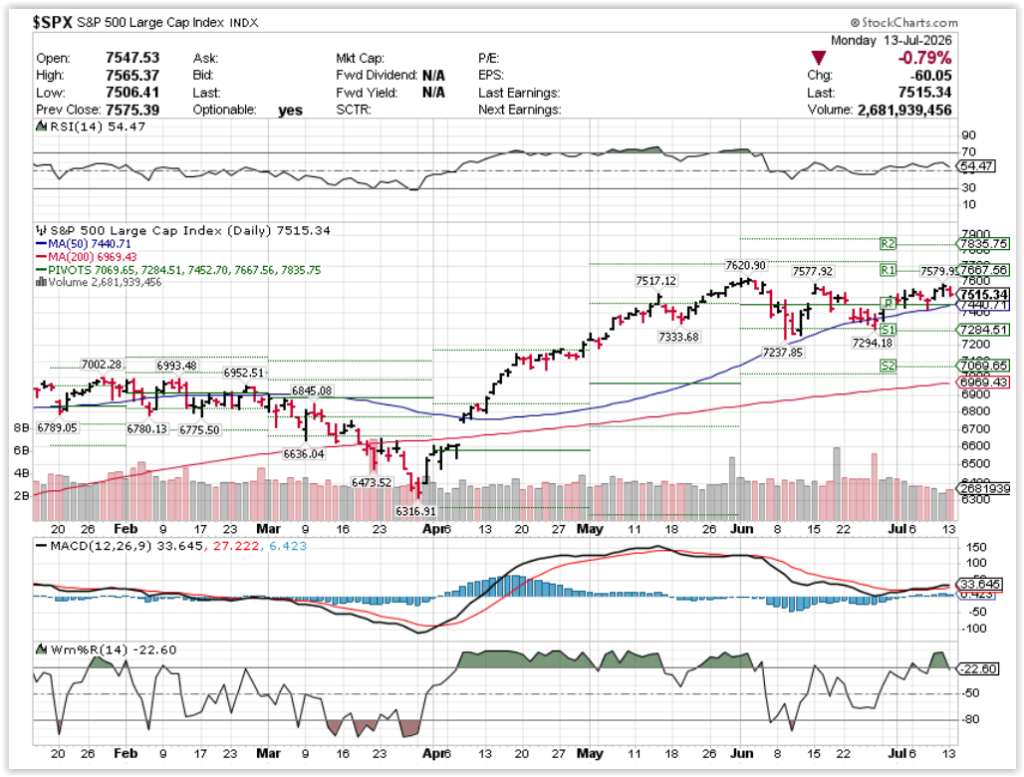
I can calculate another 5-8% in the S&P 500 by the end of the year.
I CAN’T calculate a recession for 2026 at all
I can’t calculate a recession in 2027 either
Earnings –
AAPL 7/30 AMC
BA 7/28 BMO
BABA 8/28 est
BAC 7/14 BMO
BIDU 8/19 est
CB 7/21 AMC
COST 9/24 AMC
CVS 8/05 BMO
DIS 8/05 est
F 7/28 AMC
GOOGL 7/22 AMC
JPM 7/14 BMO
KEY 7/21 BMO
LMT 7/23 BMO
LULU 9/03 est
META 7/29 est
MSFT 7/29 AMC
MRVL 8/27 est
MU 9/23 est
NFLX 7/16 AMC
NKE 9/29 est
NVDA 8/26 AMC
O 8/05 AMC
OWL 7/30 BMO
PLTR 8/03 est
QCOM 7/29 AMC
SPCX
UAA 8/07 BMO
V 7/28 AMC
VZ 7/24 BMO
WMT 8/20 BMO
https://www.briefing.com/the-big-picture
The Big Picture
Last Updated: 10-Jul-26 15:13 ET | Archive
When good earnings may not be good enough
Briefing.com Summary:
*Second-quarter earnings should be strong, but elevated valuations have raised the bar for what investors will consider a successful reporting season.
*Information technology and energy are expected to drive most earnings growth, making results from key semiconductor companies especially influential.
*Beating earnings estimates alone may not be enough; companies must validate lofty growth expectations to sustain the bull market.
In recent weeks we have focused on three metrics that ultimately reflect the same thing: expectations. Gross margins determine earnings power, forward P/E multiples reflect expectations for those earnings, and today’s elevated price-to-sales ratio suggests investors remain willing to pay a premium for future growth.
In the coming weeks we are going to see changes across all three metrics. We just don’t know how much change there will be and whether it will be positive or negative. That will depend in large part on what the second-quarter earnings reporting period tells us.
The second quarter should produce another excellent reporting season. The bigger question is whether “excellent” will be enough for a market priced for “exceptional.”
Start Your Engines
The second-quarter blended earnings growth rate is 23.7%, according to FactSet. That is up from 18.3% at the end of March.
As a reminder, the blended growth rate accounts for the actual results of the companies that have already reported and the estimates for the companies that have yet to report, which is most S&P 500 companies. At this juncture, only 18 companies have released their results, so there is a long way to go to get to the finish line of this reporting period.
Per usual, the banks will get things started. Collectively, their results should be quite good and led by the investment banks, which are in the catbird seat enjoying a robust IPO environment, an enduring bull market for stocks, and heightened volatility in the energy trade.
The financial sector has a lot going for it, although it isn’t the main engine driving the expected second-quarter earnings growth. Its blended growth rate is 6.6%, which would be good for a 1.26 percentage point contribution to the overall growth rate, according to FactSet.
The main engines are going to be the information technology sector (no surprise there) and the energy sector (thanks to the surge in energy prices during the Middle East conflict). They are projected to report earnings growth of 62.9% and 126.4%, respectively, which would contribute 14.68 percentage points and 5.04 percentage points, respectively, or 83%, to the overall growth rate of 23.7%.
Every other sector is expected to make a nominal contribution (i.e., less than 0.9 percentage point), with the exception of health care (-1.10 percentage points), although that is due almost exclusively to special charges that were incurred by Gilead Sciences (GILD).
Earnings growth, then, should be positive across much of the index, but the aggregate growth rate remains heavily concentrated in two sectors.
The Crux of the Matter
What jumps out with respect to the information technology sector’s earnings growth is how much of it is being driven by the semiconductor and semiconductor equipment industry. To be exact, that industry is 10.89 percentage points of the 14.68 percentage points the sector is expected to contribute to the overall growth rate.
Hence, what these companies report is not only important for the sector but also for the entire market, as the industry’s earnings contribution would account for approximately 46% of the 23.7% blended growth rate.
Drilling down a bit further, two companies within the industry—Micron (MU) and NVIDIA (NVDA)—comprise 8.64 percentage points of the industry growth rate. We already heard from Micron. It had a blowout report (1,227% yr/yr earnings growth and 346% yr/yr revenue growth) that was accompanied by blowout guidance. Its 4.47 percentage point earnings growth contribution is “in the bag.”
The stock, which had risen 267% for the year going into its June 24 report, gained as much as 19.7% on June 25, trading as high as 1,255.00. From there, it was nearly straight down. On July 7, MU hit a low of 891.66. That was a 29% drawdown from high to low in just seven trading sessions. Today it sits at 965.26, comfortably off its recent low but well below its post-earnings report high.
This price action is the crux of the earnings matter right now. Micron’s earnings results and guidance were tremendous! The response by the stock was not, as investors questioned whether today’s extraordinary growth and gross margins represent a sustainable earnings power that justifies the valuation already embedded in the stock.
Looked at another way, a lot of good future earnings news had been priced into the stock, so now it shifts from getting the benefit of every doubt to a prove-to-us-we’re-not-wrong story. That transition can take time, so momentum investors move on, while long-term investors wait for the next leg of earnings growth to justify the valuation.
This is a crossroads the market cap-weighted S&P 500 could find itself at this reporting season since it is governed by the mega-cap stocks and momentum stocks.
Briefing.com Analyst Insight
After a blowout first-quarter reporting period in which the 28.9% earnings growth rate more than doubled the projected 13% growth rate seen on December 31, market participants have high expectations for a repeat performance.
That is evident in the upward revision for second-quarter earnings growth to 23.7% from 13.9% on December 31 and 18.0% on March 31. Estimates just keep going up and up and up, which is also evident in the forward 12-month EPS estimate. That sits at $368.17 today versus $303.38 on December 31 and $329.78 on March 31.

Meeting these high growth expectations would be impressive, but will it be enough? The S&P 500 sits on the doorstep of its all-time high as the reporting period is about to go into full swing. It is there because investors have been expecting not only to hear good earnings news but also unquestionably good guidance.
Will it be enough, though, for a company to provide a 5% upside EPS surprise (i.e., an “earnings beat”) when it has typically been beating by 10% when it reports and/or guides?
Beating earnings expectations is now the expectation, but it is unclear what will be good enough to satisfy a bull market hungry for at least more of the same and, ideally, even better.
Thanks to the outsized results for the first quarter, the earnings bar for the second quarter is sky high, particularly for the tech stocks that command the most mind share and portfolio share. The reaction to their results will dictate the directional bias for the market cap-weighted S&P 500 in the near term.
The coming weeks will be a proving ground for the bull market, as we discussed last week. This reporting season isn’t simply about beating estimates. It’s about validating the elevated earnings expectations already reflected in stock prices.
—Patrick J. O’Hare, Briefing.com
Where will our markets end this week?
Higher
DJIA – Bullish

SPX – Bullish
COMP – Bullish

Where Will the SPX end July 2026?
07-13-2026 +1.50%
07-06-2026 +1.50%
Earnings:
Mon: FAST,
Tues: GS, WFC, BAC, C, JPM,
Wed: BLK, CAL, FHN, JNJ, MS, UAL,
Thur: ABT, GE, USB, UNH, AA, NFLX
Fri: ALV
Econ Reports:
Mon: Treasury Budget,
Tue: CPI, Core CPI, Net TIC Flows, NIFB Small Business Optimism,
Wed: MBA, PPI, Core PPI, Empire Manufacturing, Beige Book,
Thur: Initial Claims, Continuing Claims, Pending Home Sales, Phil Fed, Business Inventories, NAHB Hourins Price Index, Retail, Retail Ex-auto
Fri: Housing Starts, Building Permits, Import, Export, Industrial Production, Capacity Utilization, Michigan Sentiment
How am I looking to trade?
Placing ATM puts or slightly OTM for earnings
Adding Covered Calls to positions for the summer doldrums
www.myhurleyinvestment.com = Blogsite
info@hurleyinvestments.com = Email
Questions???
Meta to put AI chip into production in September as it looks to double computing capacity, Reuters reports
Published Thu, Jul 9 20267:44 AM EDT
Updated Thu, Jul 9 202610:22 AM EDT
Meta Platforms plans to start manufacturing an artificial intelligence chip from September as part of its plan to boost overall computing power to 14 gigawatts next year, according to an internal memo reviewed by Reuters.
The tech firm’s data center chip, code-named “Iris”, is part of a four-generation project for Meta Training and Inference Accelerators (MTIA) that it will design in-house. The plan is to use custom-built silicon to improve the AI that powers its Facebook and Instagram social media platforms.
Testing the chip took only six weeks and found no major issues, the memo showed. That relatively quick progress signals positive momentum for an in-house effort that has floundered since its launch more than half a decade ago.
Meta tailored the chip for its own needs and is working with Broadcom AVGO.O to help design it and Taiwan Semiconductor Manufacturing Co 2330.TW to manufacture it. The approach is likely to help the firm lower its massive computing costs and gain more independence from chip suppliers such as Nvidia and Advanced Micro Devices.
The bug-testing completion and production timing have not been previously reported. Meta declined to comment.
The chip is aimed at augmenting the large quantities of graphics processing units (GPUs) used for AI applications that Meta purchases from Nvidia and AMD.
However, adopting the latest GPUs at a firm as large as Meta “has been a heavy lift, and it has cost us time,” the memo showed.
Meta unveiled Iris under its technical name in March along with three other AI processors. It plans to launch a chip about every six months through 2027, whereas typically firms release AI chips at intervals of a year or more.
Seven gigawatts of computing in 2026
Meta this year plans to deploy seven gigawatts of computing infrastructure, the memo showed. It plans to double that number in 2027, the memo said.
The firm expects to spend as much as $145 billion on AI infrastructure this year, a significant portion of Big Tech’s more than $700 billion projected outlay on the technology.
To expand computing infrastructure, Meta has secured long-term, multi-year supply agreements, the memo showed. Those include agreements with Samsung Electronics for memory chips, Sandisk for flash storage and Sumitomo Electric for fiber-optic equipment.
Such long-term agreements have become critical for data center expansion targets amid a memory chip shortage that has prompted companies such as Apple to raise prices.
Sandisk declined to comment. Samsung Electronics and Sumitomo Electric did not respond to requests for comment.
Components such as memory and AI chips have experienced a surge in demand as tech companies race to expand data centers to keep pace with AI’s thirst for computing power.
Memory and other chip prices have risen rapidly and substantially enough that “chipflation” has become a macroeconomic concern, Morgan Stanley analysts said.
Rivian tailspin hasn’t shaken one trader’s resolve
Published Wed, Jul 8 202612:49 PM EDT
Mike Khouw revisits his Rivian trade after stock drops
Everyone wants to buy the dip, until the dip arrives. Case in point: Rivian.
Over the weekend, I wrote an article highlighting the new Rivian R2 — a mid-sized ESUV (electric sports utility vehicle…did I just make up that acronym?) that I believe is poised to upend the sweet spot of the U.S. auto market. Perhaps you read the article, or perhaps you saw one of a couple of videos where I discussed the car, the company and the “Holly Index” – my wife ordered one, one of her colleagues ordered one, even my mother is thinking about ordering one.
You may have heard me say in one of my videos or read in the accompanying article that I discussed the fact that the company would certainly need to raise some capital, as the approximately $9 billion in negative cash flow through FYE2029 exceeds the $4.8 billion in cash the company had on hand at the end of Q1 26.
I even went so far as to say I thought the company should do a secondary offering rather than sell additional debt.
Which is precisely what the company announced Tuesday that they intend to do — sell ~75 million shares to raise capital. Shareholders were apparently surprised and disagreed, as the stock sold off $3.65/share on the news, although it’s still up nearly 15% in 8 trading sessions.
The shares have returned almost exactly to the 150-day moving average, popularized by my colleague and fellow CNBC contributor, Carter Braxton Worth of Worth Charting, and portfolio manager of WRTH – the Worth Charting Options Income ETF.
The 150-day moving average is, not coincidentally, very close to the strike of the puts I recommended selling — the August $16s — which closed today at $1.45/contract (9% of the strike price) and still look like an interesting way to make a moderately bullish play here.
Reminder here. When traders sell puts, they are willing to buy the underlying stock at that put’s strike prices in exchange for the collected premium. You can think of put selling as a below market limit order for which you get paid, and because of that, traders often use the strategy to initiate a position in a stock. I sold the august 16 for $0.85, which means my breakeven on expiration is $15.15, sill below where the stock is trading this morning despite the sell-off.
Of course, Rivian has to raise capital — manufacturing cars is a capital-intensive business, and Rivian needs to ramp its capacity materially to prepare for what I believe will be high demand for its mid-market R2 ESUV. Equity is the right way to do it as well — it provides more flexibility than debt will. If anything, I would have thought more than 75 million shares, just 6% of the float, might have been appropriate.
Here’s the curious bit: an additional 75 million shares would dilute an existing shareholder’s ownership by only 6%, and that dilution would be for a company that, net of the offering, should have another $1 billion+ in cash on the balance sheet – a quarter’s worth of needed cash in the bank.
So why were the shares down so much?
The company will have enough cash post-offering to comfortably get into early 2027, by which time investors will be able to access the market’s appetite for the R2. Despite this, implied volatility, aka the “price” of options and a measure of investor uncertainty, rose to the 97th percentile looking back on the year.
The only thing surprising about the offering to me was that investors were surprised by it. It was the most obvious step imaginable. Why are investors hitting the stock 16% for a 6% dilution that improves the company’s near-term cash position? They appear to be pricing in two more follow-on offerings of comparable size without boosting the company’s valuation, despite the benefit of a longer runway that a stronger cash position provides.
Which brings me back to Carter Worth’s WRTH option income fund. I reached out to him for comment about Rivian – what does he think about the chart here? Does he believe it will hold the 150dma? Unfortunately, I did not hear back before this article went to print, but maybe I don’t need to. His fund, WRTH, is what is called “fully transparent” – meaning the fund publishes its holdings nightly. There are about 100 option positions in the fund overall, but one of them is a put position in Rivian. His portfolio is short 1,000 July 17th expiration $17 strike puts.
If actions speak louder than words, I don’t need him to call me back to share his thoughts; his trade reveals them, and they’re aligned with mine. Stay the course.
Traders fall back in love with Meta. Here’s where bulls see it going
Published Fri, Jul 10 20261:40 PM EDT
Zero-day action in Meta
Meta Platform’s AI efforts are looking like the recipe for a comeback after an almost year-long drought in shares of the $1.7 trillion market-cap company.
Shares of Mark Zuckerberg’s social media giant jumped more than 6% Friday to the highest level since April, extending gains that began earlier this month when the company detailed plans to sell access to its AI computing capacity. On Thursday, the company launched Muse Spark 1.1, an AI coding product that will compete with Anthropic and OpenAI. Shares of Meta are flat on the year, while the tech-heavy Nasdaq-100 is up 18%.
Options traders piled in on Friday, with volume on pace for more than three times the 30-day average and 78% of the stock’s $1.8 billion in options premium tied to calls, according to data from Cboe LiveVol and SpotGamma. Some of the call-buying was likely offset with selling as well, with as many calls sold as bought, but more than twice as many calls were bought compared to puts, and eight of the top 10 contracts by volume were calls as of midday.
Meta, 1 year
The five most popular trades were all contracts expiring Friday afternoon, looking for a quick extension of early gains. The top trade, the $675 strike call expiring Friday, trades for about $3 per contract and needs Meta to add on another 2% by the bell.
The most actively traded contract expiring after Friday is the July 17 700-strike, a trade that needs a 6% advance to break even.
While bulls dominated the action in the short-term trades, at least one big trader faded the notion of a big swing in either direction. The second-biggest trade of the session was someone selling a total $29 million of both puts and calls at the 670 strike, a bet the stock will stay right where it is for the next two months.
Traders on Kalshi think the Nasdaq-100 will end 2026 above 30,000, predicting a cooler second half of the year
Published Tue, Jul 7 20265:15 PM EDT
Davis Giangiulio@in/davis-giangiulio@GiangiulioDavis
Key Points
- The Nasdaq-100 will end the year above 30,000, Kalshi traders estimate, a level not much higher than where the tech-heavy index was trading in midday trading Tuesday.
- Traders are not confident that the index will break out to highs above 32,000 this year.
The Nasdaq-100 is up about 18% in 2026, but traders on prediction market platform Kalshi don’t think the index will move much higher in the second half of 2026.
Speculators place about 50-50 odds that the tech-heavy index will close 2026 above 30,000, a level it first crossed in late May. As of midday trading Tuesday, the index was also only about 1% below 30,000.
On Kalshi, the contracts asks speculators to place “yes” or “no” trades endorsing or opposing whether the Nasdaq-100 will end the year within a certain point range. The contracts will resolve based on prices for the index on Dec. 31, as provided by Google Finance.
The Nasdaq-100′s big run up in 2026 came after the U.S. stock market hit its Iran war-induced lows on March 30. Between then and June 2, the index, comprised of the 100 largest non-financial stocks on Nasdaq, surged more than 33% amid renewed confidence in the artificial intelligence trade.
Fading confidence
But traders today appear to think that the bull run doesn’t have much steam left.
Another contract shows 40% odds that the Nasdaq-100′s high for 2026 will end up above 32,000. The intraday high for the year thus far is 30,762, reached on June 3.
Traders only assign about a 27% chance that the Nasdaq-100 will climb above 33,000 by the end of the year.
In a report out Tuesday, UBS note said it expects the broader market rally to continue in the second-half of 2026, with the possibility that technology is no longer the leader. That could weigh on the tech-heavy Nasdaq-100, which just welcomed SpaceX as its newest member on Tuesday.
“Following the strong rally in semiconductor stocks in the second quarter of this year, investors are increasingly looking beyond tech and toward other sectors as they reassess the next phase of the AI trade,” wrote UBS chief investment officer for the Americas Ulrike Hoffmann-Burchardi. “While we remain confident in AI’s growth story … we have also highlighted that the next leg of equity gains is likely to be marked by a broadening of market leadership.”
The case for S&P 500 8,000 and sticking with Micron, tech, according to Trivariate Research
Published Tue, Jul 7 20264:01 PM EDT
The S&P 500 could surpass 8,000 thanks to earnings power from Micron and other technology stocks, according to Trivariate Research.
Adam Parker, the firm’s founder, said the consensus outlook for the broad index’s earnings per share in 2027 comes in at $401. Using a 20-times price-to-forward earnings multiple, the S&P 500 could hit 8,020, he said. At a 22-times multiple based on Trivariate’s earnings per share estimate of about $386, the benchmark could reach 8,492.
Parker said that growth will be driven by the technology sector, which has already been credited with driving the stock market to all-time highs over recent years. The sector is expected to account for about 59% of earnings expansion over the next two years, which is an “incredibly high” share, according to Parker.
“We think it is hard for the market to go up a lot, and Technology to lag meaningfully,” he said.
What’s more, Parker said that when earnings increase at rates as strong as expected, the S&P 500 typically posts high returns. The S&P 500 has already added nearly 10% in 2026, putting it on track for a fourth straight winning year.
Within tech, Parker said Micron’s shares could rise into the ballpark range of $1,500 to $1,600 per share. Based on a firm analysis, Parker said earnings could top out between mid 2028 and late 2029 at levels that could be higher than Wall Street expects.
Parker also said the demand for structural artificial intelligence should elongate Micron’s cycle beyond what’s normally anticipated. Micron shares have surged almost 220% in 2026 and more than 650% over the last 12 months amid the boom in AI memory demand.
“Even using normalized earnings rather than peak profits, Micron appears reasonably valued rather than expensive,” Parker said.
Analysts are similarly optimistic on Micron. The average analyst has a buy and a price target suggesting shares can rally about 60% in the next year, per LSEG.
Josh Brown likes this ‘sleeping giant’ AI play and Magnificent 7 member
Published Tue, Jul 7 20263:53 PM EDT
Apple may have gotten a late start in the artificial intelligence race, but iPhone maker is poised to leverage its massive consumer base to become an AI winner, Josh Brown, co-founder and CEO of Ritholtz Management, told CNBC on Tuesday.
“This is the name of the Mag Seven [to own] for the second half,” of 2026, Brown told CNBC’s “Halftime Report” on Tuesday. “It’s like a sleeping giant hidden in plain sight. Everyone’s been looking past it.”
Apple shares could soon climb to $400, Brown said, pointing to several catalysts that are likely to drive the stock higher over the next six months. His price target implies roughly 28% upside from Monday’s close.
Notably, Apple stands to capitalize on widening AI use by charging its more than 2 billion iPhone and other smart device users fees to access premium AI features behind iCloud+ subscriptions, giving it an edge over its Magnificent 7 peers that have bet on more capital-intensive AI initiatives, according to Brown.
“The conversation was [about] Apple’s late[ness] to AI,” Brown said. “All of a sudden, that narrative shifts to ‘holy cow, Apple is the company with two-and-a-half billion devices currently providing access to every large language model, every AI app, to their users, taking a toll on every transaction.’”
Brown’s comments come as investors are increasingly re-evaluating capex-heavy AI initiatives by hyperscalers, including other stocks in the so-called Magnificent 7.
Over the past month, the CNBC Magnificent 7 Index is little changed, underperforming the wider market. Microsoft and Nvidia have shed 6% and 4% over the same period, while Apple added more than 1%.
Apple may also benefit from the release of its foldable iPhone, which is expected to debut this fall, Brown said. IPhone sales also seem to be improving in China, following a period of lackluster performance, which could also boost the stock, he said.
Brown’s call matches the consensus on Wall Street, where 31 of 48 analysts covering Apple rate it a buy or strong buy, LSEG data shows. Analysts’ consensus price target on Apple stands at $316.
Trump Accounts are federally-backed tax-advantaged investment accounts designed to help American children under 18 build long-term wealth. Any child with a Social Security number can have an account. Children born between January 1, 2025, and December 31, 2028, are eligible to receive an initial $1,000 deposit from the U.S. government. [1, 2, 3, 4]
Account Details and Contributions
- Eligibility & Seeding: Any child under age 18 with a valid Social Security number qualifies. The $1,000 government seed contribution is only available to kids born between January 1, 2025, and December 31, 2028. [1, 2, 3]
- Contributions: Parents, family members, and third parties can contribute up to $5,000 annually per child. Employers may also contribute up to $2,500 annually on behalf of an employee (which counts toward the $5,000 limit). [1, 2, 3]
- Investments: Funds are automatically restricted to low-cost U.S. equity index funds or ETFs during childhood. [1, 2]
- Withdrawals: Accounts act as a “vaulted piggy bank”; no withdrawals are permitted until the year the child turns 18. At age 18, the account converts to a traditional IRA. [1, 2, 3]
How to Register
- Apply via the Web or App: Download the official Trump Accounts app from the App Store or Google Play, or visit Trump Accounts. [1, 2]
- Submit Form 4547: You can elect to open an account through your IRS account, when filing your taxes, or by submitting IRS Form 4547 directly. [1, 2]
- Manage and Track: As a parent or guardian, you act as the sole custodian until the child is 18, with the ability to manage funds and track growth through the app. [1, 2]
For a quick overview of how the Trump Accounts program functions and how the funds are intended to be used:
Micron Stock’s Sell-Off Won’t Last. Here’s the Simple Reason Why.
Jabran Kundi – Barchart – Sat Jul 11, 9:00AM CDT Columnist
Close- up of computer chip with AI sign by YAKOBCHUK V via Shutterstock
Micron (MU) stock is down 17.5% since June 25, one day after it announced its fiscal second quarter earnings. I had pointed out in my Micron earnings preview that I still had conviction in the company’s business. However, the stock was worth selling considering the volatility and risk involved. As it turns out, the stock’s slump since the earnings has proven that this risk was not worth taking.
Now that the stock is down, the question arises that if the business is as sound as before, what’s a good entry point? Bank of America Securities came out with an update on July 6, and they have the answer to the above question. To begin with, their price target stands at $1550, so they still see massive upside from this point onwards. Micron is one of their top picks right now.
As for the business, the bank expects global cloud and AI infrastructure spending to cross the $1.5 trillion mark by next year. There is no structural change in AI demand, so once the analysts get better visibility into the 2027 cloud capex across the board, renewed momentum may emerge, especially for names like Micron, Advanced Micro Devices (AMD), and Intel (INTC), among others. Analysts at BofA believe that the market is underestimating the importance of Micron’s long-term agreements and still pricing the stock as if it has reached peak earnings cycle, which doesn’t reflect the evidence of AI demand.
About Micron Stock
Micron is a semiconductor company specializing in memory and storage solutions for consumer devices, data centers, and artificial intelligence. The company operates across four segments, including Mobile and Client, Core Data Center, Cloud Memory, and Automotive and Embedded. Most recently, Micron has become a key memory and storage supplier for Anthropic, emphasizing its growing importance in the AI infrastructure supply chain. Led by CEO Sanjay Mehrotra, the company is headquartered in Boise, Idaho.
Over the last 12 months, Micron Technology’s stock has surged 727.6%, vastly outperforming even the Philadelphia Semiconductor Index ($SOX), which gained 130.8% during the same period. The SOX Index has had a remarkable increase due to the AI infrastructure boom as it is dominated by hardware stocks. Micron surpassing it so comfortably reflects the extraordinary investor confidence in the firm, along with the importance of memory as a bottleneck. The record quarterly results and the significant pricing power amidst the global supply shortage have heavily favored the firm.
Micron’s valuation remains debated, being cheap on earnings and expensive on revenue. The forward GAAP price-to-earnings ratio of 13.05 times remains well below the sector median of 33.19 times. The stock remains inexpensive on an earnings basis despite a monumental 723% stock price increase in the past year. The forward price-to-sales ratio of 8.27 times is considerably different, sitting over twice the company’s own 5-year average of 3.93 times. The company’s capital structure and EPS growth projection provide justification for the premium. Micron has a net cash position of $3.79 billion, which makes for a strong balance sheet for a company that has exceeded the trillion-dollar market cap. The EPS growth trajectory is now at an extraordinary 791% in 2026 compared to 635% before the Q3 results. The decline expected in 2029 has also reduced from -72% to -32%, suggesting that analysts’ confidence in the longevity of the AI memory cycle is gradually improving.
Micron Stock Beats Earnings Estimates
Micron reported its third-quarter fiscal 2026 earnings on June 24. The firm delivered record results across every key metric. Revenue reported at $41.46 billion, more than quadrupled year-over-year (YOY) comfortably beating the $35.69 billion consensus. The non-GAAP EPS growth was even more extraordinary, going from $1.91 to $25.11, a more than 13 times increase YOY. The gross margin skyrocketed from the same quarter last year, going from 39% to 84.9%. CEO Sanjay Mehrotra credited the growing strategic value of memory in the AI era as the driver of Micron’s record quarter.
For the fourth quarter, the guided revenue is approximately $50 billion, well over any quarter in the firm’s history. The non-GAAP EPS is also expected to be a record $31.00, plus or minus $1.00. The management expects the free cash flow to increase substantially, which was already at a record $18.3 billion in Q3. The CFO stated that the HBM total addressable market is expected to surpass $100 billion in 2027, a full year ahead of the previous estimate of 2028. Both the CFO and Chief Business Officer underlined that memory supply will be unable to meet demand not just through 2027 but into 2028 as well. The comments suggest that Micron executives believe the current boom isn’t slowing anytime soon.
What Are Analysts Saying About Micron Stock?
Robert W. Baird analyst Tristan Gerra significantly increased Micron’s price target from $500 to $1280 due to a combination of factors while maintaining a “Buy” rating. The analyst cited the favorable supply-demand outlook, robust data center and AI server growth, and the HBM expected to reach $100 billion in 2027 as reasons for the price target increase. JP Morgan analyst Harlan Sur also nearly tripled Micron’s price target from $550 to $1540 while maintaining a “Buy” rating. Analysts raising the firm’s price target so drastically is indicative of the strength of Micron’s recent financial performance.
www.barchart.comwww.barchart.com
Based on the 41 Wall Street analysts, Micron holds a “Strong Buy” rating, with a mean price target of $1,487.65, indicating a 49% upside. Prior to the Q3 results, the mean price target was $916.06, suggesting a 19% downside. This shows that earlier analysts believed the rapid stock rise had made the company’s stock overvalued, but with a record quarter and continued momentum expected, analysts’ confidence in Micron has further increased.
On the date of publication, Jabran Kundi did not have (either directly or indirectly) positions in any of the securities mentioned in this article. All information and data in this article is solely for informational purposes. For more information please view the Barchart Disclosure Policy here.
