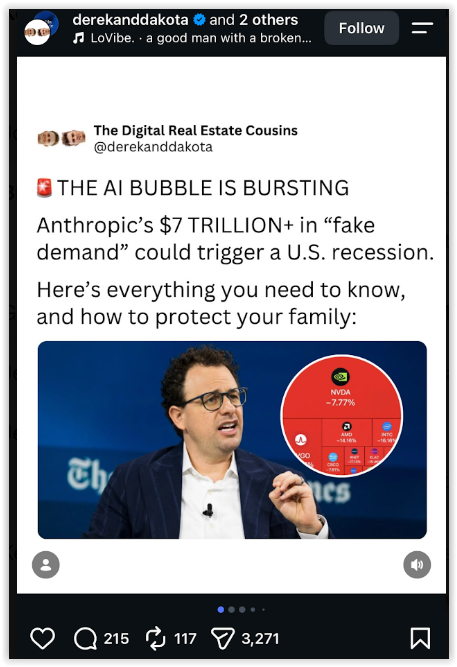
Questions: Ignore the solution at the end. Do you think the problem laid out on the first pages is accurate?
https://www.instagram.com/p/DemXBLsFBzh/?dlrf=Z3NiZW51Nzh2MmFu
Kevin:
Yes they are 100% spot on. The moment the Mag 7 stop being able to pay their bills like Tesla and Amazon are so close to being bankrupt it could definitely start the next recession and huge market drop like 35% or more because that’s how much money was pumped into the markets and economy
Client:
So why are we so heavily in chips still? Is there a point where you think we need to just get out of MU and NVDA etc even if we have plenty of time in Bull calls? Before earnings? After Christmas rally?
Kevin:
It’s a simple answer. Because chips aren’t the problem. AI and lack of liquidity of money is the problem. Companies without real earnings are the problem. MU and NVDA are a small part of AI and are making money hand over fist. Spacex, Tesla, Amazon, Open Ai and Anthropic are hardly making anything or losing money hand over fist. The demand for cloud, AI and the supply are nowhere close to crossing over and meeting the equilibrium point. With that said we are going to be very cash heavy here in December, more so in March and June next year. This is why we work our numbers to find the opportunities is areas that the media says sucks but we can prove to ourselves and others the opportunity through real numbers. Just my thoughts and feel free to push back. This can now be my talking point on Monday. Are you working your numbers????
Client:
I need to look at how much of the AI companies are actually buying and driving the chip boom. Seems like it’s a big part and that’s the number I need to work.
Kevin:
From what I’ve done, chips are relatively small compared to processors, GPU, CPU and server capacity. Energy and cooling are also a big part of cloud and AI computing. Unfortunately sentiment, as unrealistic or stupid sometimes can’t be fought against. We should have taken the 800/900 and 900/1000 MU spreads off at $1200 for MU
Client:
Yeah. I guess I’m thinking chips and processors, GPU and CPUs all together in the same boat. They are all needed for servers running AI models. But it’s not crazy to think if AI companies like Anthropic are buying up data center capacity and data centers are buying up processors and chips to fill that demand, then if that money flow stops, it directly affects NVDA, MU etc demand, right?
Kevin:
Yes, it would I believe but then it shifts to the personal computers maybe?
https://www.cnbc.com/2026/10/15/stock-market-today-live-updates.html
Those declines, coupled with drops in other stocks linked to AI, dragged the S&P 500 to a losing week. The benchmark index fell about 2% this week, while the Nasdaq shed more than 4% for its worst week since June. The Dow, on the other hand, advanced 0.7% on the week.
Investors have also grown concerned that tech companies are borrowing too much for the AI buildout. Shares of neoclouds like CoreWeave, which has seen its total debt rise to more than $51 billion, were down nearly 12%, bringing the stock’s week-to-date losses to 25%.
“The question is: Is this a systemic issue?” said Michael Rosen, Angeles’ chief investment officer. “Obviously, increased debt issuance is something to observe and continue to watch and be concerned about if it continues to get to levels of excessiveness. But we’re not remotely close to that right now.”
https://www.cnbc.com/2026/10/19/sp-500-bull-market-four-year-streak.html
Why this bull market is unlike any we’ve seen before
Published Mon, Oct 19 20269:28 AM EDT
The stock market has already reached a positive milestone despite growing consternation around the artificial intelligence trade.
The S&P 500 is up 12% year to date, even after last week’s 2% slide. The latest decline was driven by losses in artificial intelligence-linked names, as investors feared demand for AI may not be enough to justify the amount of capital companies are borrowing to build their networks.
CoreWeave was the poster child of last week’s declines, plunging more than 25%. Semiconductor stocks Micron Technology and Advanced Micro Devices dropped 15% and 13%, respectively.
But there was one bright light last week: The current bull market turned four years old. And while other bull runs have lasted much longer, this one has done something never seen before.
“This is the only bull market since WWII that posted double-digit advances in each of the first four years,” said Sam Stovall, chief investment strategist at CFRA. “History offers encouragement that this bull has further to run, as the average gain in the fifth year of bull markets since WWII was nearly 21%. Only one of the bulls that lasted four years did not survive until its fifth anniversary.”
Here’s how the S&P 500 did in each of the first four years of this bull market:
To be sure, Stovall noted that this is also the most expensive bull market going back to World War II, with the S&P 500 trading at a forward price-to-earnings ratio of nearly 23. However, that valuation may be justified by strong earnings growth. S&P 500 third-quarter earnings are tracking for 29% year-over-year expansion, FactSet data shows.
“We think this bull market, which recently celebrated its fourth birthday, has further to run,” he said.
Earnings –
AAPL 11/02 AMC
BA 10/27 BMO
BABA 11/24 est
BIDU 11/18 est
COST 12/10 AMC
CVS 11/04 BMO
DIS 11/12 BMO
F 10/28 AMC
KEY 10/20 BMO
LULU 12/10 est
META 10/21 AMC
MSFT 10/28 AMC
MRVL 12/01 est
MU 12/23 est
NVDA 12/17 AMC
O 11/02 AMC
PLTR 11/02 AMC
QCOM 11/04 AMC
ROKU 11/05 est
SPCX 11/03 est
UAA 11/05 est
V 10/27 AMC
WMT 11/19 BMO
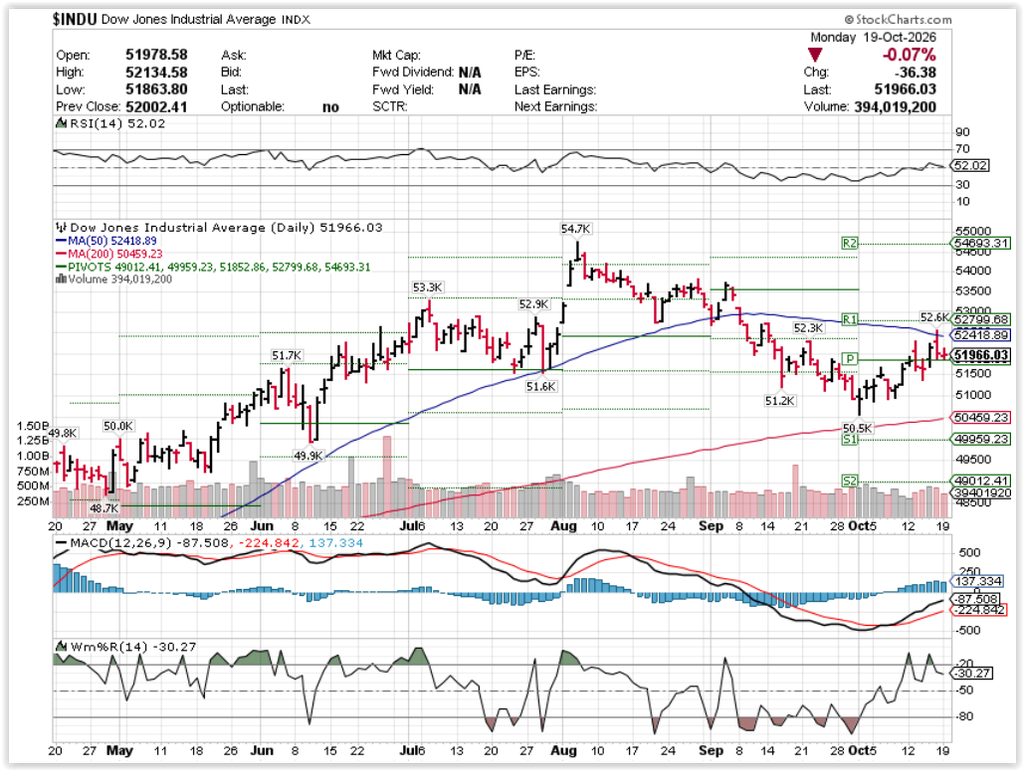
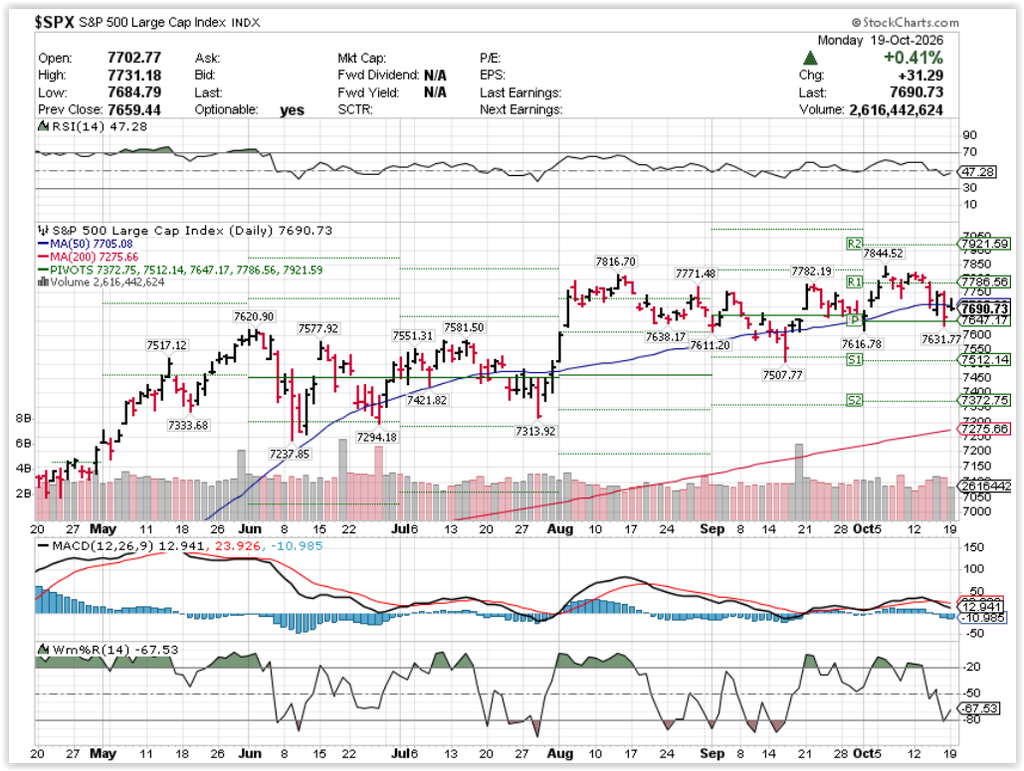
Where will our markets end this week?
Higher
DJIA – Bullish
SPX – Bearish
COMP – Bearish
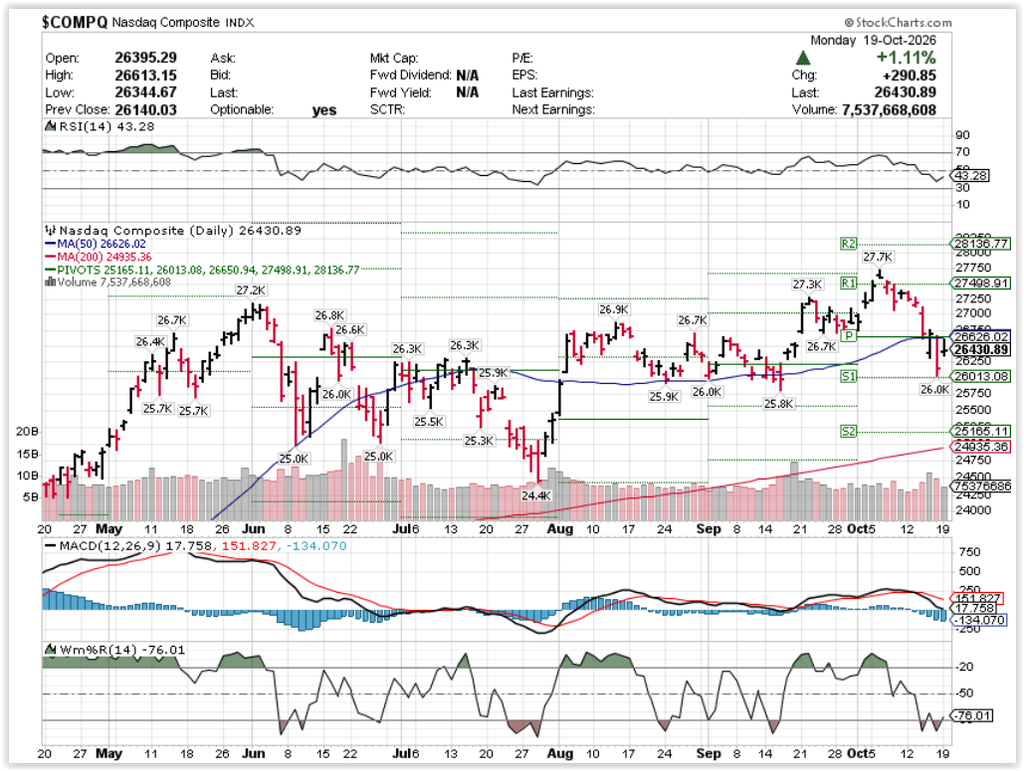
Where Will the SPX end October 2026?
10-19-2026 +1.00%
10-12-2026 Whatever Bryan Said
10-05-2026 +1.00%
Earnings:
Mon: ZION, CLF,
Tues: GE, MMM, GM, HAL, NOC, PM, VZ, COF, ALK, CB, UAL, KEY, NFLX
Wed: T, CME, CSX, IBM, ABT, KMI, LVS, LUV, TXN, META, TSLA,
Thur: AAL, BX, CMCSA, SPOT, HON, NOK, PG, PHM, UNP, VLO, NEM, SAM, WDC, LMT,
Fri: AXP, ALV, SLB
Econ Reports:
Mon: NAHB Housing Market Index,
Tue: Building Permits, Housing Starts, Pending Home Sales,
Wed: MBA,
Thur: Initial Claims, Continuing Claims,
Fri: Michigan Sentiment,
How am I looking to trade?
We are prepared for earnings, = Protective puts and collars
www.myhurleyinvestment.com = Blogsite
info@hurleyinvestments.com = Email
Questions???
https://www.cnbc.com/2026/10/08/open-ai-revenue-nvidia-oracle-coreweave.html
Nvidia, Oracle, CoreWeave and other AI stocks sink on OpenAI revenue report
Published Thu, Oct 8 20262:14 PM EDT
Updated Thu, Oct 8 20265:19 PM EDT
Ashley Capoot@/in/ashley-capoot/
Key Points
- AI stocks, including Nvidia, Oracle and CoreWeave, sank after the market learned more details about OpenAI’s revenue.
- OpenAI told investors that it hit roughly $50 billion in annualized revenue at the end of September, CNBC confirmed, lower than the the $68 billion figure widely reported late last month.
- A person familiar with the matter said the $68 billion figure included gross revenue from OpenAI’s partners, which helps investors make a more direct comparison with Anthropic.
Shares of Nvidia, Oracle, CoreWeave and other artificial intelligence names sank lower on Thursday after the market learned more details about OpenAI’s revenue.
OpenAI told investors that it hit roughly $50 billion in annualized revenue at the end of September, CNBC confirmed, lower than the the $68 billion figure that was widely reported late last month. A person familiar with the matter said the $68 billion figure included gross revenue from OpenAI’s partners, which helps investors make a more direct comparison with its chief rival, Anthropic.
The Financial Times was first to report the $50 billion figure.
OpenAI shared an update about its finances in an investor presentation, said the person, who asked not to be named in order to discuss the numbers. In addition to the $50 billion in annualized revenue, OpenAI touted 77% total run rate growth during its third quarter, as well as 107% run rate growth for its enterprise business during the same period, the person said.
Nvidia shares fell 3%, Oracle shares fell nearly 6% and CoreWeave shares slipped nearly 8% on Thursday. Additionally, Advanced Micro Devices fell 4%, Broadcom fell 4%, Intel fell 5% and Super Micro Computer fell nearly 5%.
OpenAI is under pressure to justify its $852 billion valuation to investors as it gears up for what is widely expected to be a blockbuster IPO. OpenAI confidentially filed its prospectus with regulators in June, and executives have signaled that the company is eyeing a 2027 debut.
Anthropic is also readying for a major IPO. The company has not officially disclosed when it plans to debut, but it’s been engaging in meetings with prospective investors and is reportedly seeking a $2 trillion valuation. In August, Anthropic told investors that its annualized revenue run rate hit $65 billion at the end of July.
In a report on Tuesday, independent financial research provider New Constructs called Anthropic’s upcoming offering the “most ridiculous IPO of 2026,” and valued the company at a mere $150 billion. Anthropic’s revenue in 2025 was $4.6 billion as the company racked up a net loss of $42 billion, according to Reuters, which cited a leaked copy of the company’s prospectus.
Both Anthropic and OpenAI have been at the center of a fierce debate over AI safety, after a growing chorus of researchers warned that the companies’ models could potentially cause catastrophic harm. OpenAI has disclosed several incidents where its models behaved in unintended ways, and the company recently pulled its plans to launch GPT-6.1 Astra, saying the model did not meet its safety standards.
OpenAI CEO Sam Altman said in September that “right now would be an ill-advised moment to go public,” in part because of the ongoing concerns around safety.
As OpenAI bides its time, the company is engaging in early stage discussions with investors about a potential new funding round. The company could raise around $30 billion, CNBC previously reported, but that figure could change. The round is being driven by investor demand and no term sheet has been finalized yet.
OpenAI closed a historic $122 billion funding round in March, and CFO Sarah Friar told CNBC last week that it is still “very well capitalized.”
https://www.cnbc.com/2026/10/07/flop-ai-boom-arthur-hayes-bitcoin-bitmex-coinferencex-.html
Trillions are being ‘wasted’ on the AI boom, Arthur Hayes says. He’s betting on what comes next
Published Tue, Oct 6 20268:49 PM EDT
Jenny Lee@in/jenny-lee-102020a8
Key Points
- Humanity is “wasting multi-trillion dollars” on AI data center build-up, according to former BitMEX CEO Arthur Hayes.
- A key test could come in late 2027 or 2028, when new data center capacity is delivered and customers face their compute commitments.
- Bitcoin and other cryptocurrencies could benefit from the excess liquidity that follows a bailout, Hayes said.
Former BitMEX CEO Arthur Hayes is betting that the artificial intelligence boom will eventually produce a familiar outcome: too much investment, a crash and, ultimately, a bailout that sends crypto higher.
Hayes, co-founder and chief investment officer of crypto investment firm Maelstrom, said in response to questions from CNBC at the Gamma Prime Investing Conference in Singapore that humanity is “wasting multi-trillion dollars” on building AI data centers.
The massive data center buildout would ultimately make computing power “extremely cheap and extremely plentiful,” Hayes said.
The bet runs against the massive investment pouring into AI infrastructure, as technology companies race to secure the computing power needed to develop and run increasingly advanced AI models. Hayes sees that buildout eventually becoming overcapacity, setting the stage for a downturn that he expects will ultimately benefit crypto.
“If you study financial history and you study every single major technological rollout, it always is overbuilt. There always is a crash, and there always is a bailout,” Hayes said.
Investors who position for those bailouts stand to benefit, Hayes said, pointing to the aftermath of the 2008 financial crisis and other episodes over the past two decades.
“Thankfully, we have bitcoin and other crypto to soak up that excess liquidity, and so we know the asset that’s going to perform the best when the bailout comes,” Hayes said, adding that “you just have to be patient.”
SpaceX, OpenAI and Anthropic are among the end users driving demand for computing power, and none of them makes money, Hayes said. Once the data centers currently under construction are completed, infrastructure providers will seek payment for the compute those companies have committed to, he said.
That could come in late 2027 or 2028, when much of the new data center capacity is delivered, according to Hayes.
The bull case is that AI becomes “so useful” over the next 12 months that demand grows enough for AI companies to become profitable, Hayes said.
Some companies supplying the AI boom are already making money, Hayes said, pointing to memory chipmakers and Nvidia. The question for investors is whether they are paying the right multiple for those companies’ forward earnings, he added.
Hayes also said he does not like betting on falling prices or shorting AI companies, calling it “not really a great investment opportunity,” but added that major technological rollouts have historically been overbuilt.
The abundance of computing power created by the AI buildout is also behind Hayes’ latest crypto venture, Flop, an AI-agent payments project expected to launch in the first quarter of 2027.
Cheaper and more plentiful computing power would allow AI agents to proliferate, Hayes said.
His new project, Flop, aims to create a spot market for computing power, where participants are rewarded with Flop tokens for providing GPUs and performing AI inference.
There is currently no payments network for AI agents, Hayes said. Flop aims to create a spot market for compute.
“If agents can convert a currency directly into compute, which is what they eat and consume, then they will use this currency,” Hayes said. “That’s our bet.”
Always on, always listening: New AI devices are pushing legal limits and could put users in jeopardy
Published Sun, Oct 18 20268:00 AM EDT
MacKenzie Sigalos@KENZIESIGALOS
Key Points
- Apple, Amazon, Meta and a host of startups have released AI-powered, always-listening devices this year.
- Unlike earlier smart speakers that were activated with a “wake word,” these devices are pushing the limits of privacy law in new ways.
- In some states, experts say the legal exposure may fall on the person wearing the device during a private conversation without the required consent from bystanders.
Chris Thomas is all-in on AI gadgets.
Thomas, 43, wears a pair of Meta’s camera-equipped glasses, a Fieldy note-taking pendant around his neck and a wristband from Amazon’s Bee, all of which record his daily life. A Pittsburgh-based business owner and a livestreamer, Thomas relies on the devices to help him stay organized, pay bills on time and set reminders.
“I’m forgetful AF,” Thomas said in an interview. “My life is so crazy that not having to remember to remember is fantastic.”
Not everyone is on board with his lifestyle. Earlier this week, a bystander at a local bar noticed his Meta Glasses.
“He was like, ‘I don’t feel comfortable,’” Thomas said. “I don’t turn it off, I take it off completely because people don’t really believe it’s off.”
It’s the type of interaction users are increasingly navigating as more tech companies introduce AI-powered, always-listening devices and features, which have been marketed as useful tools to transcribe meetings, keep track of conversations, set reminders and offer personalized recommendations.
The latest example of these gadgets arrived Thursday with Amazon’s Bee Frontier wearable and Bee Eclipse, a card-shaped device that attaches to a smartphone. Both devices are designed to record, transcribe and analyze a user’s day.
Apple’s latest Apple Watch Series 12, unveiled in September, will have Siri Recap, which “ambiently” takes notes throughout the day and generates summaries of conversations. Another feature called Live Rewind can recap 15 seconds of a conversation via a text transcription.
Meta’s popular smart glasses can take photos, capture video and record voice notes or reminders. Startups including Plaud and Pocket also developed card-sized note-taking devices, while Friend offers an AI necklace.
The devices have fueled concerns that they could erode privacy, by enabling covert recording without obtaining bystanders’ consent and collecting sensitive data that’s potentially accessible to others.
Amazon, Google and other makers of voice-activated smart speakers faced similar privacy concerns when their devices first hit the market, in some cases leading to lawsuits and regulatory fines.
But this new generation of AI devices is also testing the limits of privacy law.
Unlike earlier smart speakers that were activated via a so-called “wake word” and sometimes stored recordings or sent audio to the cloud, some of these products can continuously listen, interpret speech, and extract its meaning without retaining the underlying audio. This capability has raised a largely untested question about whether that processing itself can amount to an unlawful interception.
“With new technology like this, my statement is always to embrace with caution,” Karen Panetta, dean of graduate education at Tufts’ School of Engineering and a fellow at the Institute of Electrical and Electronics Engineers, said.
She added, “If I’m giving permission for myself to be recorded, or for everything I look at to be recorded, that doesn’t mean everybody else around you has given that consent.”
The gray area
Apple and Amazon appear to have sidestepped some of the privacy concerns that dogged earlier voice assistants.
Apple says the feature does not store audio, send recordings to its servers, or involve human review. Amazon has said it doesn’t store audio from Bee devices, and conversations are processed in a secure environment “where no one, including Amazon, can access your data.”
But that may not resolve the legal question.
Many state wiretap and eavesdropping laws are written around whether a private communication was intercepted or its contents were acquired — not simply whether a conventional audio recording was created.
Colin Zick, a privacy and data security attorney at Foley Hoag, said Apple appears to have learned from the first wave of litigation over voice assistants. But the new technology raises questions those earlier cases never had to answer: Can a system that is continuously listening, interpreting speech and turning it into a summary still amount to an interception if it never saves the underlying audio?
Carlos Barria | Reuters
Some state laws define interception broadly. Massachusetts, for example, defines an intercepting device to include equipment capable of “transmitting, receiving, amplifying, or recording” a communication, while the “contents” of a communication can include its substance and meaning.
In Zick’s view, a device that continuously receives speech and produces a written summary could potentially fall within that language even without retaining an audio file.
And in some states, the bigger legal risk may fall not on Apple, Amazon or other AI gadget makers but on the person wearing the device.
“A non-wearer did not buy the watch, agree to Apple’s terms, or choose to have their conversation summarized in the app,” Zick said.
Daniel Pi, an associate professor at the University of New Hampshire Franklin Pierce School of Law, said New Hampshire’s statute is broad enough that he believes the Watch’s new audio-intelligence features would qualify as an interception. The law covers not only recordings, but the “aural or other acquisition” of the contents of a communication.
That could create an unusual situation in which an ordinary consumer turns on a feature built into a mainstream device and, at least technically, runs afoul of state law by using it during a private conversation without everyone’s consent.
Pi said a user in New Hampshire could potentially face civil or criminal liability for doing so, though he stressed that the practical risk of prosecution is far lower. It could be difficult to know whether someone had the feature enabled in the first place, and he said he would be surprised to see prosecutors pursue cases involving a bare statutory violation where no one was harmed.
The legal questions are also different from those raised by earlier smart speakers and voice assistants. Those cases often centered on devices mistakenly activating or capturing speech that was not intended as a command. Here, the feature is designed to acquire and interpret the substance of a conversation — and the user has deliberately opted in.
That changes the analysis, Pi said, and could also shift responsibility toward the wearer rather than the technology company itself.
The bystanders
The broader privacy concern extends beyond who is legally responsible.
Michael Stokes, a former CIA officer and senior vice president of emerging technologies at Veilant, said the bigger shift is that people can be swept into AI-powered surveillance without owning or knowingly interacting with the device doing the collecting.
“I think the bystander problem is really the concern I have — that you can be surveilled without owning the technology,” Stokes said.
He pointed to the growing number of cameras, microphones, and sensors embedded in consumer devices, from smart glasses to watches and AI recorders. The difference now, he said, is that AI can rapidly interpret what those devices collect and draw meaning from far larger volumes of information than earlier generations of consumer technology.
For Stokes, that makes the Apple Watch part of a much larger change in the privacy landscape. During his time at the CIA, he helped develop the concept of ubiquitous technical surveillance, describing a world in which everyday devices continuously generate information that can reveal identities, locations, and associations.
The concern is not simply that more data can be collected, he said, but that the cost of making sense of it has fallen dramatically.
In the past, Stokes said, intelligence collection could require thousands of hours of work to gather, sort and analyze information about a person. AI increasingly automates that process, making it cheaper and easier to extract useful information from data that may have been gathered incidentally.
That creates a new kind of exposure for people who never opted into the technology in the first place — whether it is a private conversation picked up by a nearby wearable or information collected by a device they do not own.
“We no longer have these pockets of small privacy that we thought we did in the past,” Stokes said.
Aida Baradari, founder of the startup Deveillance, is trying to give some control back to people worried about being recorded without their consent.
The company created a hockey puck-shaped gadget, called the Spectre I, that uses AI to scan for nearby devices and sends out “adversarial signals” that scramble a person’s speech before microphones can process it.
Baradari said she watched as more AI wearables hit the market and felt users should have a greater say in how they interact with them.
“We need to be able to use technology while not giving up our core values or rights,” she said.
Analysis: Why a $2 trillion deficit and 5% Treasury yields are becoming America’s biggest economic challenge
Published Thu, Oct 15 20265:30 AM EDT
Updated Fri, Oct 16 20266:33 PM EDT
Matt Peterson@in/mattpetersonwrites
Key Points
- Treasury yields remain above 5%, pushing mortgage rates toward 7.5%.
- The deficit was $1.99 trillion for fiscal 2026, up 12% from last year.
- AI investment is increasing competition for capital.
- Divided government will likely take meaningful deficit reduction off the table.
Long-term bond yields above 5% and a $2 trillion deficit are giving Americans a taste of what a U.S. debt crisis would be like. A true emergency would hurt much more, and isn’t baked in. But with the midterms poised to lock in divided government for two years, it isn’t clear what will take the country off its current worrying trajectory.
Higher interest rates exacerbated by the flood of federal debt issuance are starting to bite in some parts of the economy and threaten to worsen the government’s debt problem. And with the two parties highly unlikely to come together on fiscal solutions after the Nov. 3 midterms, any fixes are years off in the future.
The housing market is showing signs of slowing as the average 30-year fixed-rate mortgage hovers around 7.5%. Pending home sales fell 4% in September, Redfin said Monday, the biggest monthly drop in three years.
Mortgage rates track the 10-year Treasury yield. The 10-year has climbed 114 basis points, or hundredths of a percentage point, since the end of February through midday Friday, when the 10-year traded at 5.1%.
Several factors are pushing up the 10-year, including the war with Iran, which kicked off on Feb. 28 and precipitated the rise in long-term yields. Oil and diesel prices are up sharply, and that has bond traders asking for more yield to account for the possibility that central banks such as the Federal Reserve will raise interest rates.
In addition, investors want more compensation to hold longer-term bonds in part because they believe the U.S. government will continue to flood the market with them. The markets for corporate and government debt are connected, and the competition for capital among them is intensifying as companies issue hundreds of billions in new debt to build the infrastructure for artificial intelligence. Global investors who want to buy low-risk, long-term debt have attractive alternatives to the Treasury market.
If the U.S. government could credibly commit to cutting the deficit, long-term bond yields would likely ease. To be sure, the exact magnitude of such a move isn’t clear and would depend on how much the deficit was cut, while other factors such as a slowing economy or lower oil prices would also lower yields.
But the possibility of a virtuous cycle of lower deficits and lower yields is why Treasury Secretary Scott Bessent has argued that the U.S. ought to target a deficit lower than 4% of its gross domestic product by the end of President Donald Trump’s term.
There is almost no way the U.S. will hit that target. The deficit was $1.992 trillion for the 2026 fiscal year, up 12% from last year, data released Friday by the U.S. Treasury showed. That deficit amounts to approximately 6.2% of gross domestic product, based on an estimate of third-quarter GDP.
Higher rates make debt reduction tougher. If interest rates stay a half-point above the CBO’s expectations, the cumulative deficit over 10 years will come in $1.9 trillion higher, the agency estimates. If rates overshoot by 1.5 points, that adds $6 trillion in deficits.
The CBO expects the 10-year Treasury to average 4.3% over that period, compared with 5.1% today. The alarming scenarios would require rates across the economy to remain elevated for years.
“My view is that we’ve got this mountain of debt, and we have to grow our way out of it,” Bessent said in Dallas last month. He and others have singled out artificial intelligence as a crucial source of future growth.
AI could help but can’t fix the problem entirely. It would take a decade of 7.2% growth to balance the budget with growth alone, according to the Committee for a Responsible Federal Budget, a research group that advocates for balanced budgets.
GDP growth was recently revised up for the second quarter from 1.5% to 2.2% at an annualized rate. The acceleration that quickly would get us to 7.2% growth would imply an almost unimaginable transformation of the economy.
Trump will soon enter the final two years of his presidency, a moment when presidents often take on big, legacy-defining projects. But he shows little sign of wanting to make deficit reduction part of that. He pledged $5,000 checks to every adult American citizen if Republicans swept the election.
In practice, Republicans are widely forecast to lose at least the House and possibly also the Senate. Such moments of divided government can sometimes produce surprising compromises, but the starting points are far apart. Rep. Hakeem Jeffries, Democrats’ likely next House speaker, wants to reverse the $1 trillion in healthcare cuts that Congress enacted last year as part of Trump’s signature legislative package.
And that’s leaving aside the deep animosity between the parties.
The overall U.S. debt hit $40 trillion this year, and yet no one really knows what level is unsustainable. A full-on debt crisis likely remains much further out in the future. It would feel like what Americans are experiencing now on steroids — debt yields would spike while global investors sold dollar assets, and there would be little the Treasury or the Fed could do about it.
For now, though higher yields are also attracting investors to U.S. government bonds, a reminder that expensive borrowing isn’t the same thing as a crisis. But the bottom line is that economics alone can’t solve the problem. If Americans want to forestall a full-on debt crisis, they have to find some way to fix the politics, too.
Why hedge funds could be making a bond market shock more likely
Published Sun, Oct 18 20261:00 AM EDT
Updated Sun, Oct 18 20262:13 AM EDT
Key Points
- Bank of England deputy governor Sarah Breeden said hedge funds’ growing presence in bond markets heightens the risk of financial shocks spreading across markets.
- The IMF this week warned that hedge funds’ use of leverage and crowded trading strategies could amplify market stress.
- The warnings follow a sharp sell-off in global government bonds in recent weeks.
Hedge funds’ increased presence in global bond markets makes the likelihood of a broader market shock “greater than what it was,” Bank of England deputy governor Sarah Breeden told CNBC Thursday.
Breeden — the central bank’s deputy governor for financial stability, and a member of its rates-setting Monetary Policy Committee — said the changing mix of bond market investors, and their increased use of leverage, raises the risk of localized market turbulence turning into broader financial stress.
BoE’s Breeden: Surprised how well UK economy has absorbed the energy price shock
“One of the things that has become increasingly apparent over the last several years is that the investors in our core government bond markets globally have changed,” Breeden told CNBC’s Sri Jegarajah in an interview Thursday.
“It’s not the real money investors, the insurance companies and pension funds, in the way it used to be. It’s increasingly hedge funds, and those hedge funds are price-sensitive, leveraged, international. That, of course, means that the likelihood of a shock in one market transmitting to another is greater than what it was.”
Breeden was speaking on the sidelines of the International Monetary Fund-World Bank annual meetings in Bangkok, Thailand.
With gross assets now standing at about $13 trillion, hedge funds have become an increasingly important part of the global investor landscape, the IMF said on Tuesday.
In its latest Global Financial Stability Report, published Tuesday, the IMF acknowledged hedge funds’ role in supporting market liquidity and efficiency.
But it also warned that the hedge fund industry’s use of leverage to boost returns, and its tendency to pursue crowded trades, could turbo-charge market stress in times of turmoil.
That, in turn, could spill over into broader financial markets, and areas such as banks’ prime brokerage businesses, according to the IMF.
“The source of the shocks are bond markets, and the likelihood of a spillover is higher than it was,” Breeden said.
Hedge funds’ presence in the global government bond market — particularly their use of so-called “basis trades” — has come under sharper scrutiny this year, following the sharp sell-off in sovereign debt.
Hedge funds held a record 7% of the $30 trillion Treasury market at the end of 2025, according to U.S. Office of Financial Research data published on Aug. 19.
Basis trades are an arbitrage bet in which hedge funds are positioned long in cash Treasurys while shorting their corresponding futures contracts, with the aim of profiting from the price gap. While the price differential between the two is relatively small, hedge funds often employ large amounts of leverage to further inflate returns.
Yields on France’s government bonds, known as OATs, have moved sharply higher in recent weeks amid rising concerns about the country’s fiscal outlook — fueling fears of a fresh sovereign debt crisis impacting the euro zone.
Need to Know: Nearly 40% of the S&P 500 is in a bear market. Here are 10 of those stocks that analysts say can gain up to 81%.
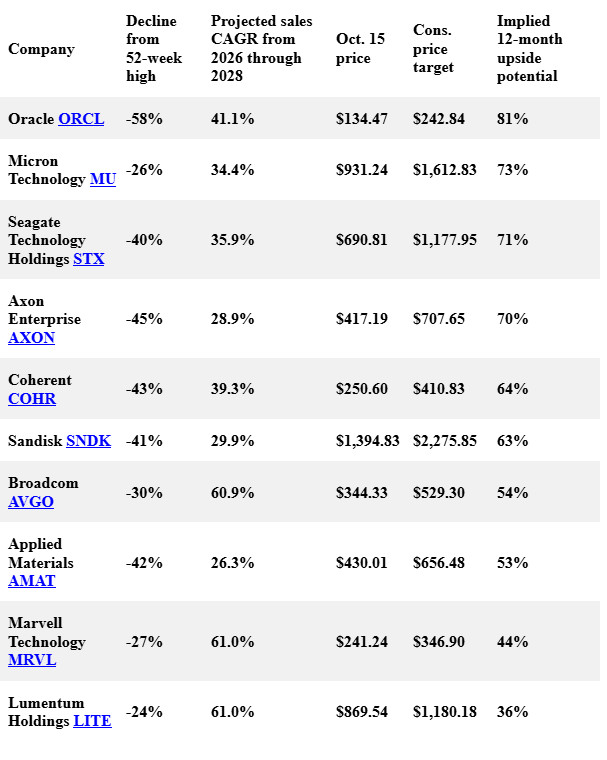
Nearly 40% of the S&P 500 is in a bear market. Here are 10 of those stocks that analysts say can gain up to 81%. Those companies are expected to at least triple the pace of S&P 500 revenue growth from 2026 through 2028 By Philip van Doorn |
Among the S&P 500’s component stocks, 191 are in bear markets, including Oracle. GETTY IMAGES A quick note: Starting Monday, Oct. 19, MarketWatch Editor in Chief Mark DeCambre will be bringing a fresh approach to Need to Know. Here’s Mark: “I’ll be handpicking the stories worth your time each morning, with more of MarketWatch’s best reporting and perspective on what it all means for your money. See you Monday!” This year is shaping up to be another excellent one for stocks, if you look at the performance of the S&P 500. But a closer look highlights a large number of stocks that are in bear markets. The S&P 500 SPX has risen 13.1% so far in 2026, and it closed on Thursday 1% below the intraday high it set on Oct. 6. However, among the large-cap U.S. benchmark index’s component stocks, 191 are in bear markets — down at least 20% from their 52-week highs. We screened those 191 stocks to identify 15 companies that are expected to increase their revenue from calendar 2026 through 2028 at compound annual growth rates (CAGR) of at least three times the 8.6% weighted sales growth CAGR for the S&P 500. The sales projections are adjusted to calendar years for companies whose fiscal reporting periods don’t match the calendar. Then we narrowed the list further to stocks rated buy, or the equivalent, by at least 80% of the analysts polled by FactSet. |
Here are the 10 companies that passed the screen, sorted by how much analysts expect the stocks to rise over the next year, based on consensus price targets: |