

What the Hell Kevin???!!!! EVERYTHING IS DOWN !!!
For the S&P 500 and the Nasdaq it was the worst month since March 2025 – CNBC
This is part of our process = I love the opportunity to make money on the way down with puts and short calls, to then dollar cost average whith more shares of stock PAID FOR by the profits in the option.
Don’t panic and run out of the market when everything goes on sale?
| One market headline caught my attention this week:“World’s largest wealth fund posts $30 billion loss after bond market turbulence.”What caught my attention wasn’t just the size of the loss. Fixed income was a major driver, returning -3.5% as rising rates pressured bond values. That’s where I think annuities can be valuable as a portfolio tool, not just a product. For the right client, allocating a portion of the portfolio to an annuity can provide:Protection from market driven lossesIndex linked growth potentialA portion of retirement assets that isn’t directly exposed to daily market declinesOptional guaranteed lifetime income when appropriate |
DISCLAIMER: This e-mail and any attachments are intended only for the individual or company to whom it is addressed and may contain information which is privileged, confidential and prohibited from disclosure or unauthorized use under applicable law. If you are not the intended recipient of the e-mail, you are hereby notified that any use, dissemination, or copying of this e-mail or the information contained in this e-mail is strictly prohibited by the sender. If you have received this transmission in error, please return the material received to the sender and delete all copies from your system. Please note that any written or oral communication, provided directly or indirectly to you by a Financial Independence Group, LLC employee, contractor, director, manager, member, or otherwise (collectively herein “FIG”), is in no way to be considered or construed as a product recommendation. Product recommendations can only be made by a licensed agent who thoroughly reviews and understands the client’s current financial situation, performs a detailed client needs analysis, and a best interest review, all of which the agent provides. Accordingly, FIG does not in any way accept fiduciary responsibility for any communication or transaction involving FIG. FIG will provide its agents on an “as is” basis with sales collateral, illustrations, educational, and additional supporting materials that the agents shall use at their sole risk and discretion. These materials are for informational purposes only to support the agent in his/her best interest review process and should not be construed as legal advice or in any other way. |
WHY AREN’T THE BREAKERS TRIPPING YO ???
1. The Drop Started in After-Hours / Pre-Market Trading
Intel’s sharp decline (dropping ~23% to 28% following its quarterly forecast) began outside regular market hours.
• LULD circuit breakers are disabled outside regular trading hours (9:30 AM – 4:00 PM ET). Volatility halts do not trigger during overnight, pre-market, or after-hours trading sessions, no matter how severe the price movement is.
• When regular trading opened, the stock simply gap-opened lower to reflect the pre-market prices. Because the market had already priced in the move before 9:30 AM ET, there was no sudden intra-day shock required to cross LULD thresholds.
2. Widened Volatility Bands at the Open
During regular trading hours, single-stock circuit breakers use dynamic price bands based on a trailing 5-minute average reference price. However, LULD rules intentionally relax these thresholds during volatile market periods:
• Opening / Closing Buffer: Between 9:30 AM – 9:55 AM ET (and 3:35 PM – 4:00 PM ET), the allowable price bands double (from 5% to 10% for Tier 1 stocks like INTC). This prevents opening imbalances from causing immediate, unnecessary halts.
3. Orderly Trading Without a 15-Second Violation
For an LULD halt to trigger during normal hours:
• The stock price must trade outside its permissible band for more than 15 consecutive seconds.
• If selling pressure is heavy but continuous and orderly, market makers continuously adjust bids lower, recalculating the 5-minute reference band along with the price. As long as trades stay within that moving band (or snap back within 15 seconds), trading will not pause—even if the stock experiences a historically large one-day drop.
Investors are giving up on CoreWeave. I see a potential triple
Published Mon, Nov 2 20261:07 PM EST
Here’s why I’m bullish on this neocloud operator
I’m a contrarian technology investor. I look for companies that I believe Wall Street has misunderstood. Right now CoreWeave is a compelling example.
The Livingston, New Jersey-based company is a leading provider of cloud infrastructure for artificial intelligence. Think of it as the Amazon Web Services of the GPU world. Rather than providing general-purpose cloud computing, CoreWeave specializes in the powerful computing infrastructure needed to develop and run AI models.
Key points
- Has built a leading position in AI infrastructure and is rapidly expanding its footprint.
- Long-term contracts with major customers help mitigate risks from its heavy debt load.
- Revenue and profitability could surge over the next several years as the company brings more data centers online.
CoreWeave has taken on an enormous amount of debt to build out its AI infrastructure, and investors are getting nervous. Those concerns coupled with a broader technology sell-off sent shares sharply lower last week.
But I’m sticking with my call.
CoreWeave has secured long-term contracts with some of the biggest names in technology, and demand for AI computing capacity shows no signs of slowing. It’s a risky strategy, no question. But I believe the company has the customers and growth potential to make its ambitious expansion pay off.
Why I’m buying
CoreWeave is building AI capacity faster than its rivals
CoreWeave has already established itself as a leader in the emerging neocloud industry, which provides specialized computing infrastructure for AI companies.
It has 51 data centers, with approximately 1.5 gigawatts of active power capacity and 4.2 gigawatts of contracted power. To put that in perspective, the company added 500 megawatts of capacity in its most recent quarter alone, more than the total deployed capacity of most of its competitors.
I also like who CoreWeave is doing business with. Its customers include Microsoft, Meta and OpenAI, some of the biggest names in AI. Many of its contracts are structured as take-or-pay agreements, meaning customers generally commit to paying for capacity whether or not they fully use it.
Debt concerns are exaggerated
Let’s address the elephant in the room: CoreWeave has borrowed heavily to finance its rapid expansion. The credit markets have started to price its debt in distressed territory and that’s transferred over to a big pullback in its equity.
One reason CoreWeave carries so much debt relative to its competitors is that it’s further along in building out its infrastructure. The company also uses specialized financing structures backed by contracted customer cash flows, which helps support its enormous capital spending requirements.
It has another powerful partner in its corner: Nvidia. The chip giant has a contractual commitment to purchase certain unused CoreWeave capacity and owns a substantial equity stake in the company.
Explosive growth could change the narrative
I expect CoreWeave’s annual revenue to grow from approximately $5.1 billion in 2025 to $43.6 billion in 2028. That’s more than an eightfold increase in three years.
I’m also forecasting an adjusted EBITDA margin of approximately 67% in 2028.
If CoreWeave can deliver on those projections, I think investors will start looking at its debt very differently. And we won’t have to wait until 2028 to see whether the company is making progress.
Why now?
With CoreWeave shares trading near their 52-week low, I see an attractive entry point ahead of the company’s Nov. 10 earnings report.
I’m expecting solid results, with the potential for an upside surprise in adjusted EBITDA margins. I’ll also be watching for signs of further margin improvement in management’s December-quarter outlook.
My official price target is $151, implying roughly 181% upside from the current price of $53.77. I believe the stock could double or even triple over the next two years.
Bottom line
CoreWeave’s substantial debt makes it vulnerable if growth disappoints or financing becomes more expensive. But my biggest concern is whether the company can bring all that new data center capacity on time and on budget.
I’m going out on a limb with this contrarian call. In a couple of years, I could look like the GOAT (Tom Brady style) or just a goat with a very bad stock pick. Time will tell. But I’m willing to go against the grain.
Paul Meeks is the Managing Director and Head of Technology Research of Freedom Capital Markets.
Disclosures: Meeks does not own shares personally or through the firm.
All opinions expressed by the [CNBC Pro contributors] are solely their opinions and do not reflect the opinions of CNBC, or its parent company or affiliates, and may have been previously disseminated by them on television, radio, internet or another medium. This content is provided as part of our editorial output for informational purposes only and does not constitute financial, investment, tax or legal advice or a recommendation to buy any security or other financial asset. The content is general in nature and does not reflect any individual’s unique personal circumstances. The above content might not be suitable for your particular circumstances. Before making any financial decisions, you should strongly consider seeking advice from your own financial or investment advisor.
Are we doubling up on Puts For GOOGL, NFLX and others…????
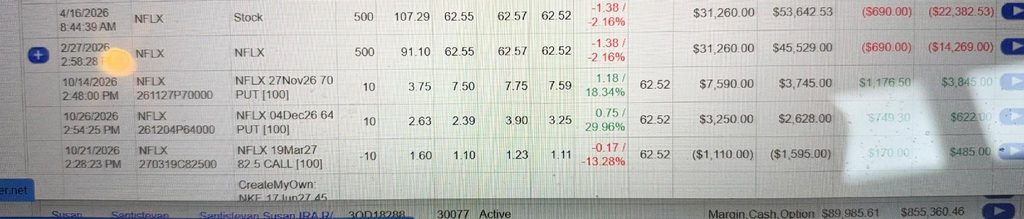
The two sets of 500 shares lost -$690 + -$690 = -$1,380
Protection
$70 Puts = $1,176.50 + $64 Puts = $749.30 + $82.50 Covered Calls $170.00 = $2,095.80
Net profitable = $715.80 / 1380 loss we made up 51.86% more than the loss
Earnings –
AAPL 11/02 AMC
BABA 11/24 est
BIDU 11/18 est
COST 12/10 AMC
CVS 11/04 BMO
DIS 11/12 BMO
MRVL 12/01 est
MU 12/23 est
NVDA 12/17 AMC
O 11/02 AMC
PLTR 11/02 AMC
QCOM 11/04 AMC
ROKU 11/05 est
SPCX 11/03 est
UAA 11/05 est
WMT 11/19 BMO
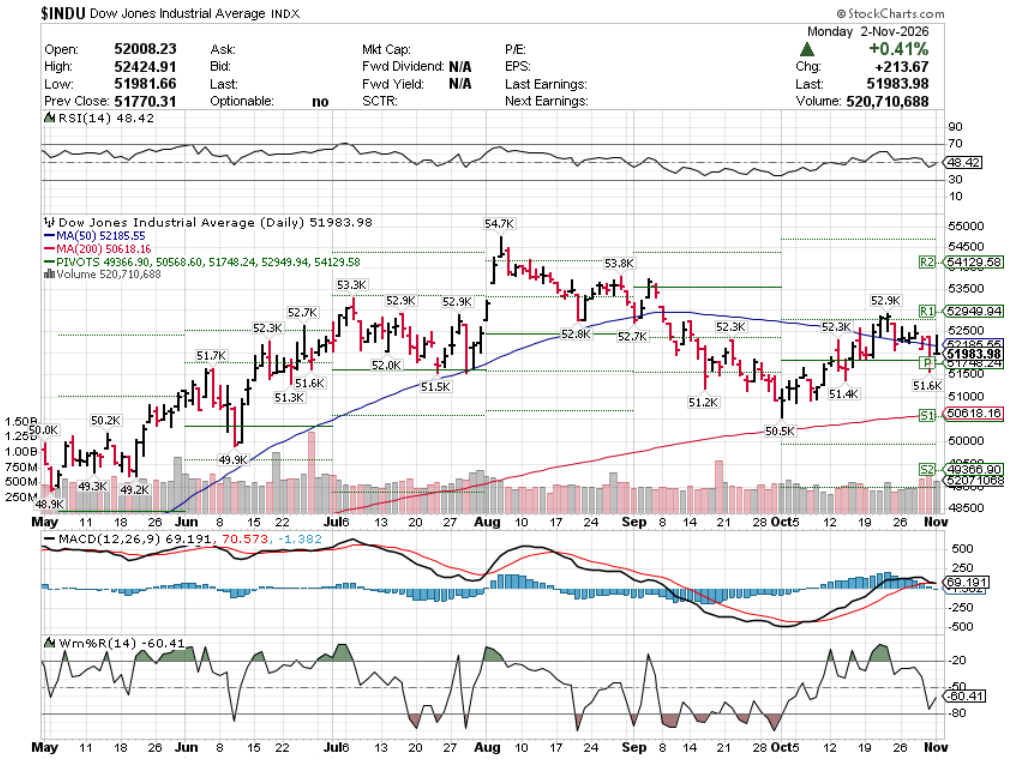
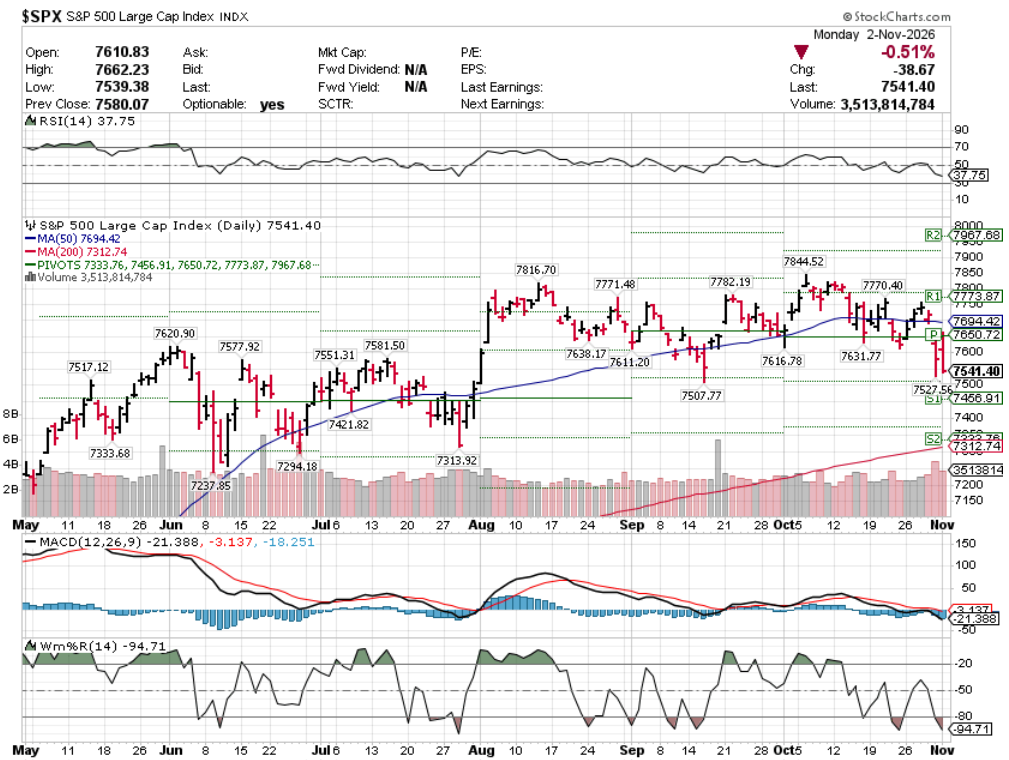
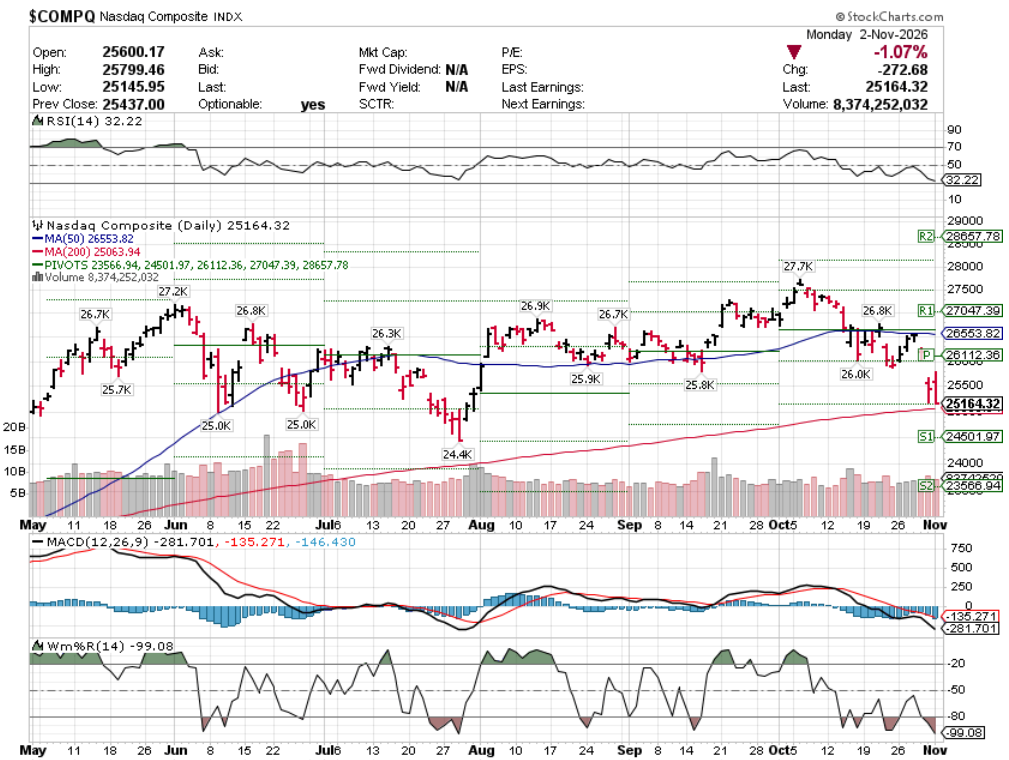
Where will our markets end this week?
?????
DJIA – Bullish
SPX – Bearish
COMP – Bearish
Where Will the SPX end November 2026?
11-02-2026 ???
Earnings:
Mon: EL, MAR, CLX, RIG, HLF, AAPL, PLTR, O, ROKU,
Tues: CNK, DD, RACE, PFE, SHOP, YUM, AMGN, XYZ, TREE, MOS, SWKS, ET, AMD,
Wed: CVS, GWW, KHC, MCD, OC, UBER, AMC, DASH, GT, EXPE, LZ, MUR, SNAP, WU, ZG, HUBS, QCOM,
Thur: CMI, DUK, HTZ, KMB, PZZA, PTON, RL, TPR, ABNB, DVN, DKNG, MAT, WYNN, YELP
Fri: FLR, HUM, UAA
Econ Reports:
Mon: Construction Spending, ISM Manufacturing,
Tue: Factory Orders, Business Inventories,
Wed: MBA, ADP Employment, Trade Balance, ISM Services,
Thur: Initial Claims, Continuing Claims, Productivity, Unit Labor Costs,
Fri: Average workweek, Non-Farm Payroll, Private Payrolls, Unemployment Rate, Hourly Earnings, Michigan Sentiment, Consumer Credit
How am I looking to trade?
We are prepared for earnings, = Protective puts and collars
www.myhurleyinvestment.com = Blogsite
info@hurleyinvestments.com = Email
Questions???
https://www.cnbc.com/2026/10/22/bill-ackman-talks-meta-and-markets-with-cnbc.html
Bill Ackman says 2027 will be an amazing year for stocks as wars, inflation ease
Published Thu, Oct 22 202610:55 AM EDT
Updated Thu, Oct 22 20261:53 PM EDT
Key Points
- “Once the overhang of the war is done — and it sounds like we’re also potentially heading in the right direction with Russia-Ukraine — energy prices could come way down, and obviously that would be very good for inflation and markets,” Ackman told CNBC’s “Squawk on the Street” on Thursday.
- Ackman, who called the Iran conflict an “extremely well-executed war,” believes that once there’s peace in the Middle East, it will be great for the region and “ultimately great for the United States.”
Bill Ackman says 2027 will be an amazing year for stocks as wars, inflation ease
Pershing Square CEO Bill Ackman said two geopolitical conflicts — the Ukraine-Russia and Iran wars — along with elevated inflation and interest rates are holding back an otherwise “booming market environment.”
“Once the overhang of the war is done — and it sounds like we’re also potentially heading in the right direction with Russia-Ukraine — energy prices could come way down, and obviously that would be very good for inflation and markets,” Ackman told CNBC’s “Squawk on the Street” on Thursday. “We’re going to have an amazing 2027.”
Ackman, who called the Iran conflict an “extremely well-executed war,” believes that once there’s peace in the Middle East, it will be great for the region and “ultimately great for the United States.”
Higher crude prices have pressured stocks all year, as traders fear elevated energy costs will drive up inflation and force the Federal Reserve to raise rates. U.S. oil is up 72% in 2026, while Brent crude has surged 83%.
Rising oil appears to have trickled down to consumer prices. Gasoline prices accounted for over half of the increase in the latest consumer price index report. Inflation has been stubborn, moving away from the Federal Reserve’s 2% target. Consumer prices rose 3.7% year over year in September.
Higher prices put the Fed in a bind to keep interest rates elevated to tame inflation.
Cheap Netflix
Ackman also discussed individual long-term stock opportunities on his radar.
The hedge fund manager said he viewed Netflix’s earnings favorably. The streaming stock dropped more than 5% on Wednesday after reporting lackluster advertising and revenue guidance. On Thursday, however, they bounced more than 3%.
Ackman said that any concerns around Netflix’s content library are overblown when considering the strength of its management team and its engagement with users. He added that the stock is currently trading at 18 times earnings, “one of the lowest valuations in history,” and expected to post earnings growth in the mid to high teens for the foreseeable future.
“Netflix is a high growth utility,” he said.
Meta undervalued
The billionaire investor also has Meta Platforms as a core part of Pershing Square’s portfolio.
Shares of the Facebook and Instagram parent are down 6% Thursday despite the company reporting better-than-expected revenue in its third-quarter earnings report on Wednesday, while issuing strong guidance for the current period.
The stock’s drop didn’t faze Ackman. “We’re in a world in which you cannot look at the day one trading of a stock after earnings because of how levered market participants are and how short-term they are,” he said.
“Meta is extremely well positioned in democratizing the use of agents,” citing the company’s success with its personal artificial intelligence agent, Muse.
Meta has “proven that AI is helping them accelerate their business and this remains an incredibly undervalued stock and that’s why we own it,” Ackman noted.
He unveiled his position on the tech giant in February. At the time, Ackman cited Meta’s “long-term upside potential from AI represents a deeply discounted valuation for one of the world’s greatest businesses,” during an investor presentation.
Ackman believes Meta’s investments in compute infrastructure are necessary and could eventually generate attractive returns.
Fannie and Freddie going up tenfold?
Ackman also reiterated his bullish stance on Fannie Mae and Freddie Mac, of which he is large shareholder in.
“These stocks will go up tenfold. and that’s you know, that’s the most asymmetric investment I’m aware of in the stock market,” he said. “These entities have fully rebuilt their capital. What’s not, I think, well understood is Fannie and Freddie today have five times the capital they had historically.”
https://www.cnbc.com/2026/10/26/apple-stock-has-become-an-anti-ai-trade-heres-why.html
Apple stock has become an anti-AI trade. Here’s why
Published Mon, Oct 26 20269:43 AM EDT
As goes Apple, so goes the tech sector. For years, that was the case, but not anymore.
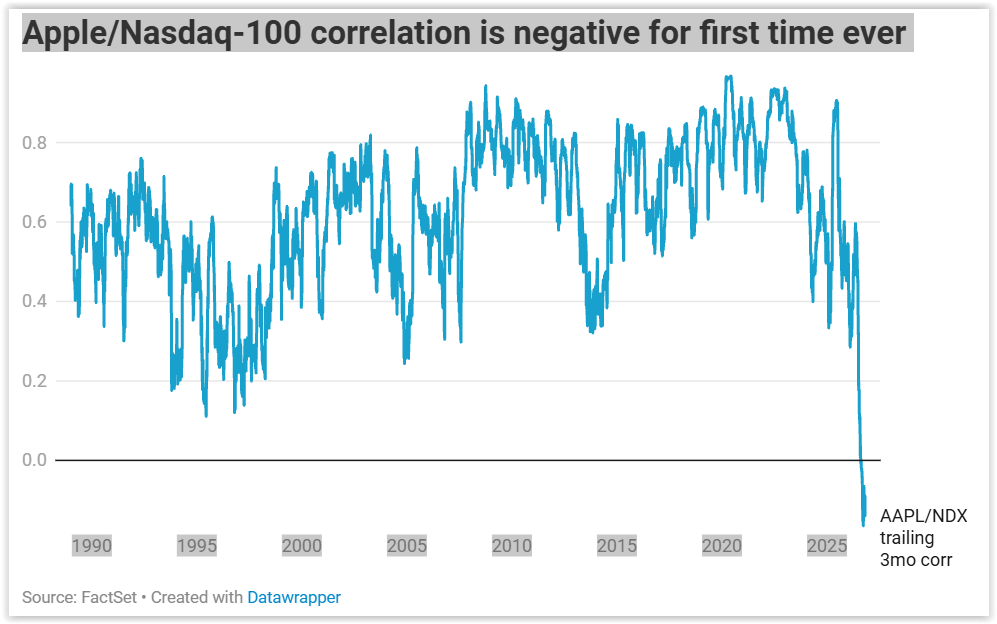
Traders at Goldman Sachs pointed out that the stock’s correlation to the Nasdaq-100 index turned negative this year for the first time ever. Indeed, the correlation coefficient between the two sits around -0.1 on a trailing three-month basis.
At one point in 2020, the Apple/Nasdaq-100 correlation stood at 0.97. In 2025, it got as high as 0.91.
The sharp decoupling comes as the company has moved to adopt artificial intelligence less aggressively than other major tech companies. For example, while Alphabet and Meta Platforms have launched chatbots and personal AI agents, Apple only released iOS 27 — which includes a rebuilt Siri AI — on Sept. 14.
Investors in turn have piled into other tech names. Apple has returned 111% to shareholders, while Meta and Alphabet have seen returns of 125% and 164%, respectively.
However, Apple’s more cautious AI approach may be helping the company of late. Shares are up 4.4% in October, while the Nasdaq-100 has dropped nearly 5% in that time amid concerns that some companies may be borrowing too much money to fund their AI build-out.
On top of that, excitement around the company’s iPhone Duo launch was palpable. Launch-day pickup inventory of the foldable phone sold out quickly, and some deliveries appear to be delayed as far as late January.
More broadly, the decoupling could be beneficial for the Nasdaq-100, with Apple potentially serving as a safety trade amid growing AI volatility.
Lockheed Martin will surge nearly 40% after new Pentagon deal, says Morgan Stanley
Published Mon, Oct 26 20267:35 AM EDT
Lockheed Martin may rally following a deal to continue producing fighter jets for the U.S. Department of Defense, according to Morgan Stanley.
The investment bank upgraded the defense contractor to overweight from equal weight. It also raised its price target on shares to $835 from $690, suggesting 38% upside from Friday’s close.
Lockheed Martin said last week it reached a 10-year framework with the U.S. government regarding the company’s F-35 Lightning II stealth fighter production.
This “takes significant risk out of the stock,” analyst Kristine Liwag said in a note to clients. “Missile ramp on-pace, driving mid-teens [missiles and fire control] growth, providing upside.”
LMT year to date
The announcement provides “a significant derisking event for the stock, which had previously been weighed down by concerns that F-35 could be a ‘billpayer’ in the U.S. defense budget to fund missile expansion. 3Q26 earnings also provided positive news on LMT’s munitions production ramp,” the analyst said.
Lockheed reported Thursday third-quarter earnings that beat analyst expectations. Shares rallied nearly 7% that day and ended last week up more than 9%.
Liwag also noted that Lockheed Martin’s partnerships with newer defense technology players, including Hadrian, support faster production and could help protect the company from disruption by newer defense manufacturers.
Morgan Stanley’s call falls in line with consensus on Wall Street. Of the 26 analysts covering Lockheed Martin, 13 have a buy or strong buy on the stock, while 12 have a hold rating on it, LSEG data shows.
Shares have popped 25% in 2026.
Nvidia’s $12.9 billion Hugging Face deal draws DOJ scrutiny
Published Wed, Oct 28 20264:13 PM EDT
Updated Wed, Oct 28 20265:58 PM EDT
Key Points
- The U.S. Department of Justice is investigating Nvidia and has asked it for information about how its $12.9 billion acquisition of Hugging Face could impact competitors.
- Hugging Face runs a widely used, open-source platform for hosting and testing AI models, and sells infrastructure and collaboration tools to the tech industry.
- The Hugging Face deal marked Nvidia’s second-biggest purchase, after it paid $20 billion for Groq assets at the end of last year.
Nvidia is facing questions from the U.S. Department of Justice concerning its acquisition of Hugging Face, an open-source platform for hosting and testing AI models, and how that deal may impact competitors in the field.
CNBC has confirmed the probe with a person familiar with the matter, who asked not to be named because they were not authorized to speak publicly. Reuters first reported the DOJ’s inquiry on Wednesday.
Nvidia announced its nearly $13 billion acquisition of Hugging Face in September, and at the time, CEO Jensen Huang wrote that the deal would help “expand access to AI for developers and institutions worldwide.”
Hugging Face already had massive adoption. At the time of the deal, Nvidia said in a press statement that more than 18 million people and more than 200,000 companies reportedly used Hugging Face to share at least 3 million models and 500,000 datasets.
Hugging Face also sells infrastructure and collaboration tools to organizations working with closed, proprietary AI including chip companies.
The Hugging Face acquisition marked Nvidia’s second-biggest purchase, after it paid $20 billion for Groq assets at the end of last year, a deal that has also attracted DOJ scrutiny. The closest comparable to Hugging Face’s business was GitHub, a software repository that was acquired by Microsoft in 2018 for $7.5 billion.
Hugging Face gained renewed recognition after reports that OpenAI agents attacked the platform during testing.
The company and that incident are part of a new, Netflix “insta-documentary” called “AI Gone Rogue.”
Nvidia declined to comment.
The ‘Magnificent Seven’ is no more. Time to pick winners and losers as group’s correlation breaks down
Published Wed, Oct 28 20269:00 AM EDT
Updated Thu, Oct 29 20261:35 PM EDT
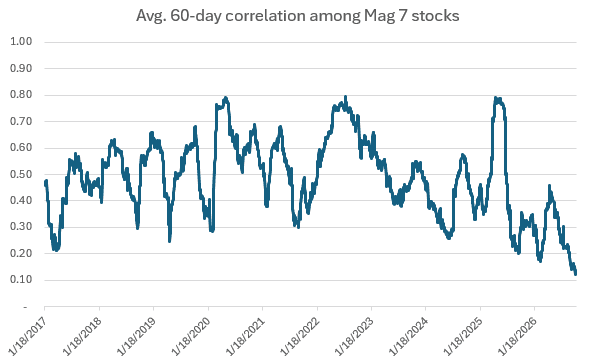
The “Magnificent Seven” doesn’t trade as a monolith anymore, challenging investors to be more discerning when picking through the market’s biggest stocks rather than viewing them as a single trade.
CNBC calculated the rolling 60-day correlation of daily returns for each of the 21 unique pairs among the Magnificent Seven — which comprises Alphabet, Amazon, Apple, Meta Platforms, Microsoft, Nvidia and Tesla.
The average of those correlations recently fell to its lowest level in more than a decade, suggesting the group is trading less like a cohesive block than it has historically. This marks a departure for a group that’s often discussed together because of its size and influence over the broader market.
The companies “all have different exposures to AI,” said Gil Luria, analyst at D.A. Davidson. “This requires a much more granular approach to which of the largest mega-caps an investor wants to own as opposed to just owning them wholesale,” he added.
The dislocation has led the group as a whole to lag the broader market. The Roundhill Magnificent Seven ETF (MAGS) is up 7% year to date, while the S&P 500 has gained 12%. Tesla and Meta are the two names in the cohort down in 2026, while Nvidia and Apple are the only ones outperforming the S&P 500.
Microsoft and Alphabet report results after the bell Wednesday. Amazon will post earnings after the close on Thursday.
The growing divergence among the Magnificent Seven reflects investors’ deeper focus on companies’ “independent fundamental growth drivers,” said Thomas DiFazio, ETF strategist at Roundhill Investments. “They have varying levels of success, when you put them in the totem pole of AI winners and losers.”
He added that “investors are focusing on the micro factors,” such as company-specific news that can signal whether the business can flourish in the AI world.
For Microsoft, the market is watching Azure’s cloud growth. For Meta, it’s assessing the potential of its consumer AI applications. Apple’s appeal is with its devices and services. Meanwhile, Alphabet’s success is tied to its Google Cloud business, its AI model Gemini and its leadership in Search. Close eyes are also on Amazon’s cloud business growth, while the market is centered on evaluating the durability of demand for Nvidia’s chips. For Tesla, it’s less about electric vehicles and more about its pivot to AI, robotics and robotaxis —potentially in a merger with SpaceX.
“These are the best stocks to still be in, but they’re starting to kind of separate and go in their own direction,” said Jay Woods, chief market strategist at Freedom Capital Markets.
The dispersion within the Magnificent Seven doesn’t point to deteriorating fundamentals. Overall, Wall Street remains largely bullish on each individual stock. For Apple, 58% of analysts have a buy or strong buy rating on the stock, according to LSEG. That number is a whopping 97% for Amazon; 92% for Alphabet; 97% on Microsoft; 89% on Meta; 97% on Nvidia; and 50% on Tesla.
Apple
Apple illustrates how investors’ assessment of AI exposure has shifted.
The iPhone maker, which had been punished for not spending high levels of capital expenditures in the AI arms race, is now being rewarded for it. In 2025, Apple was the second worst-performing Magnificent Seven name, returning 8.9%. Amazon was in last place, gaining 5.2% in 2025. Alphabet was the best performer, delivering 65.8%.
In 2026, however, Apple’s 28% gain leads the Mag-7 pack.
Performance of each Magnificent Seven stock
| Ticker | Company | Year-to-date performance (%) |
|---|---|---|
| GOOGL | Alphabet | 2.2 |
| AMZN | Amazon | 8.8 |
| AAPL | Apple | 26.8 |
| META | Meta Platforms | -5.2 |
| MSFT | Microsoft | 10.7 |
| NVDA | Nvidia | 17.3 |
| TSLA | Tesla | -10.8 |
Source: FactSet
“The one stock that got criticized the most over the last two years about not having an AI strategy is now the leader of this cohort, and that is Apple,” Woods said.
“They’re continuing to hit on what they do best, which is the products and the App Store,” Woods explained. To him, Apple is the “consistent tortoise of this race.”
D.A. Davidson’s Luria described Apple as “the place to hide from the AI trade,” while Woods referred to the company as a “technology utility” and a “consumer staple” since its devices and services are embedded into everyday life.
Nvidia
Nvidia has been volatile lately amid concerns about the durability of chip demand and investor anxiety over a pullback in capex spending.
As the biggest stock in the semiconductor sector – and the world – the stock is bound to be subject to massive price swings. The stock peaked on Oct. 6 but since then, shares have fallen by over 13%.
Still, Woods said its valuation is “relatively [and] historically cheap.” Right now, the stock is in a “digestion phase.” He favors Nvidia’s setup, pointing to continued demand for chips.
Alphabet
Alphabet’s chart has weakened following its run from March to May, according to Woods, putting greater emphasis on earnings and guidance come Wednesday evening when the company reports its third quarter earnings.
While its search business remains a strength, Woods is watching competition from other AI platforms and whether the stock can gain upward momentum.
Amazon
Amazon has been “slow and steady,” but the stock’s trend hasn’t been consistent, said Woods. “It’s not doing poorly; it’s not doing great. It’s just there.”
The key for the company is its cloud computing business, Amazon Web Services, which deliver a majority of its profits. Revenue from Amazon’s cloud segment grew 37% year over year in the second quarter. While growth is solid, it lagged Azure’s 43% year over year growth last quarter and Google Cloud, which jumped 82% year over year last quarter. To be fair, AWS is much bigger than the other cloud-computing competitors and that growth rate was the largest for the segment in 18 quarters.
Meta Platforms
Meta stock surged in September on excitement over its new personal AI assistant Muse after App Store downloads were off the charts.
Roundhill’s DiFazio noted how investors are keen on how Muse adoption could translate into revenue and profits and credited the new consumer application with potentially helping the stock’s trajectory.
But after the Facebook and Instagram parent reported negative free cash flow while raising the floor of its full-year capital expenditures in its third quarter earnings last week, the stock turned negative over concerns that attracrtive returns on all its capex could be further away.
Microsoft
Microsoft has recovered from earlier concerns about AI disrupting its software business, but now faces a technical test, according to Woods.
“The fears that AI was going to disrupt this thought were definitely overblown,” Woods said.
He identified the $530-$550 range as resistance and said that selling pressure could potentially threaten further gains.
DiFazio identified Azure as the growth driver investors are watching.
Upcoming earnings and guidance, set to be delivered on Wednesday evening, can help determine whether the stock can break above that range.
Tesla
When discussing Magnificent Seven stocks, Tesla “has been left in the dust,” Woods said. Tesla’s investment case increasingly rests on opportunities beyond electric cars, including robotics, he said.
D.A. Davidson’s Luria is also skeptical of its inclusion in the Magnificent Seven, arguing its valuation carries an “Elon premium.”
Nvidia, AMD to invest $4 billion in Meta as tech giants deepen AI partnership
Published Tue, Oct 27 20264:40 AM EDTUpdated Tue, Oct 27 202610:19 AM EDT
Key Points
- Nvidia and AMD have said they will invest $3 billion and $1 billion, respectively, in Meta.
- Meta on Monday announced plans to raise a total of $95 billion to support its investments in artificial intelligence infrastructure.
- Nvidia has been rapidly building up stakes in companies powering the AI boom.
Nvidia and Advanced Micro Devices have said they will invest a total of $4 billion in Meta after the social media and artificial intelligence giant announced plans to raise $95 billion to support its investments in AI infrastructure.
Meta on Monday said it would initially raise $35 billion in underwritten public equity offerings, before raising an additional $60 billion with an at-the-market program.
Nvidia on Tuesday said it would invest $3 billion in Meta’s equity offering, with AMD announcing it would invest $1 billion.
Meta’s Monday announcement said Nvidia, AMD and Broadcom were interested in purchasing up to $5 billion in shares.
Nvidia, AMD deepen Meta ties
Nvidia announced its investment on Tuesday, adding that Meta would expand Vera Rubin and Vera CPU deployment, and that the two companies would deepen their partnership on Muse, the social media giant’s AI agent that launched last month.
“AI agents represent a new computing paradigm — software that understands our goals, reasons, uses tools and gets work done on our behalf,” said Nvidia CEO Jensen Huang in a statement.
“This changes how we use computers, from operating applications to working with intelligent agents.”
“We’re excited to keep working with NVIDIA to deliver the best personal agents and frontier models for billions of people,” said Meta CEO Mark Zuckerberg.
AMD said that its Helios racks were running at Meta and its EPYC processors were powering Meta’s Muse.
“Together, we are building and deploying infrastructure at gigawatt scale and shaping future generations of silicon, software and systems to enable Meta’s most ambitious superintelligence models and services,” AMD CEO Lisa Su said in a statement.
AMD was up 3% on Tuesday, while Nvidia stayed flat. Meta was down 1%.
Nvidia and AMD have been rapidly building up stakes in companies powering the AI boom.
Nvidia has invested in OpenAI, Anthropic, Intel and XAI and participated in 121 investment rounds so far this year, according to Dealroom, up from just 13 in 2022.
AMD in July said it would make an equity investment of up to $5 billion in Anthropic. The company has been involved in 25 funding rounds in 2026, up from just two in 2022.
