
Let’s talk about last month.
The S&P 500 experienced a total loss of approximately 1.3% in June 2026. This decline brought the index down to a closing value of 7,499.36 after starting the month at a record high above 7,600. This dip interrupted a two-month winning streak


We do think the Mag 7 are the play into the end of the year.
Why? Let me work on the numbers for servers per minute, per hour, per day, per week
Price per square foot?= Purchase price, earnings, price per month, value price per a part of the building
Price per data captured per minute per server $23
Hour = $1,380
Day = $33,120
Week = $231,840
Year = $12,055,680
5000 servers = $60,278,400,00
Who pays for this = Schools, Universities, Governments, Boeing, Apple, Amazon, Walmart, Target, Costco, Ford, GM, United Health Care, Select Health, Tesla
It is so much better use of retail space than retail !!!!!
Why did we NOT invest in SPCX? AMZN, TSLA ????
For anyone who has taken an education in the stock market please tell me what is the most important level one analysts/indicator of the strength of a company?
Fundamental Analysis, Technical Analysis, Sentimental Analysis
Fundamentally all of those three are or were horrible fundamentally strong companies
Nobody pays HI to gamble with their money
How did we know to NOT invest into Oil?
This includes: transportation, refining and sales of oil or gas!
Because of Oil let me make this prediction = NO Rate Cuts or Raises this year
Previously I thought we would have two rate cuts and I’m changing my mind.
Earnings –
AAPL 7/30 est
BA 7/28 BMO
BABA 8/28 est
BAC 7/14 BMO
BIDU 9/19 est
CB 7/21 AMC
COST 9/24 AMC
CVS 7/30 est
DIS 8/05 est
F 7/28 AMC
GOOGL 7/23 est
JPM 7/14 BMO
KEY 7/21 BMO
LMT 7/23 BMO
LULU 9/03 est
META 7/29 est
MSFT 7/29 est
MRVL 8/27 est
MU 9/23 est
NFLX 7/16 AMC
NKE 9/29 est
NVDA 8/26 AMC
O 8/05 AMC
OWL 7/30 BMO
PLTR 8/03 est
QCOM 7/29 AMC
SPCX
UAA 8/07 est
V 7/28 est
VZ 7/24 BMO
WMT 8/20 BMO
https://www.briefing.com/the-big-picture
The Big Picture
Last Updated: 02-Jul-26 16:07 ET | Archive
The bull market meets its proving ground
Briefing.com Summary:
*Market leadership is broadening, which is indicative of bull market action.
*Rising earnings estimates have improved P/E multiples, but elevated price-to-sales ratios reflect exceptionally high growth expectations.
*The biggest threat to the bull market is falling earnings estimates, not short-term volatility or speculative positioning.
Oil prices are plummeting; S&P 500 earnings estimates are increasing; and Wall Street strategists are raising their year-end price targets, some of which have an 8-handle on them.
It has been full steam ahead for the stock market—or it had been full steam ahead for the stock market. Truth be told, the S&P 500 has been moving sideways over the last month or so. The important element is that it has been moving laterally in close proximity to its all-time highs, so it isn’t fair to claim this bull market has been put out to pasture.
No. This bull market has some fight in it still. How do we know? The mega-cap cohort has struggled over the last month, evidenced by a 5.4% decline in the Vanguard Mega-Cap Growth ETF (MGK), yet the Russell 2000 is up 1.7% over the same time, while the equal-weighted S&P 500 is up 2.3%. In fact, 65% of stocks in the S&P 500 are above their 200-day moving average.
That is the picture of a stock market broadening its buying interest. Why that is and how long it lasts remains open for debate, but in bull markets, money rotates within it and not out of it altogether.
Money tends to rotate out of the stock market and away from cyclical sectors when economic stress becomes apparent in the data and earnings estimates. That is when the bull gets put out to pasture, but it isn’t going there yet.
Confidence Is High (And So Is Anxiety)
No one will deny that the semiconductor stocks have had an epic run that has been instrumental in the bull market’s advance. At the same time, few can argue that these white-hot stocks weren’t due for a setback. At its all-time high on June 22, the Philadelphia Semiconductor Index (“SOX”) was up 107% in 2026.
As it so happens, the SOX is down 8.0% in a one-month period, with the bulk of that loss coming over the last two weeks. That hasn’t upset the bull market, however.
Over the same one-month period, the S&P 500 health care sector is up 12.0%, followed by the S&P 500 financials sector, up 8.2%, the S&P 500 industrials sector, up 5.7%, the S&P 500 utilities sector, up 4.5%, the S&P 500 consumer staples sector, up 3.6%, the S&P 500 real estate sector, up 2.8%, and the S&P 500 materials sector, up 1.4%.
There has been more to the market than the semiconductor stocks, and that is a good thing. Now, ideally, it stays that way.
The upcoming Q2 earnings reporting period will have something to say about that. Confidence is high going into the reporting period, but so is anxiety after the market’s powerful rally since late March.
That angst is reserved largely for the semiconductor stocks, the mega-cap stocks, and stocks tethered to the AI buildout. They are the nexus of the momentum trade that has been underpinning the major indices. Investors will monitor their results to determine if they are living up to the hype and how their post-report performance impacts market sentiment.
It will matter given the collective market-cap weight they carry, particularly if poor price action or qualitative commentary about demand conditions scares investors away from other stocks. To be fair, it is possible for them also to drive an upside breakout from the sideways action with results that prompt yet more upward revisions to earnings estimates.
Where Valuations Get Dicey
The forward 12-month EPS estimate for the S&P 500 stands at $366.83 today versus $329.78 at the end of the first quarter and $308.38 at the end of 2025, according to FactSet.

The upward shift in earnings estimates has actually outpaced the price gain in the S&P 500 this year. From a P/E standpoint, then, the market is less expensive today than when the year began, trading with a forward 12-month P/E multiple of 20.3x versus 22.2x at the start of the year.
A lot of that has to do with the semiconductor companies, where earnings estimates have exploded on the huge demand for memory and storage needed for the AI buildout. They are accounting for nearly half of the projected earnings growth rate of 23.3% for Q2.
A forward P/E of 20.3x versus a 10-year average of 19.0x isn’t extreme, but it is still above average.
Where valuations get dicey are in the market cap-to-GDP ratio and the price-to-sales ratio. The former is a favorite gauge of Warren Buffett, who said one is playing with fire when that ratio approaches or exceeds 200%. Today it sits at 236% versus 143% at the peak of the dot-com bubble. That comparison deserves some context, however, because today’s market is dominated by highly profitable companies with much higher margins than those that led the dot-com era.

In turn, the forward 12-month P/S ratio for the S&P 500 is higher today than it was at the peak of the dot-com bubble. That isn’t a full-fledged indictment of valuation risk. After all, the market’s biggest companies have some of the highest gross margins and are at the leading edge of the AI buildout.
The elevated P/S ratio reflects elevated expectations that they will maintain or expand their high gross margins and continue to deliver strong revenue growth. What satisfies investors as “strong” is relative, but all else equal, it becomes more challenging to deliver on growth expectations the larger one’s revenue base grows. And unlike earnings growth, sales growth is harder to manipulate.
Even with healthy revenue growth, a reversion in margins could cause the P/S multiple to compress.

The Biggest Risk
The bull market has run mostly with blinders on since March, but the trading/investing environment is not without its risks.
- Inflation remains elevated, even with the drop in oil prices, meaning the Fed has less scope to turn easy with its monetary policy.
- Real average hourly earnings have been negative for three months in a row and are a potential deterrent for discretionary spending that would be a drag on economic growth.
- Earnings expectations are extremely high, creating a tough bar to hurdle and a basis for reversion to the mean if there is a disappointment.
- There is a lot of speculative energy in the market that has been fueled by increased leverage. That is not unusual in rising markets, but elevated leverage can amplify market declines if sentiment reverses.
- Based on FINRA data, margin debt relative to GDP is at a record 4.44%, leaving it well above its 3.03% long-term average.
- There is potential for an intervention to stem the Japanese yen’s weakness against the dollar, which could lead to a sharp unwinding of yen-based carry trades.
The market is never without its risks. A key to the market’s performance is how risk manifests itself and what it portends for the economy and earnings.
The unwinding of a carry trade, for instance, can be sharp and painful, but that unwinding alone is more of a mechanical thing than a fundamental obstacle. Accordingly, it typically doesn’t have long-lasting impact and is apt to be seen as a buying opportunity when price levels and the speculative excess reset.
The biggest risk is the one that forces earnings estimates lower and is believed to have some longer-lasting duration (e.g., a recession or a stark slowdown in demand). That risk exists in the market’s consciousness, but price action to this point implies it is still a back-of-the-mind consideration.
Briefing.com Analyst Insight
This is a market that still trusts in the earnings growth outlook, which is why it is a bull market that still operates with a buy-the-dip mindset and a proclivity to rotate within itself when it thinks some industry groups/sectors have gotten ahead of themselves.
The bull market has been on the playground since the end of March, but now it is on the proving ground with the turn to the second half of the year. A lot of good news and outcomes were priced into stocks during the second-quarter rally. The third quarter will be about backing it up—or not.
This bull market should have more room to run if earnings continue to meet and exceed high expectations. If not, then the bull market may just be put out to pasture for a bit.
—Patrick J. O’Hare, Briefing.com
Where will our markets end this week?
LOWER
DJIA – Bullish and slightly overbought

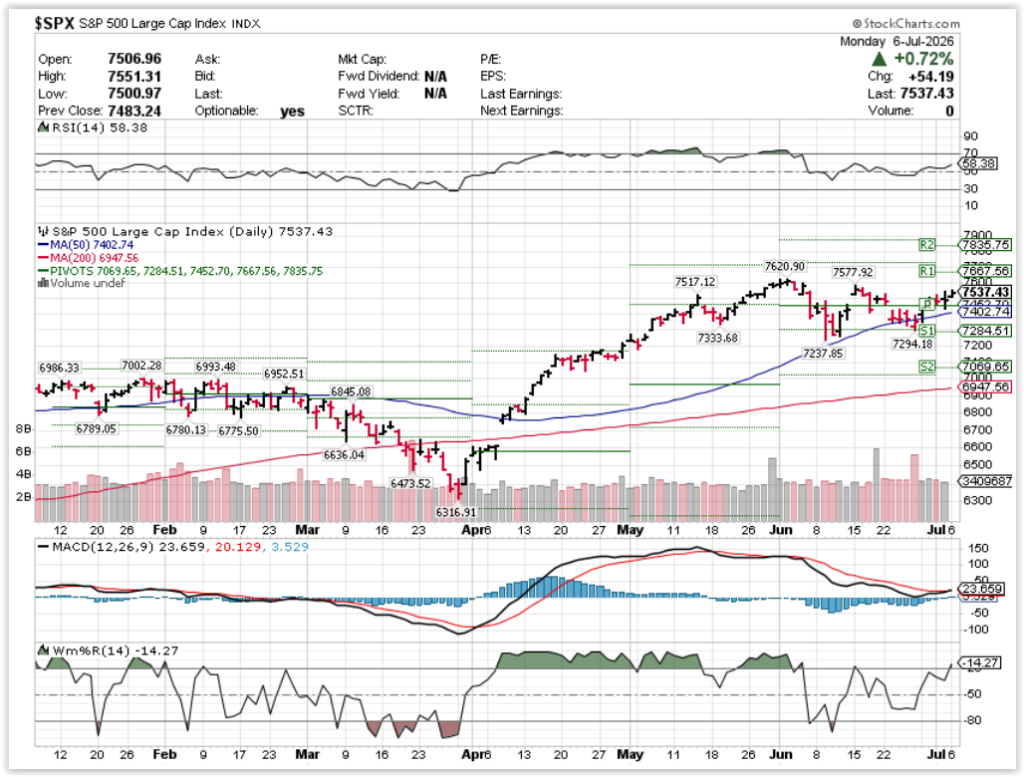
SPX – Bullish
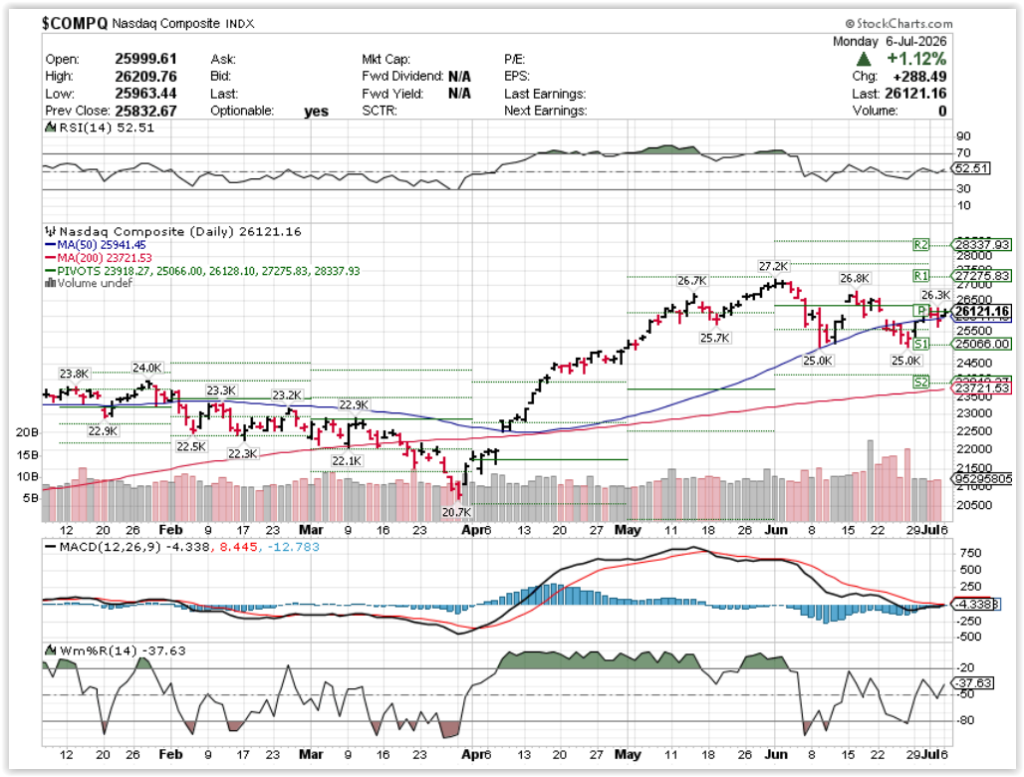
COMP – Bullish
Where Will the SPX end July 2026?
07-06-2026 +1.50%
Earnings:
Mon:
Tues:
Wed: LEVI,
Thur: PEP,
Fri: DAL,
Econ Reports:
Mon: ISM Services,
Tue: Trade Balance
Wed: MBA, Wholesale Inventories, Consumer Credit, FOMC Minutes
Thur: Initial Claims, Continuing Claims, Existing Home Sales,
Fri:
How am I looking to trade?
Rolled up OTM puts to closer to ATM or slightly OTM
Adding Covered Calls to positions for the summer doldrums
www.myhurleyinvestment.com = Blogsite
info@hurleyinvestments.com = Email
Questions???
Top-performing tech hedge fund manager Philippe Laffont explains his biggest AI trade
Published Tue, Jun 23 20269:11 AM EDTUpdated Tue, Jun 23 202611:27 AM EDT
Billionaire investor Philippe Laffont on why he owns semi cap stocks
Philippe Laffont is betting that investors don’t need to pick the winner of the artificial-intelligence chip race to profit from it.
The founder of Coatue Management said one of the firm’s preferred ways to gain exposure to AI is through semiconductor manufacturers and equipment suppliers, which is why he holds Taiwan Semiconductor, Lam Research and Applied Materials among his largest investments.
“Sometimes you can capture some of these stocks through others,” Laffont said Tuesday on CNBC’s “Squawk Box.” “You’ve got Nvidia, you’ve got Amazon with a Trainium chip. You’ve got Google with a TPU chip. You’ve got newcomers on the GPU side. All of them at the end of the day will need the same machines.”
The approach reflects a picks-and-shovels strategy toward the AI boom. As technology companies race to build data centers and develop increasingly powerful AI processors, demand for the equipment used to manufacture those chips has surged.
“If I’m a supplier to the fabs, I don’t need to make an exact bet on which of the chips is going to win,” said Laffont, an MIT grad and veteran of Julian Robertson’s legendary Tiger Management. “That’s sort of the reasons why we own the semi caps,” he said, a reference to semiconductor capital equipment stocks.
The hedge fund star, now overseeing $90 billion, noted that he previously sold Nvidia too early, missing part of the stock’s meteoric rise. Laffont said Nvidia is now a “very cheap” stock after falling about 12% from its recent peak.
Coatue, an early investor in both SpaceX and Cursor, managed about $54.5 billion as recently as the end of 2024, according to regulatory filings. SpaceX came public earlier this month at an initial valuation of $1.77 trillion, and promptly agreed to buy Cursor last week for $60 billion in stock.
Correction: This story has been corrected to show Coatue managed about $54.5 billion as of the end of 2024.
Magnificent 7 stock pullback now looks like a buying opportunity, strategist says
Published Mon, Jun 22 202610:13 PM EDT
Justina Lee@in/justina-lee-2742aa59
Key Points
- Stabilization in the Mag 7 “would be an important positive for the broader market,” according to Fundstrat technical strategist Mark Newton.
- Mag 7 has dominated the U.S. market with a combined valuation of around $22.62 trillion
Jakub Porzycki | Nurphoto | Getty Images
Recent weakness in the Magnificent 7 stocks now looks to be an opportunity for investors, given that US equity trends remain bullish in the near term, said Mark Newton, head of technical strategy at Fundstrat.
Within the Mag 7, Microsoft, Meta, Alphabet and Amazon have fallen roughly to two-month lows and the underperformance now looks mature, Newton said.
“It’s right to start looking for relative strength to reassert rather than chasing the weakness,” he said, adding that a stabilization in the Mag 7 “would be an important positive for the broader market, with the possibility of falling crude, yields, and the US dollar.”
The group dominates the U.S. market with a combined valuation of around $22.62 trillion, led by artificial intelligence chipmaker Nvidia at $5.13 trillion, according to research firm Vanda. However, questions about the sustainability of growth in AI, as well as competition from the likes of Chinese rivals are among factors that have weighed on their shares.
Newton isn’t the only analyst seeing potential for a rebound in the shares.
“I don’t think there will be a transfer out of [the Mag Seven],” Paul Meeks, sell-side head of tech research at Freedom Capital Markets, told CNBC in an earlier interview, adding that the key theme now will be AI infrastructure building.
“Because the spending is being done by the hyperscalers, which almost to a man are the Mag Seven, I think that they’re secured. I think money might come out of other investments to invest in those IPOs,” Meeks added.
Mag 7 is expected to be part of the new so-called Fab 10 — which includes SpaceX, OpenAI and Anthropic — amid surging demand for AI, with retail investors buying SpaceX in record numbers as part of their new portfolio plan, according to analysts.
—CNBC’s Tobias Burns contributed to the story.
These are Schwab’s top three income ideas for the rest of 2026
Published Wed, Jun 24 20263:00 PM EDT
Investors can still enjoy solid yields in the bond market right now, but selectivity matters, according to Charles Schwab’s mid-year outlook.
The firm expects inflation to stay sticky and the Federal Reserve to remain patient. However, a rate hike seems a little bit more likely after the June Fed meeting and latest hot inflation report, said Collin Martin, head of fixed income research and strategy at the Schwab Center for Financial Research.
As a result, the bond market’s bumpy ride will likely continue, he said.
In the Treasury market, the 10-year note yield will likely stay in the range of 4% to 4.5%, Martin noted. Bond yields move inversely to prices. However, he cautions there’s a risk the yield could turn higher. Because of that, now is not the time to add duration, Martin said. Duration measures a bond’s price sensitivity to interest rate fluctuations, and bonds with longer maturity dates tend to have greater duration.
“They tend to be the most sensitive to interest rate changes, and we do see a risk that long-term interest rates stay elevated or even rise a little bit further from here,” he said in an interview with CNBC. “More importantly, we don’t think that investors are going to miss the opportunity to invest at the yields we’re seeing right now.”
He sees three areas of opportunity for income investors in the second half of 2026.
Investment-grade bonds
Investment-grade corporate bonds offer high-quality income, with yields that average around 5%, Martin said.
Spreads remain tight, which means the yield advantage corporates enjoy over Treasurys is low. However, that’s due to strong fundamentals, he said.
“Corporations are seeing strong profits, and they have healthy balance sheets,” he said. “That low risk premium isn’t necessarily scaring us away. We are focusing more on the absolute yields and the income you can earn.”
Martin said investors should be diversified throughout investment-grade sectors. There are a host of exchange-traded funds available in the space.
Corporate bond ETFs
| Ticker | Fund | 30-day SEC yield | Expense ratio |
|---|---|---|---|
| USIG | iShares Broad USD Investment Grade Corp Bond ETF | 5.21% | 0.04% |
| SPBO | State Street SPDR Portfolio Corporate Bond ETF | 5.27% | 0.03% |
| SCHI | Schwab 5-10 Year Corp Bd ETF | 5.18% | 0.03% |
| VTC | Vanguard Total Corporate Bond ETF | 5.15% | 0.03% |
Source: Fund websites
Bump up high-yield exposure
Investors should also consider shifting their allocation to high-yield bonds up by a percentage point or two, Martin said. The specific allocation depends on the investor’s risk tolerance and time horizon, he noted.
To be sure, high-yield bonds are considered riskier than investment-grade corporates — which means there is the potential for defaults. However, the overall market is better quality than it once was, with higher-rated credits now taking up more of the Bloomberg U.S. Corporate High Yield Index, Martin said.
“The risk of default is always a risk with high yield bonds, and it’s still present today. But we think the risk to the broad market is relatively low,” he said. “A key trend that we think really helps support our case with high-yield bonds is the shifting makeup of the bonds that make up the high-yield bond market.”
Individual investors would have a tough time building a portfolio of high-yield bonds, Martin said. However, can get diversification through mutual funds and ETFs, like the Schwab High Yield Bond ETF (SCYB) or the iShares Broad USD High Yield Corporate Bond ETF (USHY). The former has a 30-day yield of 6.88% and 0.03% expense ratio. The latter has a 6.96% 30-day SEC yield and expense ratio of 0.08%
Schwab High Yield Bond ETF
Preferred securities
Lastly, investors can snap up yields of around 6% in preferred securities, which also offer a tax advantage. The assets have features of both stocks and bonds. They trade on exchanges like stocks, but also have par values and pay a stream of income like a bond.
Most preferred securities pay qualified dividends, Martin said. That means they are subject to a rate of 0%, 15% or 20%, depending on the investors’ taxable income.
“Those after-tax yields can look even more attractive when you compare them to other fully taxable alternatives,” he said.
The assets also have long maturities, or no maturity at all, so they can be sensitive to interest rate fluctuations. However, while Martin is cautious on long-duration bonds, that’s not the case with preferreds.
“They’re not as correlated to long-term interest rates as you might think, based on their maturities. They’re actually correlated more to to the credit risk side of the equation and the equity markets,” he said. “That is where we’re a little bit more comfortable right now, because the economic outlook is relatively favorable.”
ETFs in the space include the iShares Preferred and Income Securities ETF (PFF), which has a 6.32% 30-day SEC yield and a 0.45% expense ratio, and the Invesco Preferred ETF (PGX), which has a 6.33% 30-day SEC yield and an expense ratio of 0.50%.
Micron stock jumps 15% as soaring prices from memory crunch lead to quadrupling of revenue
Published Wed, Jun 24 20264:07 PM EDT
Updated Wed, Jun 24 20266:39 PM EDT
Key Points
- Micron reported fiscal third-quarter results that topped analysts’ estimates.
- The company has been one of the biggest beneficiaries of the AI boom, which has caused historic demand for memory.
- Micron’s stock price is up about 700% over the past year, lifting the company’s market cap past $1 trillion.
Micron’s revenue more than quadrupled in the fiscal third quarter, the company said on Wednesday, as the memory maker continued to benefit from soaring demand tied to the artificial intelligence boom. The stock rose 15% in extended trading.
Here’s how the company did versus LSEG consensus estimates:
- Revenue: $41.46 billion versus $35.84 billion estimated
- EPS: $25.11, adjusted, versus $20.78 estimated
Revenue increased from $9.3 billion a year earlier, Micron said in a statement. For the current quarter, the company said it expects revenue of about $50 billion, up from $11.3 billion a year earlier. Analysts were looking for a revenue forecast of $43.58 billion, according to LSEG.
Memory prices have skyrocketed in the last couple years as AI chips eat up all the production capacity of the small crop of vendors. With data center demand increasing by the day, prices are also rising for memory used in smartphones, laptops and other gadgets.
“Our customers are recognizing that supply shortages in memory and storage will take considerable time to improve, even as we expect industry supply to improve gradually in 2028,” Micron CEO Sanjay Mehrotra said on a call with analysts.
That’s turned Micron into a Wall Street darling as its technology is essential for chips made by Nvidia and Google, as well as the servers that house those companies’ processors. Micron’s stock price is up roughly 700% over the past year, lifting the company’s market cap past $1 trillion.
Micron revenue more than quadruples in latest earnings report
Micron said on Wednesday that it has signed 16 long-term agreements with customers such as data center operators and automakers that lock in sales for a period of three to five years.
“When completed, we expect approximately half or more of our company revenue to be under these” strategic customer agreements, Mehrotra said. He added that they were structured with binding agreements to purchase volumes of Micron’s chips.
Micron said it expected financial commitments of $22 billion from the long-term agreements.
“This is good for Micron,” CFO Mark Murphy told analysts. “We get visibility on our demand, it’s committed volume that we can be confident about making our investments.”
Micron’s gross margin, the profit left after accounting for the cost of goods sold, jumped to 84.9% in the third quarter from 74.9% in the prior period and 39% a year earlier. Margins topped analyst estimates.
Net income during the quarter was $28.24 billion, or $24.46 per share, versus $1.89 billion, or $1.68 per share in the year-ago period.
While all four of Micron’s business units saw revenue multiply, the most explosive growth was in the core data center business, where sales climbed more than sevenfold to $11.5 billion from $1.53 billion in the same period a year ago. In addition to memory, Micron also recorded over $5 billion in data center solid state drive revenue, the company said in a presentation.
Cloud memory was up over 300% to $13.77 billion.
The company’s mobile and client business unit saw a 250% growth in revenue to $11.52 billion, and even memory for automotive and embedded applications more than quadrupled to $4.63 billion in sales.
The company said shareholders will receive a 15-cent dividend in July.
Americans are paying record prices for steak. Here’s why demand isn’t cracking
Published Thu, Jul 2 20267:00 AM EDTUpdated Thu, Jul 2 202610:47 AM EDT
Brandon Gomez@in/brandon-gomez/@bgomezreports
- Beef prices remain near record highs as the U.S. cattle herd sits at its smallest size in decades, with ground beef up 13% and steak up 16% from a year ago.
- Consumers are still buying beef despite higher prices, with Fourth of July beef sales up about $352 million from last year, according to NielsenIQ.
- Shoppers continue to treat steak as an affordable luxury, favoring premium cuts and quality labels even as prices remain elevated.
Here’s why beef prices keep rising, and why consumers keep buying
As Americans prepare to fire up their grills for the Fourth of July, they’re facing some of the highest beef prices on record.
Yet despite the sticker shock, demand for beef and steak are holding up.
Beef prices have surged after the U.S. cattle herd shrank to its smallest size in decades following years of drought, high feed costs and herd liquidation. The resulting supply crunch has driven up cattle prices and, ultimately, the cost of beef at grocery stores and on restaurant menus.
While prices eased slightly in May after reaching record highs in the spring, consumers are still paying near-record prices for ground beef and steaks. The average price of ground beef was $6.75 per pound in May, according to U.S. Bureau of Labor Statistics data, up nearly 13% from a year ago and just below April’s record high of $6.90. Beef steak prices averaged $12.80 per pound, up 16% from a year earlier and the second-highest level on record.
But so far, shoppers don’t appear willing to abandon their summer grilling traditions. The resilience offers another clue into consumer behavior at a time when investors are closely watching for signs of whether and where high prices are causing shoppers to pull back.
“We are seeing customer demand for steaks remain quite high, with a shift towards more premium and organic options,” a Kroger spokesperson told CNBC. “We’ve also seen beef continue to be a preferred choice during recent holidays, including Easter and Memorial Day.″
Beef has generated the largest dollar growth of any food category ahead of Independence Day, with sales rising roughly $352 million compared to last year, according to data from NielsenIQ.
“Consumers are entering the holiday with discipline, making more trips but with clear intent behind each one,” the consumer research firm said in a June report.
Steak and quality win
As demand for beef holds up, consumers have shown clear preferences within the segment.
NielsenIQ said consumers increasingly view steak as the centerpiece of special occasions: an “affordable luxury” where they’re willing to pay more for quality and the experience, while finding savings elsewhere when they shop for groceries.
The data also suggest consumers aren’t simply searching for the cheapest protein. Instead, many are placing a greater emphasis on quality.
Shoppers reported increasing favor toward quality claims such as USDA Prime (42%), no added hormones (40%), grass-fed (37%), and no antibiotics ever (36%) when purchasing meat, according to NielsenIQ.
“Shoppers are looking past the label and into the story behind the meat,” the firm said. “Claims tied to quality and sourcing are gaining ground as buyers seek confidence.”
The demand has also benefited others in the industry, like Omaha Steaks, which told CNBC that consumers continue to prioritize gifting steaks even as they cut back elsewhere.
“Customers are still celebrating dad with premium proteins, but they’re also being thoughtful about value and versatility,” said Nate Rempe, president and CEO of Omaha Steaks last month as Father’s Day approached.
The company said it has seen continued growth in its USDA certified tender top sirloin filet, a recently introduced value cut, with sales up 25% in the weeks heading into Father’s Day this year compared to 2025.
Restaurants have also reported seeing benefits from the dynamic. LongHorn Steakhouse, among others, has seen a rise in diners seeking out steaks.
“The guests know they’re getting high quality steaks when they come to LongHorn [Steakhouse],” said Rick Cardenas, CEO of the chain’s parent company Darden Restaurants. “They get a great value. And it doesn’t hurt that there’s a high beef inflation in the market. And so the relative value looks a little bit better.”
The key question for investors is how long the dynamic can last. Rebuilding the U.S. cattle herd could eventually increase beef supplies and ease prices, but that process takes years without the aid of imported supply.
https://www.cnbc.com/2026/06/30/jim-cramer-ai-trade-shifted-stocks-leading-now.html
Jim Cramer says the AI trade has shifted — and these stocks are leading now
Published Tue, Jun 30 20266:24 PM EDT
Alexa LoMonaco@in/alexa-lomonaco/
Key Points
- CNBC’s Jim Cramer said Wall Street is rewarding the companies supplying the artificial intelligence boom rather than the technology giants funding it.
- While Cramer continues to own several Magnificent Seven stocks, he believes AI suppliers such as Micron, Intel, Marvell, AMD and Sandisk are currently in the strongest position to benefit from the industry’s massive spending cycle.
In this article
Intel CEO has turned the company around, says Jim Cramer
CNBC’s Jim Cramer on Tuesday offered up a straightforward framework for Wall Street’s current approach to the artificial intelligence trade.
“Wall Street’s now rewarding tech companies with products in high demand and punishing their customers,” the “Mad Money” host said.
The shift comes as the “Magnificent Seven” collectively shed roughly $2.3 trillion in market value during the month of June as investors questioned whether the group’s enormous AI spending will ultimately generate enough earnings and free cash flow to justify their decisions. The Mag 7 consists of Apple, Google parent Alphabet, Amazon, Microsoft, Meta, Nvidia and Tesla.
The biggest spenders on AI data centers in the group are Amazon, Alphabet, Microsoft and Meta. Now, Cramer said these so-called hyperscalers have become victims of their own AI ambitions. The companies have the financial resources to keep pouring billions into AI, Cramer said, but demand for compute infrastructure has outstripped supply, driving up the cost of critical components such as memory chips and networking equipment. That dynamic, Cramer said, has rewarded the companies selling the picks and shovels of the AI boom rather than the companies footing the bill.
“The biggest gainers are the exact opposite of the Magnificent Seven,” he said. “They make products that are in short supply, with demand that’s off the charts.”
Nvidia fits the bill as a key supplier of AI compute, but Cramer said the stock has fallen into the laggard camp due in large part to concerns about custom chip competition.
Cramer pointed to memory chipmakers Micron and Sandisk, along with Intel, Marvell Technology, and AMD, as some of the second quarter’s biggest winners. He said the supply-demand imbalance has fueled strong earnings growth and a steady stream of analyst upgrades and price target hikes across the group.
Among the group, Cramer singled out Intel as his new favorite stock. He credited CEO Lip-Bu Tan with revitalizing the chipmaker, and said Intel is well-positioned to benefit from rising demand for CPUs, advanced chip packaging and domestic semiconductor manufacturing. Cramer’s Charitable Trust, the portfolio run by CNBC’s Investing Club, owns Intel shares.
“It’s a national treasure,” he said.
While Cramer said the Club continues own six of the Mag 7 constituents — Tesla is the exception — he thinks the suppliers will continue to benefit as long as demand for AI infrastructure outpaces supply.
“Some of you may think that’s unfair … but the market has spoken and I don’t know if it’ll learn another language next quarter, let alone the rest of the year,” he said.
