

OK, back to talking about Iran and what Trump just did because “IT AFFECTS OUR MARKETS !!!!”
Marco Rubio – Every single day this regime in Iran has less missiles and less launchers.
The US now agrees with Iran and agrees to help them block the Strait of Hormuz
What does this mean to our markets??? Tell me
The market seems to be ignoring the war
Trump shut off China, Russia and India cheap oil
For HI – We have been working since last Wednesday in opening up position to the upside -10%
We’ve taken off short calls for huge profits – stocks out up to three months, leap shorts on bull calls and we have adjusted and rolled short calls out to sept
Our other chance – we will most likely run OTM puts for this earnings
COUNTRIES – in general want to Security in – Sovereign, Cyber, Energy
The fog of War is sentimentally driven decisions – Emotion
The war will not affect earnings first quarter this year = Guidance
AI is NOT a one winner take all sector = Look online entertainment
Siri on my phone, Chat GPT, what would you for programming, what do use for advertising, do you use Alexa around the home
Meta online advertising
Earnings –
AA 4/16 AMC
AAPL 4/30 AMC
BA 4/22 BMO
BABA 5/14 est
BIDU 5/13 est
CB 4/21 AMC
CVS 5/06 BMO
DIS 5/06 est
F 4/29 AMC
GE 4/21 BMO
GOOGL 4/29 AMC
KEY 4/16 BMO
LMT 4/23 BMO
META 4/29 est
MSFT 4/29 AMC
MSTR 4/29 est
MU 6/23 est
NEM 4/23 AMC
NVDA 5/20 AMC
O 5/06 AMC
OWL 4/30 BMO
PLTR 5/04 est
UAA 5/14 est
V 4/28 AMC
VZ 4/27 BMO
WMT 5/21 AMC
https://www.briefing.com/the-big-picture
The Big Picture
Last Updated: 10-Apr-26 15:30 ET | Archive
Iran war kicks up some earnings estimate dust
Briefing.com Summary:
*The first quarter blended earnings growth rate today is 12.5%. That is down from 12.8% on December 31, but not to worry; that will be the sixth straight quarter of double-digit earnings growth.
*The information technology sector continues to do the earnings driving.
*The forward 12-month EPS estimate sits at $333.52 today, according to FactSet, versus $317.70 when the war started.
The stock market has a major geopolitical problem on its hands. It does not have an earnings problem—not yet anyway.
The start of the first-quarter earnings reporting period is right around the corner, and it promises to be another period where the earnings results in aggregate belie any economic problems. They will also once again conveniently mask that the aggregate earnings growth isn’t as strong as it appears when you peel back the reporting layers.
Nevertheless, the S&P 500 is an index that trades off aggregate earnings estimates, so it all counts no matter how you slice it.
Time to Break Open a Six-Pack
According to FactSet, the first quarter blended earnings growth rate today is 12.5%. That is down from 12.8% on December 31, but not to worry; that will be the sixth straight quarter of double-digit earnings growth. We’re using future tense and not conditional tense because it is common for the aggregate earnings growth rate to be at least two to three percentage points higher than the estimated growth rate when it is all said and done.
This reporting period, like most, will be driven by the information technology sector. Its blended growth rate is 44.4%, which will translate into a 10.2 percentage point contribution to the 12.5% blended growth rate for the S&P 500. So, one sector is effectively 80% of the aggregate growth rate.
The next big contributor is the financials sector, which is expected to account for 2.77 percentage points of growth.
The contribution from other sectors is negligible, and there are three sectors—health care (-1.17 percentage points), communication services (-0.49 percentage points), and energy (-0.17 percentage points)—that are expected to detract from earnings growth.
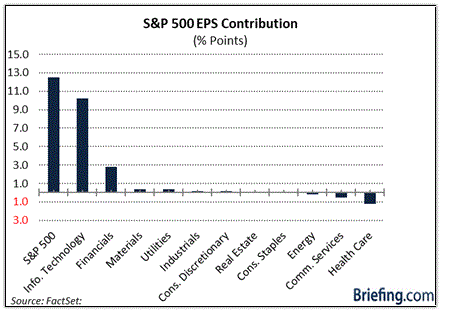
It is a different story for first quarter sales growth. Every sector is expected to contribute to the blended growth rate of 9.7%, which is up from 8.1% on December 31. The information technology sector is expected to contribute 3.19 percentage points, or approximately 33%, to the overall growth rate.

Rising Estimates
Per usual, the early stage of the reporting period will be led by the financial sector. Heading into 2026, this sector was a popular pick among strategists to be overweight. It is currently the worst-performing sector year-to-date (-7.2%).
It has been upended by festering concerns related to the private credit market, which has been besieged by redemption requests that have run headlong into prescribed withdrawal caps. In other words, some investors have been prevented from getting all the money they have requested.
The rush of requests was precipitated by AI disruption concerns surrounding the software industry. Separately, rising interest rates, a flattening yield curve with short-term yields rising faster than long-term yields, a stock market correction, and growth concerns have been additional headwinds buffeting the sector.
The earnings conference calls for the banks and alternative asset managers, in particular, should be a crowded forum this reporting period, as market participants are eager for more context related to the private credit disruption and expectations for capital markets, which have gotten more volatile since the start of the Iran war.
The war and its residual impact on global economies and markets are going to be a central topic of conversation on most earnings conference calls. It certainly offers a valid excuse to be conservative with guidance, to issue wide guidance ranges, or to withhold guidance altogether.
The market will have to determine if it is fine looking through the fog and trading on a belief that the air will clear soon enough to retain confidence in what remains a stellar forward 12-month earnings outlook.
As we noted in our last column, earnings estimates have continued to rise despite oil prices increasing as much as 75% since the start of the Iran war, the national average for gasoline prices hitting $4.15 per gallon, hiring activity slowing, wage growth moderating, the dollar strengthening, supply chains rusting, and the market pricing out any further rate cuts this year.
The forward 12-month EPS estimate sits at $333.52 today, according to FactSet, versus $317.70 when the war started.

Briefing.com Analyst Insight
We don’t know if the Iran war will be over by the time the first-quarter reporting period concludes. We certainly hope it is, but even if it is, its aftershock will continue to register through the second quarter and perhaps beyond.
A lot will depend on when traffic starts moving safely and freely through the Strait of Hormuz.
To this point, the market has moved safely and freely for the most part through the last five reporting periods. It makes sense because earnings have increased double-digits in each of those periods, and the market is driven by earnings and the estimate trend.
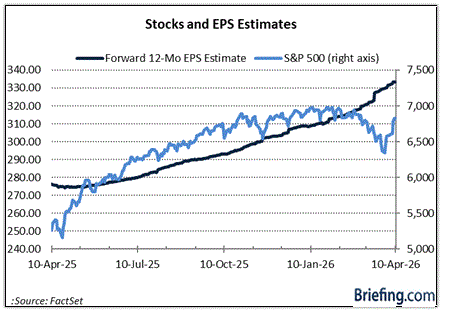
That trend has been stellar, but the current geopolitical situation has kicked up a lot of dust that is going to reduce visibility. The market should be able to cope with some temporary blindness, but it is going to need to see the light sooner rather than later that the upbeat earnings estimates are achievable. If it doesn’t, it will have another battle on its hands that gets in the way of multiple expansion.
—Patrick J. O’Hare, Briefing.com
Where will our markets end this week?
Higher
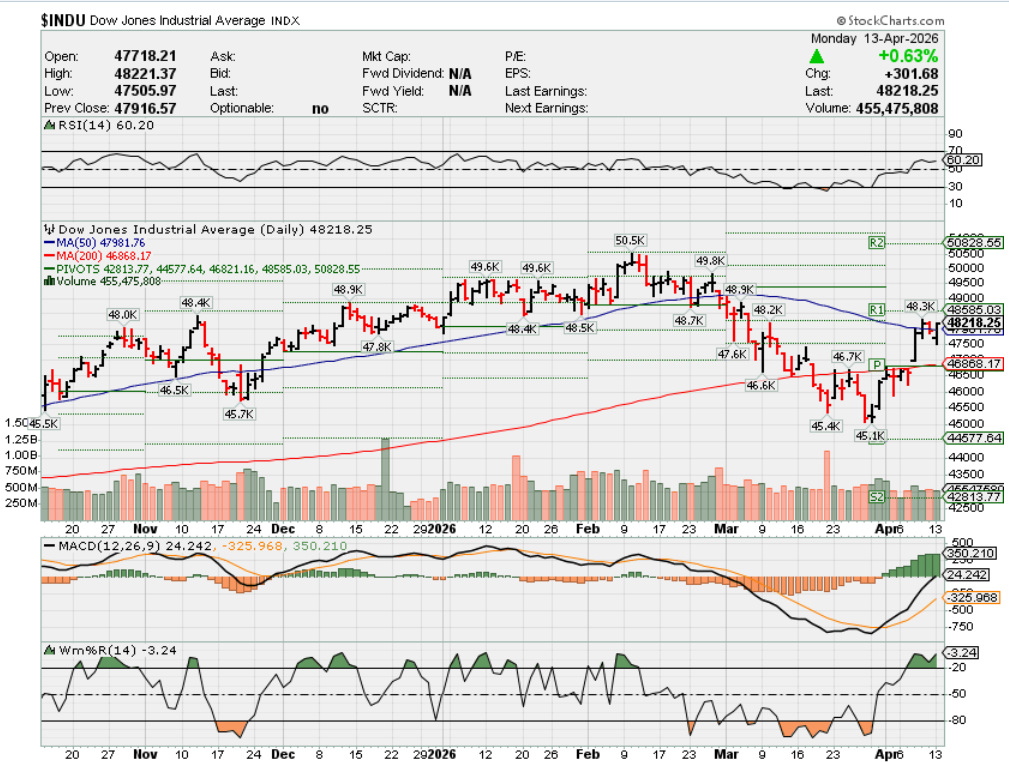
DJIA – Bullish
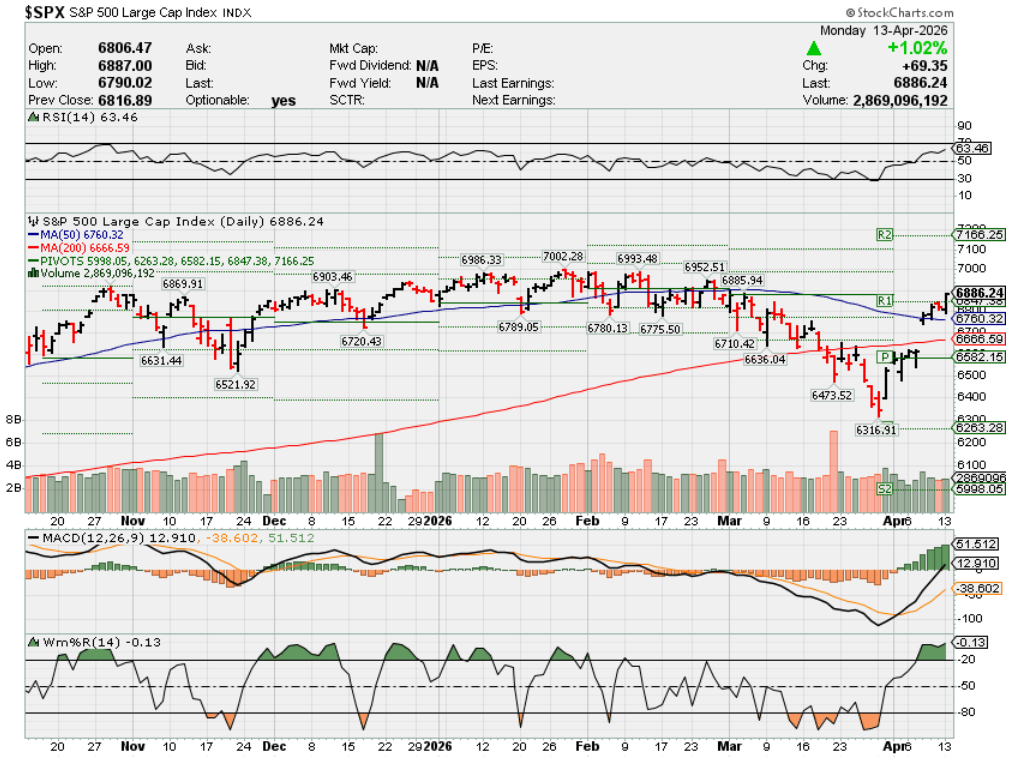
SPX – Bullish
COMP – Bullsih

Where Will the SPX end April 2026?
04-13-2026 +2.5%
04-06-2026 +2.5%
Earnings:
Mon: FAST, GS
Tues: BLK, C, JNJ, WFC, JPM,
Wed: BAC, FHN, MS, PNC,
Thur: ABT, BK, SCHW, PEP, USB, AA, KEY, NFLX
Fri: ALV
Econ Reports:
Mon: Existing Home Sales,
Tue: PPI, Core PPI, NIFB Small Business Optimism
Wed: MBA, Empire Manufacturing, Import, Export, NAHB Housing Market Index
Thur: Initial Claims, Continuing Claims, Phil Fed, Industrial Production, Capacity Utilization,
Fri: MONTHLY OPTIONS EXPIRATION
How am I looking to trade?
Protected for earning mostly running OTM Puts
www.myhurleyinvestment.com = Blogsite
info@hurleyinvestments.com = Email
Questions???
Trump ‘ordered’ the Education Department’s demise almost a year ago — what’s happened since?
By Jason Swensen, Deseret News | Posted – March 15, 2026 at 8:30 p.m.
KEY TAKEAWAYS
- President Donald Trump signed an executive order to dismantle the Education Department in March 2025.
- The department remains active but shifted many duties to other federal agencies.
- Controversial actions include civil rights investigations and changes to student loan policies.
WASHINGTON — One year ago, the Education Department handed pink slips to almost half of its workers — a dramatic signal that the Trump administration was making good on its pledge to scrap the federal agency.
A few days later — March 20, 2025 — President Donald Trump signed an executive order formally seeking the elimination of the Department of Education.
Trump’s ire for the 47-year-old agency was no secret when he issued last year’s order. He had long called the Education Department “a big con job.”
“We’re going to shut (the DOE) as quickly as possible. It’s doing us no good. We want to return our students to the states.”
Shortly before the executive order signing, Utah Gov. Spencer Cox threw his own support behind Trump’s actions against the Department of Education, writing in an op-ed that “education is, and always has been, a state and local responsibility.”
In the year since Trump’s executive order, the Education Department is still breathing — at least as an active public agency. But it looks far different than it did when the president took his pen to the executive order in the East Room of the White House.
The Trump administration said “significant progress” has been made over the past year — adding that the past year’s historic disruptions have shattered “the federal education bureaucracy” while prioritizing students and families.
But others disagree.
“The machine is just broken in ways that we can’t see,” Antoinette Flores, director of higher education accountability and quality at New America, a left-leaning think tank, told Inside Higher Ed.
“You won’t know that something has gone wrong until it’s too late.”
Last April, several Republican senators introduced the “Returning Education to Our States Act,” which, if passed, will force the Department of Education’s demise.
While opinions of the Department of Education’s actions under Trump are divided, all would surely agree it has been a year like no other for the agency.
An unforgettable year: Education highlights/disruptions
While signing his “Scrap The DOE” executive order, Trump said that many of the Education Department’s “useful functions” — including Title I funding and resources for children with disabilities — would be “fully preserved” and “redistributed to various other agencies and departments.”
And, as pledged, the president’s budget maintained Title I funding at the prior levels of $18.4 billion.
The Education Department’s 2026 budget included a proposed “K-12 Simplified Funding Program,” consolidating many federally funded grant programs for elementary and secondary education into a single “state formula” grant program.
“States and localities would have flexibility to use (Simplified Funding Program) funds for any number of elementary and secondary education activities, consistent with the needs of their communities,” noted the Department of Education’s 2026 budget request.
Last year, more than 108,000 Utah K-12 students were benefiting from Title I money.
Several prior Education Department-funded programs were eliminated as stand-alone programs — and instead were recommended for consolidation into the K-12 Simplified Funding Program — including programs promoting literacy; enhanced library programs; education services for “Neglected, Delinquent & At-Risk Children”; the McKinney-Vento programs assisting homeless students; rural education programs; and arts education for students, including those with disabilities.
Handing traditional education duties to sister agencies
Last November, the Department of Education shifted administrative duties of several of its key programs to other federal agencies — including the departments of Labor, Interior, Health and Human Services, and State.
The varied interagency agreements, according to the Department of Education, were expected to move billions of dollars in grant programs to sister federal agencies to halt education bureaucracy and “ensure efficient delivery of funded programs.”
Notable modifications included shifting several key K-12 education programs such as Title I money for schools in low-income communities from the Department of Education to the Labor Department.
The Department of Education and the Department of Labor also established the Elementary and Secondary Partnership that promised to streamline agency administration of elementary and secondary education programs — while connecting Department of Education programs with Labor Department workforce programs “to better align the nation’s education and workforce systems.”
The Department of Education and the Labor Department also established a Postsecondary Education Partnership to better coordinate postsecondary education and workforce development programs, according to the Department of Education. The Labor Department is assuming a greater role in administering most postsecondary education grant programs authorized under the Higher Education Act.
Another new interagency agreement — the Indian Education Partnership — connected the Department of Education with the Department of the Interior.
And last month, the Department of Education announced two additional interagency agreements “to further break up the federal education bureaucracy.”
One of the recent agreements established a partnership with the State Department designed to improve the accuracy and transparency of foreign gift and contract reporting for “certain public and private institutions of higher education.”
The partnership, according to the Department of Education, ensures that data gathered from the foreign funding reporting portal “can be easily used by national security experts, allowing potential threats to be addressed decisively and proactively.”
Meanwhile, a new Department of Education partnership with the Department of Health and Human Services is hoped to improve safety at educational institutions.
“The partnership will better keep American students, teachers, and administrators safe and secure in education institutions by consolidating resources and initiatives to provide a unified federal strategy focused on school support and related issues,” the Department of Education noted.
‘Civil rights’ action against universities — including a Utah school
While last year’s sweeping layoffs at the Department of Education have reportedly slowed the work of the department’s Office for Civil Rights, the agency has aggressively utilized the office to go after schools they accuse of discriminatory or “woke” practices.
Last week, for example, the Department of Education’s civil rights office initiated a Title IX investigation of Wisconsin’s New Richmond School District following reports that the district was allowing “biological men to use female restrooms” based on students’ “gender identity.”
The department has also taken high-profile action against San Jose State University for “allowing a male to compete on the women’s volleyball team.”
One of the Department of Education’s most powerful tools is the ability to pull federal funding from schools that violate civil rights laws. Facing that threat, schools usually have agreed to make changes when pressed by the agency.
Such power was evident last July when Columbia University reached a deal with the Trump administration to pay more than $220 million to the federal government to restore federal research money that was pulled in the name of combating antisemitism on campus.
The school had been threatened with the potential loss of billions of dollars in government support, including more than $400 million in grants canceled earlier in 2025. The administration pulled the funding because of what it described as the university’s failure to squelch antisemitism on campus during the Israel-Hamas war, according to the Associated Press.
The department’s investigative arm also reached into Utah last March when it alleged the University of Utah and dozens of other higher education institutions were practicing “racial preferences and stereotypes in education programs and activities.”
A Trump administration directive designed to ensure that U.S. colleges and universities receiving federal assistance are not considering race in admissions is heading to the courts.
The Department of Education announced it was investigating Utah’s flagship university and 44 other American schools for allegedly violating Title VI of the Civil Rights Act (1964) by partnering with “The Ph.D. Project” — an organization “that purports to provide doctoral students with insights into obtaining a Ph.D. and networking opportunities, but limits eligibility based on the race of participants,” according to the Department of Education.
The University of Utah later settled with the department’s Office of Civil Rights after terminating its partnership with the Ph.D. project.
The Utah school’s connection with the organization was fairly limited.
In recent years, the university paid an annual fee to participate in the Ph.D. Project’s Annual Conference. Meanwhile, only two students involved through the Ph.D. Project had been admitted into the University of Utah’s David Eccles School of Business.
What about changes to federal student loans?
Regarding federal student loans, Trump’s “Big Beautiful Bill” introduced new borrowing limits for graduates — while raising challenges to the Public Service Loan Forgiveness program, reported the Associated Press.
More than 5 million Americans were in default on their federal student loans as of September, according to the Education Department. And millions are behind on loan payments and at risk of default this year.
Last month, the Education Department announced that it would delay involuntary collections for student loan borrowers in default until the department finalizes its new loan repayment plans. The date for this is still unclear, according to the Associated Press.
Meanwhile, the president’s “Big Beautiful Bill” changed the amount graduate students can borrow for federal student loans. Previously, graduate students could borrow loans up to the cost of their degree.
Now, the new borrowing rules cap the amount depending on whether the degree is considered a “graduate” or a “professional” program.
Under the new plan, students in professional programs would be able to borrow up to $50,000 per year and up to $200,000 in total. Other graduate students, such as those pursuing nursing and physical therapy, would be limited to $20,500 a year and up to $100,000 total.
The Education Department, noted AP, defines the following fields as professional programs: pharmacy, dentistry, veterinary medicine, chiropractic, law, medicine, optometry, osteopathic medicine, podiatry and theology.
The Key Takeaways for this article were generated with the assistance of large language models and reviewed by our editorial team. The article, itself, is solely human-written.
Powell sees inflation outlook in check, no need to hike rates because of oil shock
Published Mon, Mar 30 202611:40 AM EDTUpdated Mon, Mar 30 20263:34 PM EDT
Jeff Cox@jeff.cox.7528@JeffCoxCNBCcom
Key Points
- Federal Reserve Chair Jerome Powell said that he sees inflation expectations as being grounded, even as energy prices rise.
- In the near term, the right move is to look beyond the short-term gyrations of the energy market and concentrate on the Fed’s goals of stable prices and low unemployment, Powell said.
- The central bank leader said that the current shake-up in the private credit space doesn’t seem to have the makings of a broader systemic event.
Fed Chair Powell: Inflation expectations appear to be well anchored beyond the short term
Federal Reserve Chair Jerome Powell, in a wide-ranging talk at Harvard University, said Monday that he sees inflation expectations as grounded despite rising energy prices so the central bank doesn’t need to respond with higher interest rates.
As his term leading the central bank nears an end, Powell avoided questions about the longer-term direction of interest rates or inclinations his designated successor has espoused.
In the near term, he said the proper move is to look beyond the short-term gyrations of the energy market and focus on the Fed’s goals of stable prices and low unemployment.
“Inflation expectations do appear to be well anchored beyond the short term, but nonetheless, it’s something we will eventually maybe face the question of what to do here,” he said during a question-and-answer question with a moderator and students. “We’re not really facing it yet, because we don’t know what the economic effects will be, but we’ll certainly be mindful of that broader context when we make that decision.”
As he has in the past, Powell said he believes the current rate target, in a range between 3.5%-3.75%, is “a good place” for the Fed to sit as it observes events currently playing out, including the Iran war and the impact tariffs are having on prices.
The comments appeared to register in financial markets, with traders no longer pricing in a significant chance of a rate hike this year. As recently as Friday morning, markets were looking at a better than 50% probability of a quarter percentage point increase amid expectations the Fed would react to the surge in energy costs. However, odds of a hike by December fell to 2.2% after Powell’s appearance.
Powell said raising rates now could have negative effects on the economy later. He noted that Fed rate moves have a lagged impact on the economy, so tightening here wouldn’t help the inflationary impact of the Iran war.
“By the time the effects of a tightening in monetary policy take effect, the oil price shock is probably long gone, and you’re weighing on the economy at a time when it’s not appropriate. So the tendency is to look through any kind of a supply shock,” he added.
Market-based measures such as breakeven rates in Treasury yields indicate few fears of an inflation spike. Breakevens measure the difference between Treasurys and inflation-indexed securities. The five-year breakeven rate most recently was around 2.56% and trending lower over the past 10 days.
Powell’s term ends in mid-May, and President Donald Trump has nominated former Governor Kevin Warsh as the next chair. However, Warsh’s nomination is being held up in the Senate Banking Committee as U.S. Attorney Jeanine Pirro continues her investigation into renovations at Fed headquarters.
Though a judge threw out a subpoena Pirro’s office issued to Powell, she has appealed the decision. While the case is being adjudicated, Sen. Thom Tillis, R-N.C., has vowed to prevent the nomination from going through.
For his part, Warsh has stated a preference for lower interest rates than the current level. Asked to comment on his successor’s plans, Powell said, “I’m not going to swing at that pitch.”
Regarding private credit, Powell noted rising defaults, investor withdrawals and concerns about wider issues in the $3 trillion sector.
“I’m reluctant to say anything that suggests that we’re dismissive of the risk, but we’re looking for connections to the banking system and things that might result in contagion. We don’t see those right now,” he said. “What we see is a correction going on, and certainly there’ll be people losing money and things like that. But it doesn’t seem to have the makings of a broader systemic event.”
Goldman Sachs tops estimates on record equities trading — here’s why the stock is falling
Published Mon, Apr 13 202612:01 AM EDTUpdated 2 Hours Ago
Key Points
- Goldman Sachs posted record equities trading revenue for the first quarter, helping propel the overall firm to its second-highest quarterly revenue.
- Investment banking fees climbed 48% to $2.84 billion, about $340 million more than expected, on a surge in advisory revenue from completed mergers transactions.
- Still, the firm’s fixed income operations saw revenue fall 10% to $4.01 billion, an unusually large miss of $910 million versus the StreetAccount estimate.
In this article
Goldman Sachs reports better-than-expected investment banking
Goldman Sachs on Monday posted first-quarter results that topped expectations on record equities trading results and higher-than-expected investment banking revenue.
Here’s what the company reported:
- Earnings: $17.55 per share vs. $16.49 LSEG estimate
- Revenue: $17.23 billion vs. $16.97 billion expected
The bank said profit climbed 19% from the year-earlier quarter to $5.63 billion, or $17.55 per share. Revenue rose 14% to $17.23 billion.
Trading desks across Wall Street were busy at the start of the year as institutional investors set new positions against the churn of artificial intelligence-led disruption in markets. For Goldman, that resulted in its biggest quarter from equities trading, helping propel the overall firm to its second-highest quarterly revenue.
Equities revenue rose 27% to $5.33 billion, or about $420 million more than the StreetAccount estimate, on rising financing activity to hedge fund clients in its prime brokerage business, as well as matching more buyers and sellers in cash equities products.
Investment banking fees climbed 48% to $2.84 billion, about $340 million more than expected, on a surge in advisory revenue from completed mergers transactions. The firm also cited higher revenue in equity and debt underwriting.
But the firm’s fixed income operations didn’t fare as well. Revenue there fell 10% to $4.01 billion, an unusually large miss of $910 million versus the StreetAccount estimate. Goldman cited “significantly lower” revenues in interest rate products, mortgages and credit for the results.
The firm’s asset and wealth management division saw a 10% jump in revenue to $4.08 billion in the quarter. But that was about $140 million below expectations, as higher management fees from rising assets under supervision were partially offset by lower private banking revenues.
Goldman’s provision for credit losses rose nearly 10% from a year earlier to $315 million, or more than double the StreetAccount estimate of $150.4 million, on loan growth and impairments on wholesale loans.
It was the bank’s largest increase in loan loss provisions since 2020, which raises questions as to what Goldman executives see developing in credit markets, Wells Fargo banking analyst Mike Mayo said Monday morning in a note.
Shares of the bank fell more than 3% in morning trading.
The bank’s results in the quarter were also helped by a lower-than-expected tax rate, compensation ratio and a larger-than-expected stock buyback, Barclays banking analyst Jason Goldberg said in a note.
For Goldman Sachs, which gets most of its revenue from its trading and investment banking franchise, the main question analysts will have is about the impact of the Iran war that started on Feb. 28.
Disruptive events that impact the price of commodities — like the Iran conflict has — can sometimes force corporate clients to the sidelines, which could threaten future capital markets deals like mergers or debt issuance.
Goldman CEO David Solomon referenced rising volatility “amid the broader uncertainty” of the period.
“Goldman Sachs delivered very strong performance for our shareholders this quarter, even as market conditions became more volatile,” Solomon said in the earnings release. “The geopolitical landscape remains very complex – so disciplined risk management must remain core to how we operate.”
Later Monday, Solomon told analysts on a conference call that while the environment for mergers and other deals has been resilient, he was closely monitoring how the war in the Middle East was developing.
“if the resolution of the conflict drags, that probably will be a headwind in some of these areas, particularly inflation trends as we get further into the second and the third quarter,” Solomon said. “So we’ll have to watch that.”
Solomon also said that market churn from the war cooled IPO listings in March, but that he still saw the need for several large IPOs in the pipeline to come to market.
Tesla is down sharply in 2026. JPMorgan sees the stock falling another 60%
Published Mon, Apr 6 20267:55 AM EDTUpdated Mon, Apr 6 20268:16 AM EDT
Tesla is unlikely to go higher anytime soon as the electric vehicle company sees a record surge in unsold cars, according to JPMorgan.
The investment bank reiterated its underweight rating for the EV maker and maintained its $145 price target. That implies roughly 60% downside from Thursday’s close.
“We … advise investors approach TSLA shares with a high degree of caution,” analyst Ryan Brinkman said in a note. “Although both technology and execution risk seem substantially less than was once feared, expansion into higher volume segments with lower price points seems fraught with greater risk relative to demand, execution, and competition.”
JPMorgan lowered its forecast for the company’s earnings per share outlook in 2026 to $1.80 from $2, below consensus estimates, after Tesla delivered less vehicle than expected. Tesla delivered around 358,000 vehicles in the first quarter, below the roughly 370,000 analysts polled by StreetAccount anticipated.
The analyst added that JPMorgan’s rating “considers notable investment positives, including a highly differentiated business model, appealing product portfolio, and leading-edge technology.”
However, those positive attributes are “more than offset by above-average execution risk, rising competition, growing controversy with regard to the brand, and valuation that seems to be pricing in a lot.”
JPMorgan’s call goes against consensus on the Street. Of the 54 analysts covering Tesla, just 10 have an underperform or sell rating on the stock, per LSEG.
Tesla Inc
‘Silent killers’: How AI start-ups are trying to solve one of the retail industry’s biggest problems
Published Sun, Apr 5 20268:37 AM EDTUpdated Mon, Apr 6 20264:18 AM EDT
Key Points
- A growing number of AI start-ups have emerged to provide virtual try-on technology, allowing potential customers to visualize fit and style before they buy.
- Online returns are a multibillion-dollar problem for the industry that’s eating directly into companies’ margins.
- The returns problem is solvable now due to advancements in AI, allowing firms to run visuals for end users cheaply enough to make a return on investment, Ed Voyce, founder and CEO of AI startup Catches, told CNBC.
It pinches here; drags there; the draping is wrong. These are some of the examples of the feedback a new crop of artificial intelligence apps might give a prospective customer trying on clothing ahead of a purchase, and in the process reduce the chances of a product being returned to a store.
Fashion retailers are increasingly turning to AI to solve the issue of rising product returns, a persistent drag on profitability and something many in the industry refer to as its “silent killer”.
A growing number of AI start-ups have emerged to provide virtual try-on technology, allowing potential customers to visualize fit and style before they buy.
While tech companies have attempted to solve online fit issues since the 2010′s, the rapid development of generative AI has finally made these applications good enough to meaningfully impact retailers’ bottom lines.
The U.S. National Retail Federation late last year estimated that 15.8% of annual retail sales were returned in 2025, totaling $849.9 billion. For online sales, that number jumped to 19.3%. Gen Z is driving this trend, with shoppers aged 18 to 30 averaging nearly eight online returns per person last year, the NRF found.
Most returned items never make it back to the shelves and often cost the retailer more to process than the value of the refund itself. It’s a multibillion-dollar problem for the industry that’s eating directly into companies’ margins.
“Figuring out how to proactively use returns and then how to minimize them can be a meaningful driver of business and profitability,” Guggenheim Senior Managing Director Simeon Siegel told CNBC.
While fit technology will never be as good as trying something on in person, it’s a great way to bridge the gap, Siegel said. “It’s going to continue to get better, I think that’s going to continue to reduce returns.”
Mirror-like realism?
The primary reason for returns and abandoned shopping carts is uncertainty over fit, Ed Voyce, founder and CEO of AI startup Catches, told CNBC in an interview.
Catches has developed a platform that allows users to create a “digital twin” to try on clothes virtually with what it calls “mirror-like realism.” The application went live last month on luxury brand Amiri’s website for a select range of clothes.
Unlike other models that Voyce says “just look pretty,” the Catches platform incorporates the physics of fabric texture and how material interacts with a moving body.
“The reason we built Catches was to take advantage of a kind of confluence of technologies that is taking place right now to solve this issue effectively,” says Voyce, who founded the startup backed by LVMH’s Antoine Arnault and built on Nvidia’s CUDA platform.
“The reason it’s solvable now in terms of timing is that you have to be able to run visuals for end users on bare metal in the cloud, cheaply enough to make a [return on investment] for brands,” Voyce says.
“This technology has the potential to impact the whole industry and really usher in the new wave of what end users expect.”
Protecting the margin
These AI tools aren’t only meant to reduce returns, but also to help enhance purchases.
While e-commerce has grown rapidly in recent years, with online shopping driving retail sales growth, the current U.S. trade policy under President Donald Trump has put a dampener on the sector which relies heavily on manufacturing in Southeast Asia. Across the price spectrum, retailers are struggling to maintain margins as costs rise and consumers become increasingly price sensitive amid inflationary pressures.
While returns are a meaningful drag on profit margins, they are also a critical factor in consumers’ purchasing decisions. NRF data shows that 82% of consumers consider free returns essential, yet the cost of providing them is becoming unsustainable for many brands.
Retailers are now testing a mix of tech and policy to protect margins.
Strategies to reduce returns range from charging for return shipping to providing more granular sizing information and incentivizing exchanges over refunds.
Zara, owned by Inditex, was one of the first to implement return fees for online orders, and while it was a contentious change for some customers, it helped the Spanish retailer protect its gross margin and discourage “bracketing” – the practice of buying multiple sizes to try on at home.
The retailer also rolled out a virtual try-on tool, “Zara try-on,” in December.
Meanwhile, ASOS recently highlighted a stark improvement in profitability, partly driven by a 160 basis point reduction in its returns rate.
The online fast fashion player has been experimenting with virtual try-ons in partnership with deep-tech startup AIUTA, allowing prospective customers to see a piece of clothing on a range of body types, heights, and skin tones. ASOS, however, cautions that the tool is designed to give general guidance and that customers must still check size guides before purchasing.
Shopify, meanwhile, has integrated startup Genlook’s AI virtual try-on app into its commerce platform, which it says “removes sizing doubts, boosts buyer confidence and drives higher conversion rates while reducing costly returns.”
Tech giants like Amazon, Adobe, and Google have also created virtual try-ons in various shapes and forms, partnering with major brands to roll out the technology.
From April 30, Google’s virtual try-on tech can be accessed directly within product search results across Google platforms, according to Google Labs’ website.
What Gap’s Gemini AI partnership says about the future of retail
As for Catches, it projects that its app can drive a 10% increase in conversions and a 20- to 30-times return on investment for brand partners. It focuses on luxury brands because of their higher price point. The startup hasn’t yet put a number on how much returns might decline with the use of its platform, but targets “massive reductions.”
Not a fix-all solution
“There are certainly companies that have absolutely seen benefits – figuring out how to quantify them is more difficult,” said Siegel.
While the benefits are clear, the analyst cautions that AI is not a magic wand. Beyond fit, retailers are looking at AI for inventory management, customer targeting, and fraud prevention.
“All of those are really interesting use cases, as long as companies don’t abandon who they are,” Siegel says.
“What you sell is always going to be more important than how you sell, and so I just think remembering that will help dictate who wins and benefits and amplifies from AI versus who gets consumed by it.”
Morgan Stanley says to watch rates as stock correction is almost over
Published Mon, Mar 30 20264:15 PM EDT
The biggest near-term risk for stocks may be rising interest rates — not oil. Higher bond yields and increased expectations for tighter monetary policy are putting pressure on stock valuations, which have already dropped due to rising energy prices.
This could be because markets have priced in a scenario where oil supply is constrained but does not trigger a recession, according to Morgan Stanley chief U.S. equity strategist Michael Wilson. He said there is growing evidence the S&P 500 correction is nearing its ending stages.
There has been significant damage “under the surface” in markets with over 50% of the stocks in the Russell 3000 index down more than 20% — bear market territory — while the S&P 500′s forward price-to-earnings multiple for the next 12-months has declined 17%, matching “prior growth scares in the absence of a recession or the Fed hiking,” Wilson said in a note to clients.
He noted the negative correlation between interest rates and stocks, meaning stocks decline in value when yields rise, is about as high as it’s been in several years. He cited the 4.5% level in the 10-year Treasury yield as the point where it really begins to affect stock valuations.
The “re-pricing of fed funds futures toward a more hawkish outcome” along with higher rates is what Wilson sees as the bigger risk for stocks in the near-term.
The 10-year yield climbed as high as 4.48% on Friday before closing at 4.44%, while the S&P 500 closed lower by 1.7%. One basis point equals 0.01%, and yields move inversely to prices.
On Monday, the broad index opened 0.5% higher as yields fell. The 10-year yield retreated by 9 basis points to 4.35%, but the S&P 500 index eventually succumbed to higher oil prices closing down by 0.4%. Brent crude, the global benchmark, is pacing for a record monthly gain on 55%.
The decrease in yields followed comments from Federal Reserve Chair Jerome Powell during a talk at Harvard University where he said that “inflation expectations do appear to be well anchored beyond the short term.”
His remarks were echoed earlier in the day by Federal Reserve Governor Stephen Miran, who said in a CNBC interview that he doesn’t see signs the current war in Iran is having an impact on inflation beyond the next year.
Fed fund futures had been pricing in a greater than 50% chance of a rate hike at the end of last week, according to data from the CME Group’s FedWatch tool, but these odds have fallen significantly following Powell’s comments.
Morgan Stanley sees Big Tech as having a favorable risk/reward profile at the moment, noting that the “Magnificent Seven” “trades at nearly the same multiple (23x) as Staples (22x; a popular defensive hedge) but it has over 3x the forward earnings growth.”
If the current oil supply shortage begins to abate and tankers begin to transit the Strait of Hormuz once again, Morgan Stanley expects the consumer discretionary, financials and short-cycle industrials sectors will outperform.
Warren Buffett says he sold Apple too soon and would buy more of it, though not in this market
Published Tue, Mar 31 20268:54 AM EDT
Updated Tue, Mar 31 202611:31 AM EDT
Key Points
- Warren Buffett said he sold Apple too soon and would buy more of it, though not in the current market.
- “It’s not impossible that Apple would get to a price, we would buy a lot of it,” Buffett told CNBC’s Becky Quick. “But not in this market.”
- The billionaire investor also announced he’s bringing back his famed charity lunch.
Warren Buffett on Apple: I sold too soon
Warren Buffett said he sold Apple too soon and would buy more of it, though not in the current market.
“I sold it too soon. But, I bought it even sooner, so,” Buffett told CNBC’s Becky Quick in an interview Tuesday on “Squawk Box″ in which he announced he’s bringing back his famed charity lunch.
Apple remains Berkshire Hathaway’s largest holding even after the conglomerate trimmed its stake to $61.96 billion at the end of last year, according to InsiderScore.
However, Buffett said Tuesday that he would continue to add to the position if it gets cheaper. He said the iPhone maker is not yet attractive even after falling more than 14% off its recent high, and dropping more than 6% this month. That’s amid turmoil in the broader market, with both the Dow Jones Industrial Average and the Nasdaq Composite in a correction.
Apple performance year to date
“I’m very happy to have it be our largest holding,” Buffett said. “I was not happy to have it be as large as almost everything else combined.”
“It’s not impossible that Apple would get to a price, we would buy a lot of it,” he added. “But not in this market.”
Buffett said the firm has made more than $100 billion in the stock pretax, and was favorable in his comments regarding Tim Cook’s leadership of the firm over Steve Jobs.
“Tim Cook has done better with the hand. Steve Jobs — he couldn’t have done what Steve Jobs did — but Steve Jobs handed him a hand that Steve would not have done as well,” Buffett said.
“Tim was a fantastic manager, and he’s a good guy, and somehow he gets along with everybody in the world,” he added. “That’s a technique I wouldn’t have, for example, certainly my partner, Charlie Munger, wouldn’t have had it.”
Buffett stepped down as Berkshire’s CEO at the beginning of 2026 after six decades running the conglomerate. He remains chairman of the firm.
https://www.cnbc.com/2026/04/09/disney-layoffs-ceo-josh-damaro.html
Disney plans layoffs of as many as 1,000 employees
Published Thu, Apr 9 202610:38 AM EDTUpdated Thu, Apr 9 20263:01 PM EDT
Key Points
- Disney expects to lay off as many as 1,000 employees, much of which will come from its marketing department, according to a person familiar with the matter.
- The layoffs occur as part of Disney’s latest phase of cost cutting, which comes shortly after Josh D’Amaro took the helm as CEO.
- Disney most recently reorganized the company in 2023, soon after Bob Iger had returned as CEO, and cut 7,000 jobs from its workforce.
Disney is planning to begin its next phase of cost cutting, which will include as many as 1,000 layoffs, according to a person familiar with the matter.
The cost-cutting initiative comes shortly after Josh D’Amaro took the helm as CEO in mid-March.
The layoffs are expected to mostly affect Disney’s marketing department, according to the person, who requested to speak anonymously because the moves had not yet been made public. That department was recently consolidated under Asad Ayaz, who was named chief marketing and brand officer in January.
Ayaz, who reports directly to D’Amaro and Dana Walden, Disney’s president and chief creative officer, oversees marketing for all of Disney’s divisions — entertainment, experiences and sports — in the newly created role. It’s the first time that Disney brought all of its units under one marketing chief.
Disney’s stock was slightly down in afternoon trading on Thursday. The layoffs were first reported by The Wall Street Journal.
The changes to the marketing department structure occurred in January, when Bob Iger was still CEO of the company. Disney announced shortly after that that D’Amaro would take take over the top job — a long-awaited decision for the company.
D’Amaro, who previously was chairman of Disney Experiences, succeeded Iger after a period of uncertainty for the media and theme park giant — which had included a succession race and recent reorganization and turnaround of the business.
Iger reclaimed the Disney CEO role in late 2022, about two years after his initial departure. He was immediately tasked with a turnaround of the business as its stock price had fallen and earnings began to miss expectations.
By February 2023, Disney had announced sweeping plans that reorganized the structure of the company, cut $5.5 billion in costs and eliminated 7,000 jobs from its workforce.
On D’Amaro’s first official day as CEO in March, he noted the work Iger had done to get the company past one of its most difficult periods.
“When Bob returned to the company a few years ago, his goal was to fortify our business and lay the groundwork for long-term growth, by reigniting creativity and improving performance at our studios, building a robust and profitable streaming business, transforming ESPN for a digital future, and turbocharging our parks and experiences,” D’Amaro said on stage at the company’s investor day.
“We’ve accomplished all of those things, and we’re operating from a place of strength, with ample opportunity for growth.”
