

Now let’s talk the market :

What disrupted the markets today?= Tariffs
AI now next then formulas, can fix programing, find “problems” in programming (cybersecurity)= Security tools can disrupt current AI, Computer models
OR does the fear of equal tariffs, trade deals, trade balances move our markets lower?
IF its tariffs that is the disruption = A great buying opportunity
IF it’s an AI problem = Great buying opportunity? = James- No, with potential SAS companies staying down,
Nathan Tentative and cautious investing
I would think IF AI problem huge downside drop in the markets = 35%
Let’s talk mistakes Part 2 : You make your best educated decision with the information you have at the EXACT Second!! Which means a second later you might have new information that changes the equation.
HI = We collar trade, Protective Put, Covered calls, Just Stock, We do double or triple protective puts on stocks, leap bull calls that adjust to straight bull calls
WHY = Because we know we can be wrong
Do we sell puts? = Hardly ever because we want to make hundreds of dollars on stock ownership not just a credit
Short Put = Obligation to buy the stock, Credit trade = Expectation is a bullish movement upward usually done by earnings or a continuation trend
NVDA = Tomorrow
What do know about NVDA = Same as MU = Sold out for the next two quarters of EVERYTHING they can make!!, Both like BA is now building a backlog with new contract coming in over the quarters worth tens of billions of dollars
MAG 7 and MAG 19 = People are stupid, can’t calculate values, profits, cash holdings
Earnings
BIDU 02/26 AMC
DG 03/12 est
MU 03/18 est
NVDA 02/25 AMC
O 02/24 AMC
https://www.briefing.com/the-big-picture
Where will our markets end this week?
Higher
DJIA – Bullish

SPX – Bearish
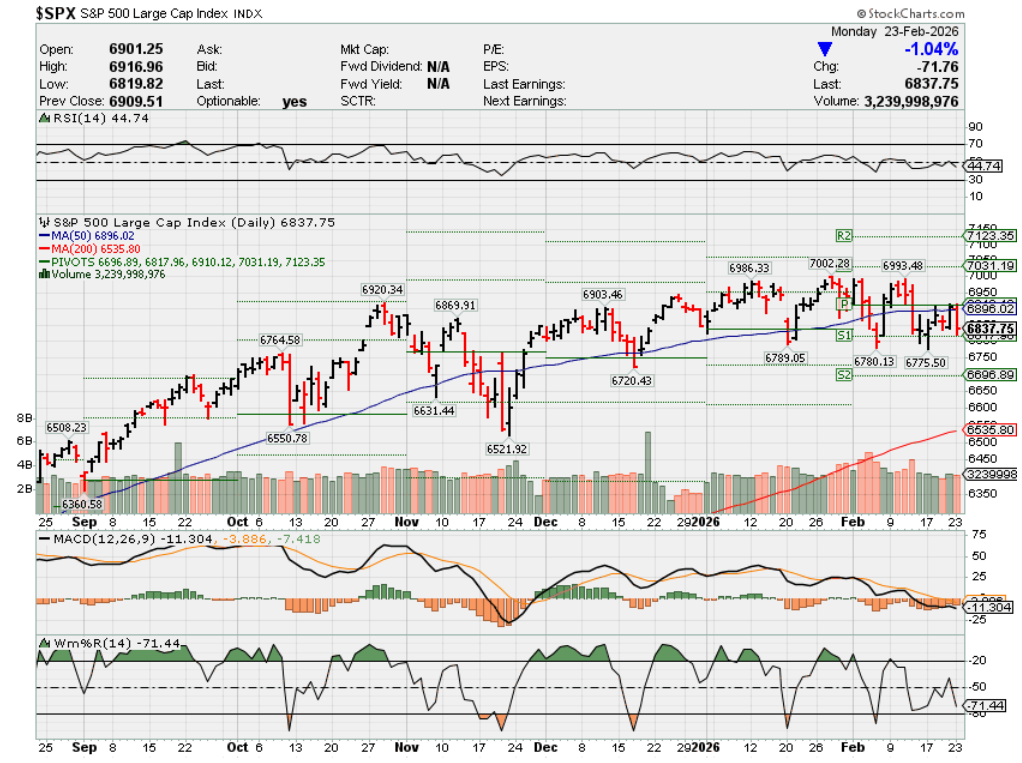
COMP – Bearish
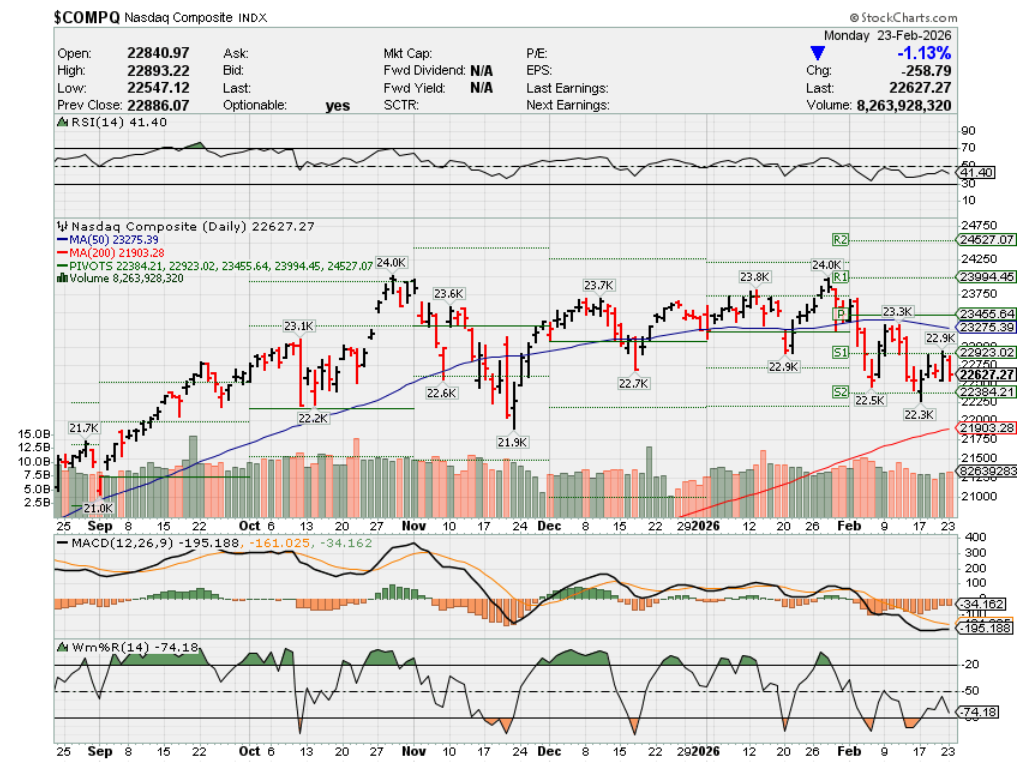
Where Will the SPX end Feb 2026?
02-23-2026 -1.0%
02-17-2026 +1.5%
02-09-2026 +1.5%
02-02-2026 +1.5%
Earnings:
Mon: DPZ, BBBY, MYGO
Tues: HD, KDP, AMC, SAM, FSLR, GDDY, HPQ, MOS, O
Wed: LOW, OC, TJX, SNOW, UHS, URBN, ZM, NVDA, CRM
Thur: LNG, HTZ, SHAK, CRWV, DELL, MNST, NTAP, BIDU, MXYZ
Fri: WU
Econ Reports:
Mon: Factory Orders,
Tue FHFA Housing Price Index, S&P Case Shiller, Consumer Confidence, Wholesale Inventories,
Wed: MBA, New Home Sales,
Thur: Initial Claims, Continuing Claims,
Fri: PPI, Core PPI, Chicago PMI, Construction Spending
How am I looking to trade?
Protection and still holding onto cash we raised end of last year/beginning of this year
www.myhurleyinvestment.com = Blogsite
info@hurleyinvestments.com = Email
Questions???
not all AI companies will be profitable, have go sort out who the winners will be, Nividia make picks and shovels, so has an
That’s the same thing they said about cell phone companies, Online entertainment, Automobiles,
Markets are moving now = We probably have a 6-8% drop lower from today before they rebound.
not all AI companies will be profitable, have go sort out who the winners will be, Nividia make picks and shovels, so has an
Supreme Court Trump tariffs ruling could put U.S. on hook for $175 billion in refunds, estimate says
Published Fri, Feb 20 202610:51 AM EST
Updated Fri, Feb 20 20262:13 PM EST
Key Points
- The U.S. government could owe more than $175 billion in refunds to importers after the Supreme Court ruled in a 6-3 decision that tariffs unilaterally imposed by President Donald Trump are illegal, a new estimate says.
- The potential refunds to a broad range of companies would be for tariffs already collected by the government since Trump slapped on the duties without authorization from Congress under the International Emergency Economic Powers Act, or IEEPA.
- The $175 billion refund estimate from the Penn Wharton Budget Model was produced at the request of Reuters. The model is a nonpartisan fiscal research group at the University of Pennsylvania.
The U.S. government could owe more than $175 billion in refunds to importers after the Supreme Court ruled Friday in a 6-3 decision that tariffs unilaterally imposed by President Donald Trump are illegal, a new estimate says.
The potential refunds to a broad range of companies would be for tariffs already collected by the government since Trump slapped on the duties without authorization from Congress.
The $175 billion refund estimate from the Penn Wharton Budget Model was produced at the request of the Reuters news wire service. The model is a nonpartisan fiscal research group at the University of Pennsylvania.
Multiple importers already have pending lawsuits seeking refunds of their tariffs, citing lower-court rulings that found Trump’s tariffs are not legal.
The Supreme Court ruling on Friday did not say that the federal government could keep the money it has already collected from those tariffs but didn’t explicitly address refunds.
The president had invoked the International Emergency Economic Powers Act to impose the tariffs. He was the first president to ever use IEEPA for that purpose.
Supreme Court Justice Brett Kavanaugh, one of three conservative members of the high court to dissent from Friday’s ruling, warned about the potential logistical difficulty of having to refund tariffs already collected.
“In the meantime, however, the interim effects of the Court’s decision could be substantial,” Kavanaugh wrote in his dissent.
“The United States may be required to refund billions of dollars to importers who paid the IEEPA tariffs, even though some importers may have already passed on costs to consumers or others,” he wrote.
“As was acknowledged at oral argument, the refund process is likely to be a ‘mess,’” Kavanaugh wrote.
“In addition, according to the Government, the IEEPA tariffs have helped facilitate trade deals worth trillions of dollars — including with foreign nations from China to the United Kingdom to Japan, and more,” he wrote.
“The Court’s decision could generate uncertainty regarding those trade arrangements.”
Brian LeBlanc, senior economist at PNC Financial Services Group, in a LinkedIn post Friday said “we estimate” that the IEEPA-related tariffs that have been ruled illegal constitute “roughly 60% of the tariffs issued to date.”
“That’s a big deal. Until President Trump replaces those tariffs with alternative authorities, the tariff rate just dropped from around 9.5% to around 5%,” LeBlanc wrote. “Refunds are going to be tricky, and we expect the Trump administration to replace most (but not all) of this lost tariff revenue.”
U.S. Customs and Border Protection in December said the amount of tariffs collected that would be at risk of having to be refunded was $133.5 billion.
That tally would have risen since then because of the ongoing collection of duties.
https://www.cnbc.com/2026/02/21/trump-tariffs.html
Trump to hike global tariffs to 15% from 10%, ‘effective immediately’
Published Sat, Feb 21 202611:23 AM EST
Key Points
- President Donald Trump on Saturday said he would increase global tariffs to 15% from 10%, one day after the Supreme Court struck down his “reciprocal” tariffs.
- The new tariffs will be “effective immediately,” Trump said in a Truth Social post.
- While Trump’s announcement claimed that the new tariffs will take effect without delay, it is unclear if any official documents have been signed detailing the timing.
President Donald Trump on Saturday said he would increase global tariffs to 15% from 10%, one day after the Supreme Court struck down a broad swath of the president’s trade agenda.
In a Truth Social post, Trump said the new tariffs will be “effective immediately.” He also warned that additional levies would follow.
“I, as President of the United States of America, will be, effective immediately, raising the 10% Worldwide Tariff on Countries, many of which have been “ripping” the U.S. off for decades, without retribution (until I came along!), to the fully allowed, and legally tested, 15% level,” he wrote.
“During the next short number of months, the Trump Administration will determine and issue the new and legally permissible Tariffs,” he added.
Trump’s announcement claimed that the new tariffs will take effect without delay, but it is unclear if any official documents have been signed detailing the timing. A White House fact sheet issued Friday said the original 10% tariffs would go into effect on Tuesday, Feb. 24, at 12:01 a.m. ET.
The White House did not immediately respond to a CNBC request for clarification.
Trump, who is scheduled to deliver his State of the Union address to Congress on Tuesday, was dealt a blow Friday when the Supreme Court decided in a 6-3 tariff ruling that the president wrongfully invoked the International Emergency Economic Powers Act (IEEPA) to implement his levies.
On Friday, Trump responded hours after the ruling with a 10% global tariff that he invoked under Section 122 of the Trade Act of 1974. The statute allows the president to impose temporary levies for 150 days. Any extension requires congressional approval.
The president was scathing in his remarks against the Supreme Court decision, calling the ruling “ridiculous, poorly written, and extraordinarily anti-American” in a social media post.
He also attacked Justices Neil Gorsuch and Amy Coney Barrett after they voted with the majority in the ruling.
Congressional Democrats rejoiced following the decision, with Senate Minority Leader Chuck Schumer, D-N.Y., saying in a statement that the tariffs were “chaotic and illegal.” Tariffs and the broader economy are expected to be key issues for the Democrats on the campaign trail for this year’s midterm elections in November.
Republicans were more divided on the issue. Some slammed the Supreme Court for its decision, while others argued that Congress has the constitutional authority to implement levies.
On Friday, stocks rallied initially following the Supreme Court decision, before pulling back and then recovering again. Investors expect the ruling could allay tensions between the U.S. and its trading partners, and possibly refund affected companies and reduce inflation.
How the U.S. government will proceed with refunds remains a question. By one estimate, the U.S. government could owe more than $175 billion in refunds to importers following the Supreme Court decision.
Mortgage rates sink to the lowest level in a month, sparking more refinance demand
Published Wed, Feb 18 20267:00 AM EST
Updated Wed, Feb 18 20268:06 AM EST
Diana Olick@in/dianaolick@DianaOlickCNBC@DianaOlick
Key Points
- The average contract interest rate for 30-year fixed-rate mortgages with conforming loan balances, $832,750 or less, decreased to 6.17% from 6.21%
- Applications to refinance a home loan rose 7% for the week and were 132% higher than the same week one year ago.
- Applications for a mortgage to purchase a home dropped 3% for the week and were just 8% higher than the same week one year ago.
Mortgage interest rates dropped last week to the lowest level in a month, prompting more current borrowers to seek savings in a refinance. While lower rates didn’t give potential buyers much incentive, the run on refinances was enough to push total mortgage demand 2.8% higher compared with the previous week, according to the Mortgage Bankers Association’s seasonally adjusted index.
The average contract interest rate for 30-year fixed-rate mortgages with conforming loan balances, $832,750 or less, decreased to 6.17% from 6.21%, with points remaining unchanged at 0.56, including the origination fee, for loans with a 20% down payment.
“Treasury yields ended the week lower as weaker data on retail sales and home sales outweighed better-than-expected readings on the job market for January,” said Joel Kan, vice president and deputy chief economist at the MBA, in a release.
As a result, applications to refinance a home loan rose 7% for the week and were 132% higher than the same week one year ago. Last year, rates were 76 basis points higher. While that annual jump may seem large, refinancing was at extremely low levels at this time last year.
“Refinance applications increased across all loan types, marking the strongest week for refinancing since mid-January,” Kan added.
Get Property Play directly to your inbox
CNBC’s Property Play with Diana Olick covers new and evolving opportunities for the real estate investor, delivered weekly to your inbox.
Applications for a mortgage to purchase a home dropped 3% for the week and were just 8% higher than the same week one year ago. While lower mortgage rates are making homes slightly more affordable, new supply is not coming onto the market fast enough, and concern over the broader economy has consumers sitting on the sidelines.
Mortgage rates didn’t move at all to start this holiday-shortened week, but economic data set for release this week could impact the current trajectory. In general, however, mortgage rates have been hovering in a pretty narrow range, between 6% and 6.25%, since the start of this year.
Charts suggest this sector could be the next to lead the market higher
Published Thu, Feb 19 20261:17 PM EST
All the talk going into next week will be about the importance of Nvidia’s results and the impact that it could have on the market. That’s no secret. I gave my thoughts to Morgan Brennan earlier in the week (literally early) on “Worldwide Exchange.”
The market recently hit some nice numerical milestones — S&P 7,000, Dow 50,000 — but those rallies were short lived and didn’t push much higher. The S&P 500 only reached the 7,000 milestone intraday and has struggled to close above that level, receding each time it has neared it. The market breadth has been strong, but the leadership is wrong.
That’s the bigger story.
Let’s simplify it.
What’s going on?
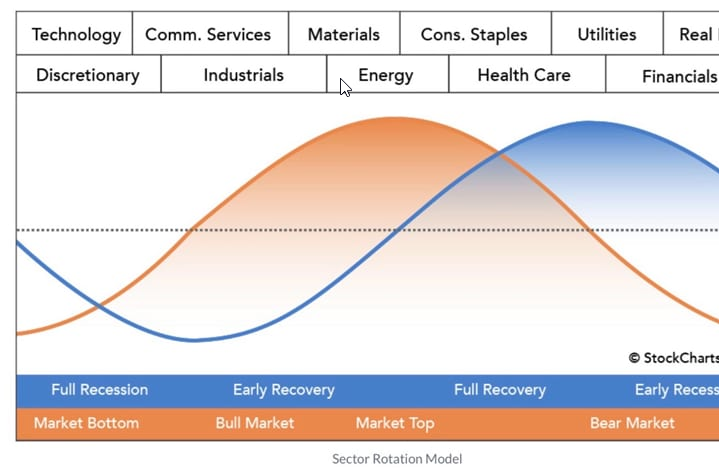
Let’s look at historical cycles to see the normal ebbs and flows of market rotation. This is from the CMT curriculum and shared by my friends at StockCharts.
What are the three leading sectors for 2026?
StockCharts.com
If you guessed energy, materials and staples, you would be correct. They have fantastic gains of 22.5%, 16.9% and 13.3%, respectively so far for 2026. These sectors tend to lead near market tops, hence not ideal leadership.
Will this be the top? I don’t think so, but a changing of the guard and a pause seems to be in order.
Past precedent
One of the things we discussed coming into the year was the importance of the presidential cycle. We are in year two — a midterm election year — and that tends to be the most challenging time for markets.
When looking back at Trump 1.0 in 2018, we see similar characteristics. What were three of the leading sectors that year? Health care, utilities and real estate.
Guess what sectors just lifted their heads over the past few weeks? Yep… Health care, utilities and real estate.
Last week utilities rallied over 8% and are sitting on the cusp of a major breakout. Real estate jumped as well. Just two weeks ago, it was 20% below its all-time high and now it’s coming back to life. The sector is up 7.4% for 2026 and looks to continue its climb.
Then there is health care.
The next to move?
In hockey, you succeed by skating where the puck is going. In the market, you need to position yourself toward new leadership.
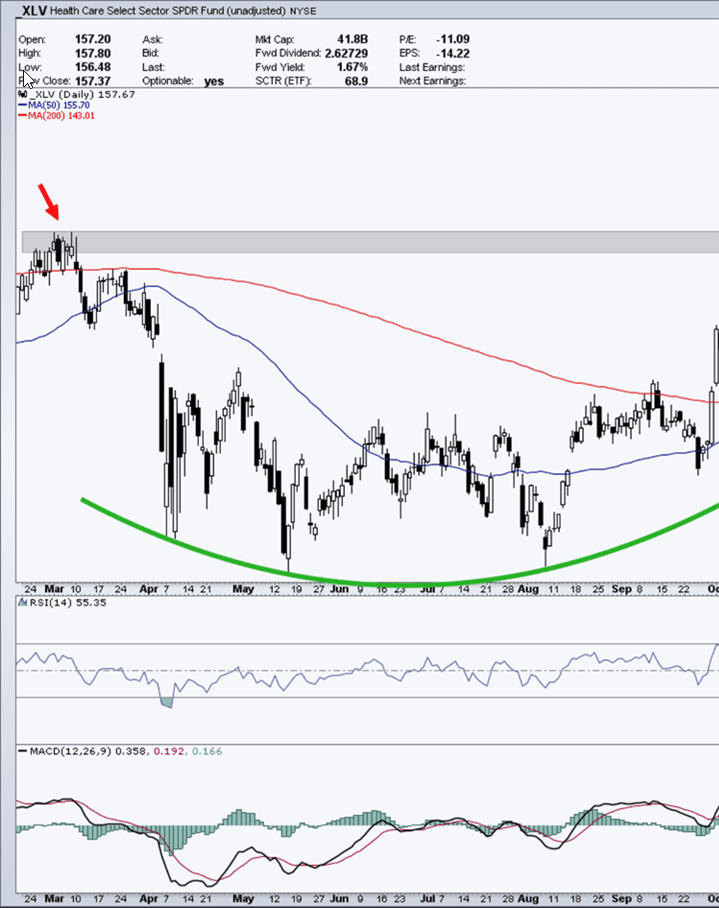
The State Street Health Care Select Sector SPDR ETF (XLV) is starting to turn around. It is only up 1.9% year-to-date, but when breaking down the technicals and watching the sector rotation going on in this market, we need to examine it more closely.
Some of its most well-known names in CVS, Humana and UnitedHealth have been struggling, but the largest components Merck, Johnson & Johnson and Amgen — all Dow stocks — are trading at or near 52-week highs.
StockCharts.com
On the yearly chart, we see a recent breakout and now an ascending triangle pattern that looks due to resolve. Given its momentum indicators and the recent breakout, the likelihood is for this to continue to new highs and move higher.
We also mentioned the cyclical nature of this market. Knowing this and seeing the current set-up, it is very likely to be the next sector to follow the lead of utilities and real estate.
StockCharts.com
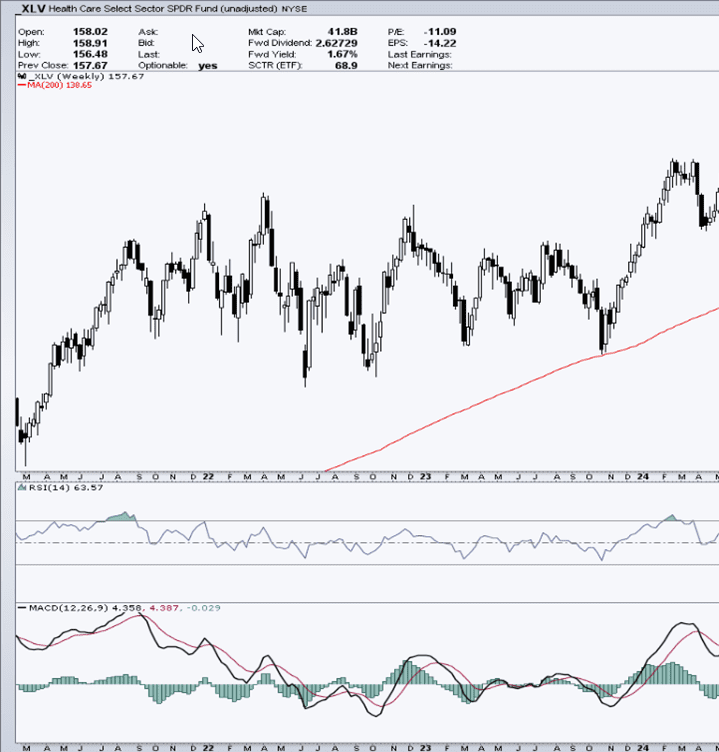
Lastly, it’s always good to put the moves in a longer-term perspective. When looking at the XLV on a five-year weekly chart, we see the sector is on the verge of a major breakout.
There are some negative momentum divergences on this time frame that make me think it may take more time before fully breaking out, but the $60 level is worth watching.
The trade
Again, this is a scenario of positioning your portfolio to where the puck will go next to capitalize on the opportunity. Here we see a golden one with great risk/reward set-ups that favor buying the sector.
The $160 level is crucial for confirmation that this trade will succeed. If price can clear this technical hurdle, look for upside targets to the mid 180′s over the next several months.
Until we get that sign, we wait patiently and add to the name on pullbacks to the $155 level. Depending on your risk threshold, it may take some time for the perfect trigger to shoot your shot but given the rotational theme, health care should be the next sector to thrive in this market environment.
— Jay Woods, CMT with Chase Games
DISCLOSURES: None.
All opinions expressed by the CNBC Pro contributors are solely their opinions and do not reflect the opinions of CNBC, or its parent company or affiliates, and may have been previously disseminated by them on television, radio, internet or another medium.
THIS CONTENT IS PROVIDED FOR INFORMATIONAL PURPOSES ONLY AND DOES NOT CONSTITUTE FINANCIAL, INVESTMENT, TAX OR LEGAL ADVICE OR A RECOMMENDATION TO BUY ANY SECURITY OR OTHER FINANCIAL ASSET. THE CONTENT IS GENERAL IN NATURE AND DOES NOT REFLECT ANY INDIVIDUAL’S UNIQUE PERSONAL CIRCUMSTANCES. THE ABOVE CONTENT MIGHT NOT BE SUITABLE FOR YOUR PARTICULAR CIRCUMSTANCES. BEFORE MAKING ANY FINANCIAL DECISIONS, YOU SHOULD STRONGLY CONSIDER SEEKING ADVICE FROM YOUR OWN FINANCIAL OR INVESTMENT ADVISOR.
Click here for the full disclaimer.
The ‘Magnificent Seven’ drove the stock market to record highs in recent years. Is the trade over?
Published Sun, Feb 22 20267:37 AM EST
Pia Singh@in/piasingh72/@pia_singh_
The “Magnificent Seven” that propelled the broader market to record heights in recent years has been flipped on its head this year.
All but two stocks in the group are in the red to start 2026, with Microsoft down nearly 18% and Tesla and Amazon each shedding more than 8%. Google-parent Alphabet, crowned one of the leading artificial intelligence winners of 2025, is roughly flat while chipmaking darling Nvidia is up just 1% this year. The Roundhill Magnificent Seven ETF (MAGS) is down nearly 6% year to date.
The declines come amid a flurry of concerns about these companies’ soaring capital expenditures on artificial intelligence — and their ability to meet increasingly high earnings growth expectations. Rapidly improving AI models and ramping industry competition are also adding volatility.
Scrutiny has also increased due to the stocks’ massive run-up, leading to a rotation away from high-growth names and towards cyclical areas of the market that have long been considered undervalued by comparison.
“All of these things are kind of creating a little bit of a headache and a headwind for the sector. Are they dead? They might be this year. They might just trade in a range,” Hightower Advisors chief investment strategist Stephanie Link told CNBC.
Free cash flow concerns
A notable issue for investors has been the strain in tech giants’ free cash flow given their AI-driven capex.
“The catalyst for the initial selling was some of them having negative free cash flow, and some of them just having flat year-over-year cash flow, as opposed to both that we have been seeing over the last decade with these companies,” Link said. “And I think you’re seeing a broadening out of the AI trade and that you don’t just have to own the Mag 7. There’s others that will win.”
Four of the largest U.S. technology companies by market cap — Alphabet, Amazon, Meta and Microsoft — are expecting to spend nearly $700 billion combined this year. That would be a roughly 60% increase from 2025 levels. Those four major internet companies together generated $200 billion in free cash flow last year, down from $237 billion in 2024.
Microsoft is now expecting roughly flat free cash flow for the first time in years, primarily due to intense spending on data centers. Amazon recorded an $11.2 billion drop in free cash flow for its fourth quarter, down from $38.2 billion for the year-ago period. Alphabet boasted strong free cash flow for its fourth quarter, but said it expects 2026 capital expenditures to nearly double its 2025 spend.
Link and Melius Research analyst Ben Reitzes both noted that the slide in Big Tech comes as the group’s AI investments have benefited a slew of downstream AI players — such as data center builders, power generating companies and energy infrastructure names.
“We wouldn’t be surprised if Broadcom generated more free cash flow than MSFT this year when it’s all said and done. The cash goes right from one place (the hyperscalers) and into another (NVDA, Broadcom and other infrastructure names) … Investors are voting with their feet so far this year since nobody can figure out hyperscaler free cash flow in the 2030s for their mental DCF model,” Reitzes wrote in a Thursday note to clients.
Stagnating earnings in question
Earnings growth is key for the Mag 7 moving forward to justify their lofty stock prices and valuations.
The season has been “so-far mediocre,” Barclays analyst Venu Krishna wrote in a Wednesday note to clients. Big Tech’s earnings per share growth is tracking at 26.6% year over year — which, “in the context of Big Tech’s own history is the slowest growth” since the first quarter of 2023, he said. Only Nvidia is left to report results, which he said could be make-or-break for the group.
“Big Tech EPS surprise is tracking at +5.3%, below the LT median of +7.2%, and unlike last quarter, there were no large one-time charges weighing down the group’s overall beat,” Krishna wrote, adding that “EPS deceleration is contributing to multiple compression.”
According to Krishna, Big Tech now trades at roughly 25 times forward earnings, returning to valuation levels last seen in the first half of last year.
Even though most of the Big Tech companies that have reported have beaten estimates on top and bottom lines, it has not been enough for Wall Street.
Microsoft shares experienced a historical sell-off even after the company posted its largest earnings beat ever. Investors came away disappointed by slightly weaker-than-expected growth in Azure and other cloud services, and many remain skeptical about Microsoft Copilot’s growth given the company’s high capex levels.
Bryn Talkington, founder and managing partner of Requisite Capital Management, thinks the market is in wait-and-see mode for results driven by tech companies’ AI capex. Alexa and Copilot are laggards compared to peer AI products, she said.
“When you actually look at earnings and margins, squarely, all of the earnings and margins still come from tech … The market does not like the capex spend and until there’s a clear line of sight for what these companies are solving for, the Microsoft’s, the Amazon’s will continue to be under pressure,” Talkington said Thursday on CNBC’s “Halftime Report.”
On top of these worries, the market rotation has also pressured tech this year. Cyclical companies that sat out of the bull market rally are now benefiting from strength in the U.S. economy and gross domestic product growth, GDS Wealth Management’s Glen Smith pointed out.
“Mag 7 stocks are struggling this year simply because these stocks are exhausted. These are incredible companies and incredible stocks, but at some point, a breather is needed,” said Smith, GDS’ chief investment officer. “So much of the AI-related boost has already been priced in.”
Some Wall Street banks are also getting less bullish on tech. In a move to “diversify” its Mag 7 exposure, Citi on Thursday downgraded technology to neutral and moved half of its overweight tech holdings into cyclicals.
U.S. launches Peace Corps-backed ‘Tech Corps’ to help export AI, counter China
Published Sun, Feb 22 20269:43 PM ESTUpdated Mon, Feb 23 20268:41 AM EST
Dylan Butts@in/dylan-b-7a451a107
Key Points
- The White House launched the Tech Corps to export U.S. AI through the Peace Corps model.
- The Tech Corps will implement AI solutions aimed at “real-world grassroots problems” across key sectors, including agriculture, education, health and economic development.
As competition with China intensifies, Washington is turning to a cornerstone of American soft power and diplomacy to expand its global influence in artificial intelligence: the Peace Corps.
The White House on Friday announced the “Tech Corps” initiative within the Peace Corps aimed at promoting American AI abroad and helping partner nations adopt cutting-edge systems.
The Peace Corps is an independent U.S. government agency that sends American volunteers abroad to support local development projects, including in education, health, agriculture and economic growth.
The new Tech Corps will be structured similarly but will recruit, train, and deploy volunteers with tech skills, including engineers and graduates in science, technology, engineering, and mathematics to provide “last-mile” support for the implementation of American AI solutions abroad, particularly at the application layer.
A website for the Tech Corps has launched and is accepting applications, which it says will be accepted on a rolling basis.
In an announcement, the Peace Corps said that the AI solutions the new group implements would be put towards “real-world grassroots problems” in key sectors, including agriculture, education, health, and economic development.
Volunteers would be sent to countries participating in the American AI Exports Program, announced in July under a Trump administration executive order aimed at maintaining U.S. dominance in advanced technologies globally.
The executive order aligns with broader U.S. efforts to counter the influence of Chinese technologies globally, including in developing nations.
Chinese firms have gained traction in some developing nations by offering open-source or open-weight models that are inexpensive, highly customizable, and able to run on local infrastructure — including Qwen3 and Deepseek.
AI sovereignty
While a full list of countries taking part in the AI Exports Program remains unclear, India is expected to be among them, with the Commerce Department welcoming its participation last week.
That statement had come ahead of the inaugural India AI Impact Summit 2026 in New Delhi, where Michael Kratsios, director of the White House Office of Science and Technology Policy, first announced the Tech Corps.
India is also joining the U.S.-led Pax Silica initiative — a Trump administration effort aimed at securing the global supply chain for silicon-based technologies — alongside Japan, South Korea, Singapore, the Netherlands, Israel, the United Kingdom, Australia, Qatar and the UAE as core members.
At the summit, Kratsios argued that expanding access to U.S. AI technologies was central to closing the gap in global AI adoption between developed and developing economies. “Real AI sovereignty means owning and using best-in-class technology for the benefit of your people,” he said.
AI sovereignty — which was a major topic at the Indian AI conference — refers to a country’s ability to develop, control and govern artificial intelligence systems within its own legal, economic and strategic framework.
The summit saw a number of American tech companies announce major investments in India’s AI infrastructure, building on the billions announced last year, aligning with the goals of the Tech Corps.
“AI is the future, and as the undisputed world leader in AI technology, the United States, through the Tech Corps, will be at the forefront of delivering these benefits,” said Richard E. Swarttz, acting Peace Corps director.
Tech Corps volunteers will serve abroad for 12 to 27 months or participate in virtual service placements, with on-ground deployments expected to begin in fall 2026. As with the Peace Corps, volunteers will receive housing, healthcare, a living stipend, and service awards upon completion.
In addition to the Tech Corps, the White House also announced other initiatives during the India AI summit, including a National Champions Initiative to integrate leading foreign AI companies into customized American AI export stacks.
“We recognize that partners need the chance to build their native technology industries, and believe facilitating this will be a critical part of the exports program,” the White House said.
It also announced new initiatives to help partner countries “overcome financing obstacles as they import the American AI stack,” through other soft-power institutions such as the World Bank and the U.S. International Development Finance Corporation.

1 comment
Great article, i really enjoy reading it, i hope you post more, keep up the good wok , is gona come follow you for more , nice reading it.