

OK OIL first today with the possibility for the Kharg Island or Iran’s oil wells destroyed if Iran doesn’t immediately open the Hormuz Strait
I personally would rather have a down stock market for a while than have a possible 11 or even 1 nuclear missile fired off from the Middle East
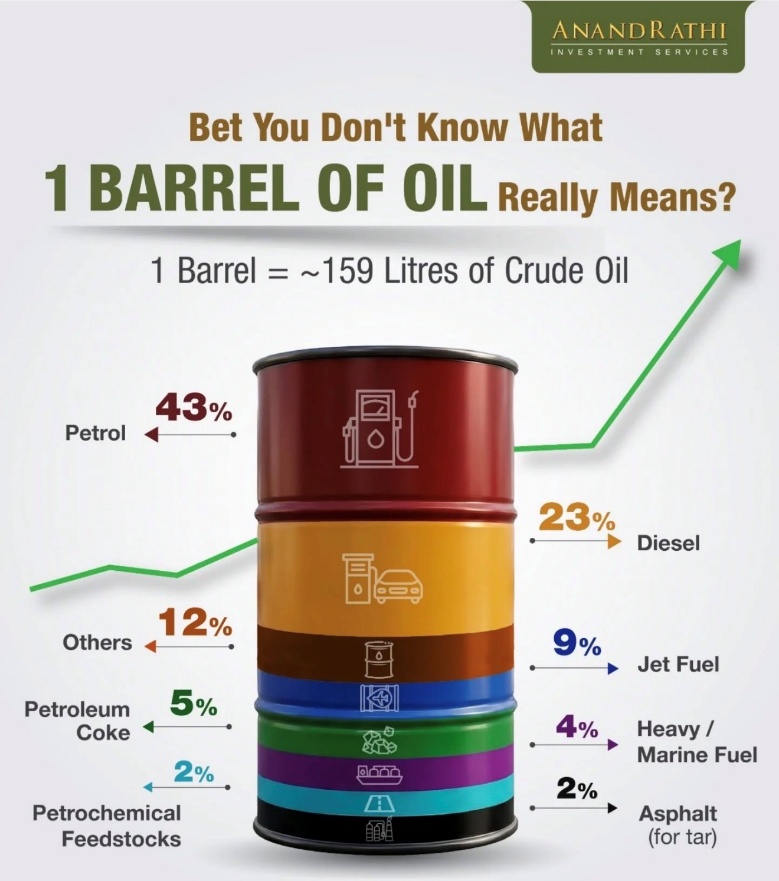
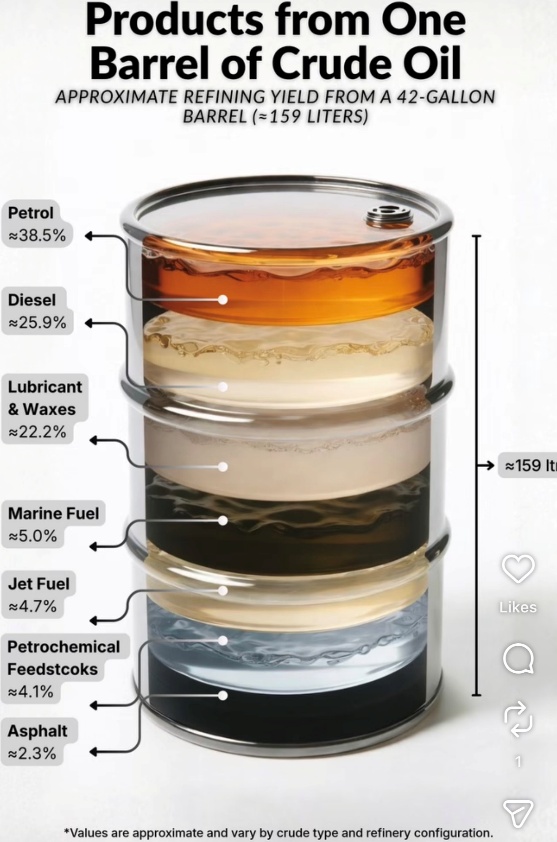
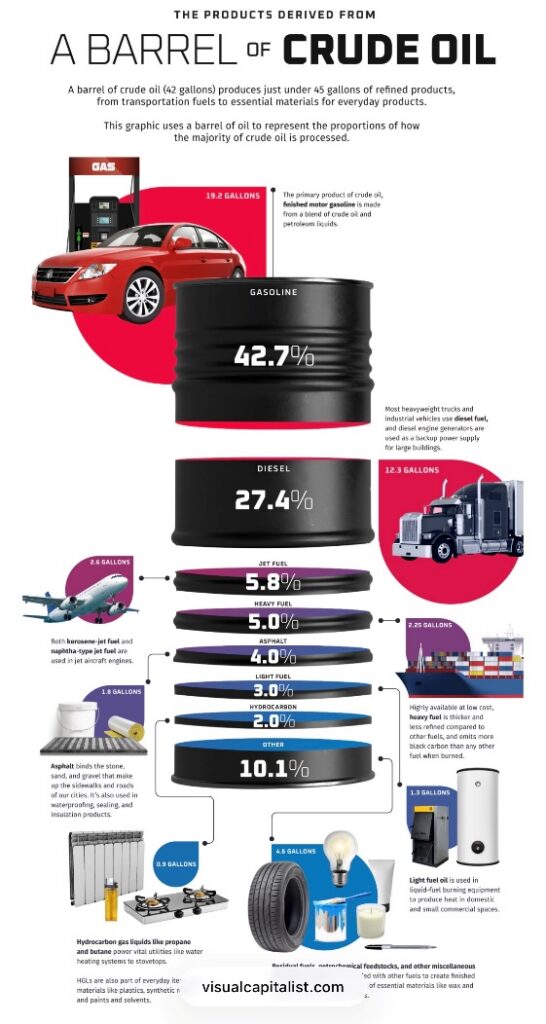
https://eureka.patsnap.com/article/light-crude-vs-heavy-crude-what-is-the-difference
Please be careful of what you say. Last Week I said light crude mostly comes from Canada as I’ve done the research and can read the Oil import numbers given by the US Government
Investors sold off chip stocks amid concerns that a prolonged conflict could disrupt global supply chains and push inflation higher across the semiconductor industry.
Nauman Khan Fri, March 27, 2026
When you in sentiment driven market, facts and figures, comments from leaders and reality all gets distorted!!!
Not all AI can be profitable? WHY because all auto industry participants, all online movie participants all stores, gas station, refiners,
Blue vs Orange MoneyBlock brokerages – It has to do with the same issue identified earlier with not all option values getting picked up in the after hours pricing feed. The tech folks have been troubleshooting the issue and are working on a solution. I know you don’t like getting these calls or messages from clients any more than I like getting them from you. I have emphasized the urgency in getting this fixed as quickly as possible and once again apologize for putting you guys in the situation to start with.
Two things tonight to help you as a client better understand what we do!
Let’s work through the collar trade and/or protective put protection on stock:
How much risk do you have in stock ownership?$100 Share of stock = EVERY FREAKING PENNY
$100 x 1000 share = $100,000
Buy a protective put ATM $100 out in time 2-3 is should cost no more than 4.1%
$100 + 4 PP = $104 = New Cost basis
Long Put which gives you the right to sell your stock at a certain price for a certain period of time.
What is risk of your new cost basis? Per share = $4 roughly 3.9% of your total invested capital (TIC)
We like to lower the risk even more by Selling a covered call
Covered call = Obligation to sell your stock at a certain price for a certain period of time = $110
We would receive = $2 – $2.5 credit to be obligated to sell stock at a higher price than our cost basis
Overall risk per share = $100 + $4 PP – $2.50 CCC = $101.50
Overall risk per share as long as we keep the PP in place $1.5 or 1.4 TIC or $1,400
Because what do HI do if the stock looses 50% of it’s value
$100 goes to $50 and we can still sell @ $100 = We are dollar cost averaging for you and picking up twice as many shares of stock
We lose the $4 for protection but we now gain twice as many shares of stock
NEW cost basis after we DCA $4 / 2 shares = $2 each shares is $50 = $52
2000 shares X $100 per share = $200,000
OK now let’s work through the leap long call strategy or stock replacement strategy
MU was $471.14 but today it closed at $321.80 = IT lost $149.34
IF we were in 300 = $42,802
IF we were in 500 = $74,600
IF we were in 1000 = $149,300 lost in stock ownership
We use LEAP long calls = Right to buy obligated to sell higher

Maximum risk is $33.35
On a stock that has lost OVER $200 has lost your investment $13 per share per contract $5200
Vs stock ownership which would be $80K

THESE ARE RISK FREE TRADES –

LAST Comment – How Important is every single account and why?
OUR accounts get hit the same amount as yours, IF we lose 10% in an account that we are charging=10% roughly in all accounts which means we get paid 10 LESS for that month
Earnings – Start end of Earnings Season AA April 16th
Next week we will have earnings out for you
https://www.briefing.com/the-big-picture
The Big Picture
Last Updated: 27-Mar-26 13:41 ET | Archive
Fog of war clouds the prior rose-colored outlook
Briefing.com Summary:
*Market sentiment has soured since the start of the war with Iran.
*Earnings estimates have continued to increase, but doubts are surfacing about the achievability of those estimates.
*The market is nearing some red lines that create an opportunity to leg into beaten-down stocks and sectors.
Through February 28, the stock market was looking pretty good. Granted, most of the mega-cap cohort was languishing, but the broader market seemed to be benefiting at their expense, fueled by confidence in the economic, earnings growth, and interest rate outlooks.
One day and one month, though, has made things look and feel differently. On February 28, the U.S. and Israel jointly launched a military campaign against Iran under the pretense of preventing Iran from getting a nuclear weapon, destroying its ballistic missile-making capabilities, and triggering regime change.
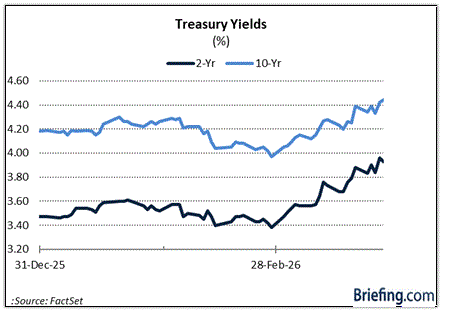
The ensuing market response has not been good. The major indices have rolled over; oil prices have skyrocketed 47%; the 2-yr note yield has spiked 53 basis points; the 10-yr note yield has jumped 46 basis points; and expectations for another rate cut this year have been swept away.
Simply put, the fog of war has clouded the stock market’s rose-colored outlook.
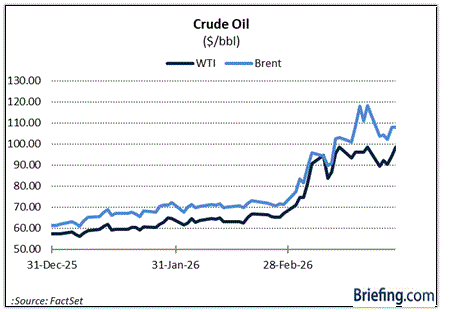
Takes Two to Tango
With oil prices rising due to shipping disruptions through the Strait of Hormuz, inflation concerns have increased. That is the genesis of why Treasury yields have risen and why market participants no longer expect a rate cut this year. In fact, the fed funds futures market has assigned a 37% probability to a 25-basis-point hike at the December FOMC meeting, according to the CME FedWatch Tool.
A rate hike in 2026 wasn’t on anyone’s bingo card when the year began, so it goes to show how quickly this geopolitical conflagration has changed the dynamic.
The latter point notwithstanding, the stock market is still harboring hope that the Iran war can end soon and that oil, fertilizer, and other goods can start flowing freely again through the Strait of Hormuz. The main hangup at the moment is that there is no clear sense that Iran harbors the same hope.
It bears repeating that it takes only one party to start a war, but both parties to end it. On that note, just because the U.S. declares the war is over doesn’t mean Iran will consider the war over. That is why the context and the participation around any such declaration are key for the market’s direction of travel.
For now, things are going south in terms of stock prices and bond prices, but not all things are going south. Remarkably, earnings estimates have continued to rise.
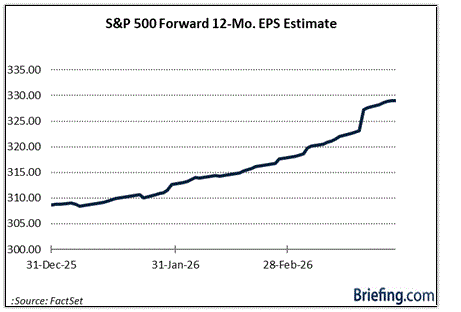
On February 27, the forward twelve-month earnings estimate for the S&P 500 was $317.82. Today it is $329.02. With the S&P 500 down 7% in the interim, the result has been multiple compression. The forward 12-month P/E multiple has slipped from 21.7 to 19.7, a slight premium to its 10-year average. For the equal-weighted S&P 500, the forward twelve-month P/E multiple has gone from 17.6 to 15.9, which is a 5% discount to its 10-yr average.
Things have gotten less expensive, but of course, things have also gotten a lot more uncertain and have created misgivings about the achievability of earnings estimates.
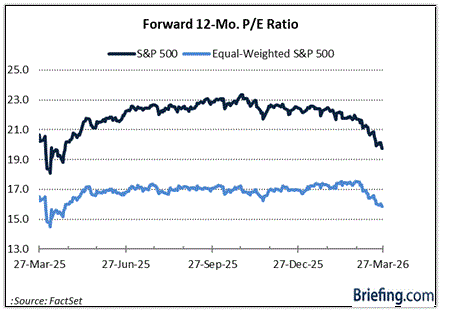
Picking Spots
Although the U.S. and Israel started the war with Iran, the reverberations of what is going on are not isolated. They are having far-reaching effects around the globe, with markets in Europe and Asia feeling the pinch of shipping disruptions more acutely than the U.S., since they are highly dependent on energy imports.
The energy price shock for them, then, has a higher voltage than it does for the U.S. Nonetheless, the interconnected global economy is at risk of seeing a slowdown in spending driven by supply chain disruptions that are leading to higher prices for consumers and businesses alike.
Central banks are all grappling with whether to raise rates to combat the inflation pressure. That understanding has driven up sovereign bond yields and has led to flatter yield curves and less conviction in the outlook. Hence, the willingness to buy complacently on any dip has been supplanted by more discernment related to the achievability of earnings estimates.
Market participants are no longer chasing stocks higher. Rather, they are picking spots to average down in an environment where phrases like “stagflation,” “recession,” “rate hikes,” and “tighter financial conditions” are a credible part of the market narrative that is also featuring talk of private credit concerns and AI disruption.
They have a lot of spots from which to choose. Every S&P 500 sector is down since the war began, with losses ranging from 3.2% to 11.5%. The lone exception is the well-situated energy sector (+12.5%). The major indices have fallen between 8% and 12% from their 52-week highs. Only 22% of S&P 500 stocks are above their 50-day moving average, while only 44% are above their 200-day moving average.
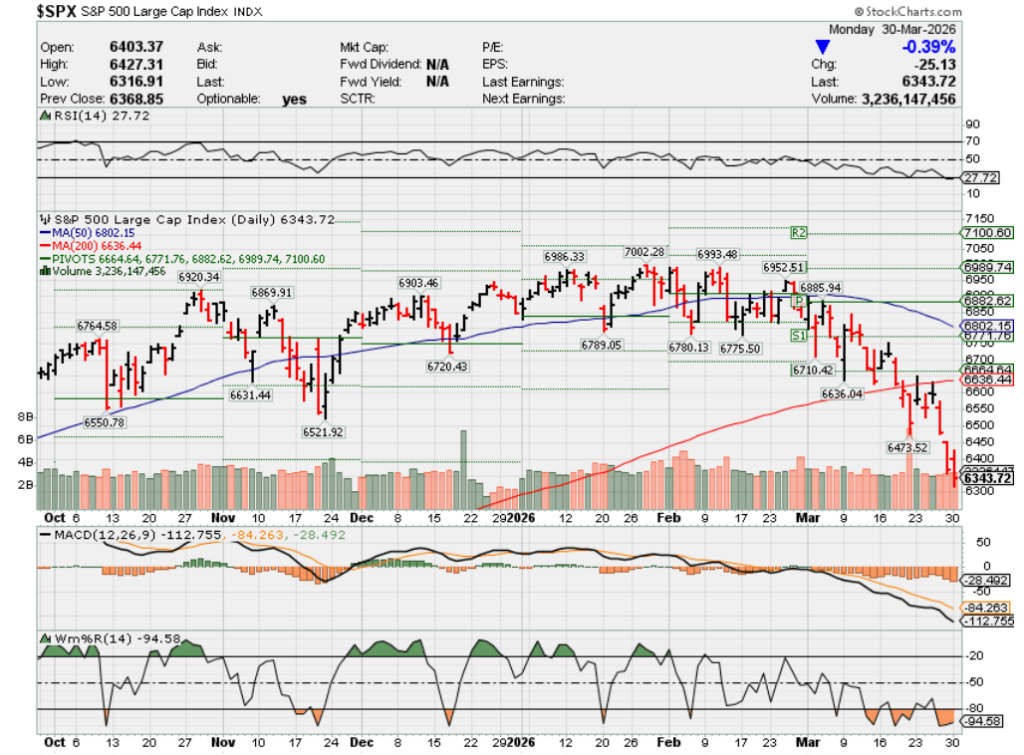
The S&P 500 itself is trading below its 200-day moving average (6,635).
Briefing.com Analyst Insight
The stock market has gone from looking supremely confident to looking inordinately shaky. That could change in a hurry if, and when, the U.S., Israel, and Iran are all on the same ceasefire page, and the hope is that concession comes sooner rather than later.
In The Big Picture column we posted on March 5, we identified some red lines that we think President Trump wouldn’t want to see markets cross with velocity. They were $100.00/bbl oil, a 4-handle on the national average for gasoline prices (we’re at $3.98 now, according to AAA), a 4.50% 10-yr note yield, and an S&P 500 that trades below 6,300. The latter would mark a 10% correction from the 52-week high.
We are close in each respect, so it is our expectation that the Trump put will be exercised in some fashion when those lines are crossed. Again, though, for the sentiment tide to turn, there has to be conviction in the belief that Iran is done being at war with the U.S. and Israel as much as the U.S. and Israel are done being at war with Iran and its proxies.
That understanding and when it is no longer in doubt are equally important. The longer the war drags on, the longer the energy price shock and supply chain disruptions will persist and upend global economic activity and lofty earnings estimates.
With the S&P 500 nearing a 10% correction and some other important red lines coming into focus, there is an opportunity to start legging into the market with cash sitting on the sidelines. However, with other issues lurking out there, like the private credit worries, rising mortgage default rates, tariffs, and AI disruption, it is not an “all-in” environment because it is tough to be all-in like before on the achievability of earnings estimates.
—Patrick J. O’Hare, Briefing.com
Where will our markets end this week?
HIGHER
DJIA – Bearish
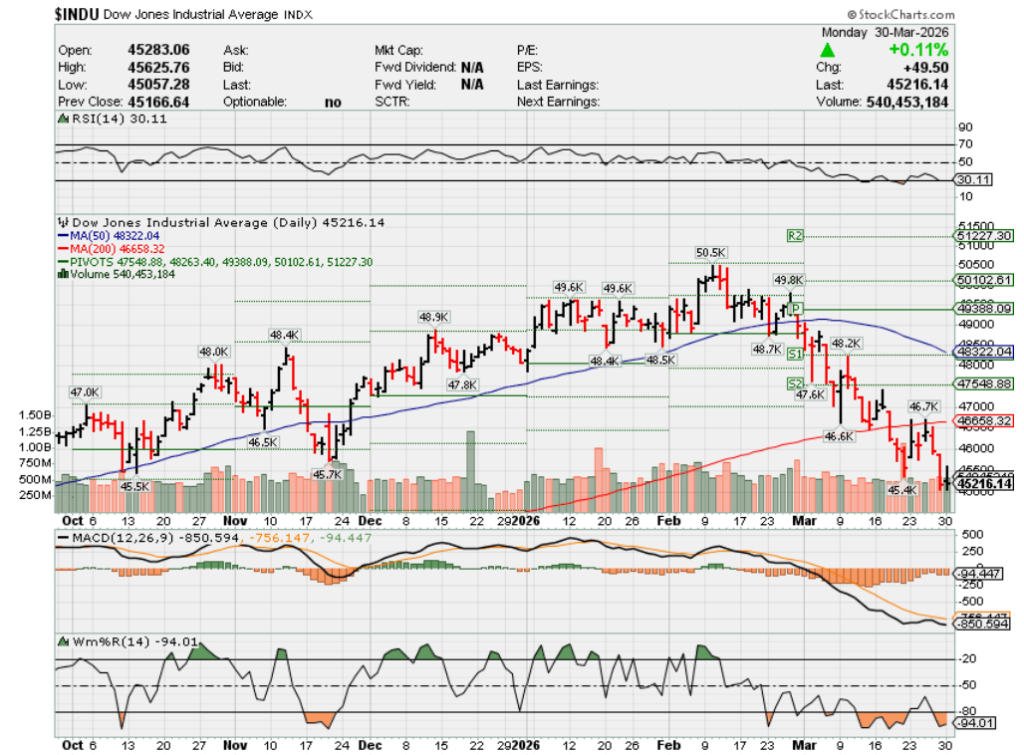
SPX – Bearish
COMP – Bearish
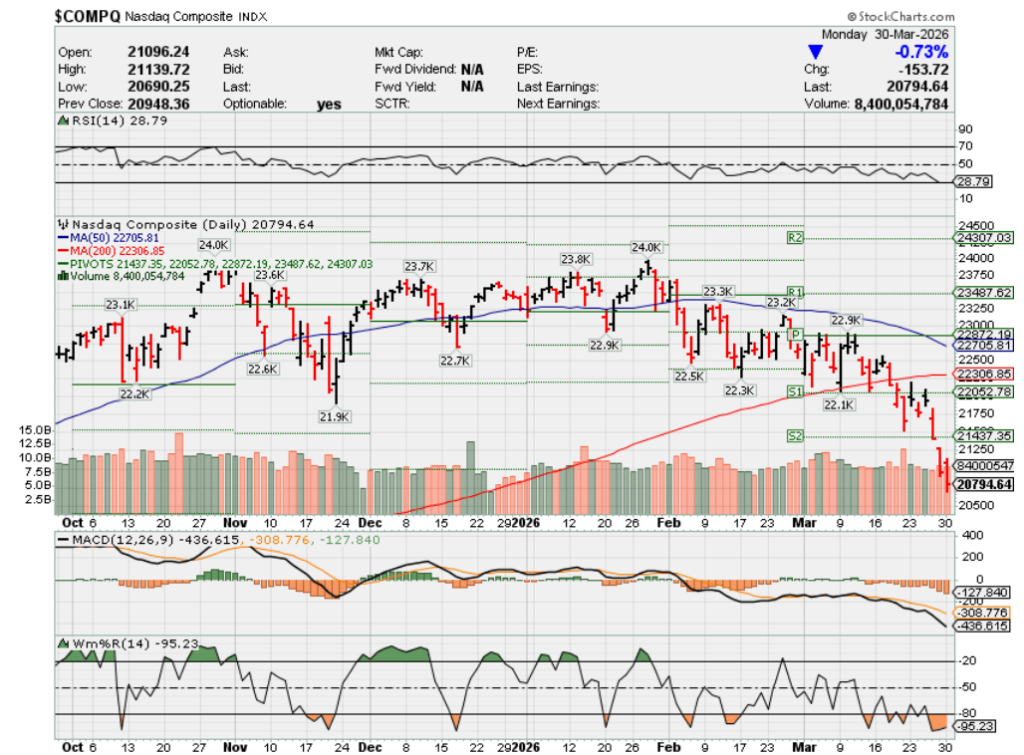
Where Will the SPX end March 2026?
03-23.2026 -4.0%
03-09-2026 -2.0%
03-02-2026 -2.0%
Earnings:
Mon:
Tues: PLAY, NKE, PVH
Wed:
Thur:
Fri:
Econ Reports:
Mon:
Tue FHFA Housing Price Index, S&P Case-Shiller
Wed: MBA, ADP Employment, Retail. Retail ex-Auto, ISM Manufacturing,
Thur: Initial Claims, Continuing Claims, Business Inventories, Trade Balance,
Fri: GOOD FRIDAY
How am I looking to trade?
Protection and still holding onto cash we raised end of last year/beginning of this year
Looking to protect Friday for when nothing gets resolved or we bomb him!!!
www.myhurleyinvestment.com = Blogsite
info@hurleyinvestments.com = Email
Questions???
Google sells partial stake in fiber business, becomes minority owner of new venture
Published Wed, Mar 11 20267:27 PM EDTUpdated Wed, Mar 11 202611:19 PM EDT
Jennifer Elias@in/jennifer-elias-845b1130/
Key Points
- Google said its GFiber unit is combing with Astound Broadband and forming a independent fiber provider.
- The new entity will be majority owned by investment firm Stonepeak.
- “This partnership with Astound and Stonepeak is the next step in our decade-long mission to redefine what customers can expect from their internet provider,” GFiber CEO Dinni Jain said in a statement.
Google said its fiber internet unit called GFiber is combining with Astound Broadband and forming an independent provider, with Google remaining as a minority shareholder.
The new company will be majority owned by investment firm Stonepeak and led by the existing GFiber executive team, “utilizing their expertise in high-speed fiber innovation to manage the combined network footprint,” Google said in a press release on Wednesday. The transaction is expected to close in the fourth quarter.
Google Fiber, launched in 2010, was an early effort by Google to build ultra-fast fiber-optic broadband networks in the U.S., starting with a gigabit-speed rollout in Kansas City in 2012. Google proposed building gigabit fiber connections to homes, far faster than typical U.S. internet speeds at the time.
Since then, some planned expansions were canceled and the company focused on select markets rather than a costly and time-intensive nationwide rollout.
The spinout comes at a time when demand is growing for high-capacity networks fueled by the increasing popularity of artificial intelligence services. The external capital will help the new entity expand across the country, the company said.
“This partnership with Astound and Stonepeak is the next step in our decade-long mission to redefine what customers can expect from their internet provider,” GFiber CEO Dinni Jain said in the release.
GFiber has been part of Google’s “Other Bets” segment, which includes non-core assets such as the Waymo robotaxi division and drug discovery business Isomorphic Labs. In 2025, the combined segment generated $1.54 billion in revenue, or less than 0.5% of Alphabet’s total sales, and recorded an operating loss of $16.8 billion.
The shift toward fiber infrastructure has become increasingly important as demand grows for networks that can support cloud computing, streaming and emerging AI services. U.S. tech giants are also rolling out a rapidly expanding network of transcontinental subsea cables, seeking to keep pace with growing bandwidth demand.
Astound is a major U.S. cable operator and broadband platform, which was acquired by Stonepeak in 2021 for $8.1 billion. Stonepeak specializes in infrastructure and real estate.
A Google spokesperson didn’t immediately respond to a request for comment.
https://www.cnbc.com/2026/03/30/micron-stock-earnings-sell-off-memory-shortage.html
Micron stock sinks 10%, further cratering in post-earnings sell-off
Published Mon, Mar 30 20264:09 PM EDTUpdated 47 Min Ago
Lola Murti@in/lolamurti/@lolavkm
Key Points
- Micron shares fell 10% Monday, continuing a slide that began after the company reported earnings on March 18.
- The memory company’s stock has cratered 30% since that blowout report.
- CEO Sanjay Mehrotra said on the earnings call that the company has been unable to meet the soaring demand for its chips.
Micron shares plummeted 10% on Monday, continuing the memory maker’s significant post-earnings sell-off.
The company snapped a six-day slide on Friday with a modest gain, but with Monday’s loss, the stock is down 30% since its blowout earnings report on March 18.
Other tech names also saw big losses Monday as oil climbed with the Iran war entering a fifth week and President Donald Trump threatening to destroy the country’s oil facilities. Neocloud companies CoreWeave and Nebius were each down about 8%, while memory makers SanDisk and Western Digital sank 7% and 9%, respectively.
Micron’s strong earnings report for the second quarter was fueled by insatiable demand for artificial intelligence chips.
Micron, SK Hynix and Samsung are the major memory suppliers for high-performance AI chips from companies like Nvidia. The surge in AI demand has led to a shortage.
After reporting earnings, CEO Sanjay Mehrotra told CNBC’s “Squawk on the Street” that key Micron customers only get “half to two-thirds of their requirements” due to the supply crunch.
Micron shares are up 270% from one year ago, but most of those gains have retreated in 2026. The stock is only up about 2% year to date after the recent slide.
Netflix raises prices across all streaming plans
Published Thu, Mar 26 20264:04 PM EDTUpdated Thu, Mar 26 20265:44 PM EDT
Key Points
- Netflix subscription plans have increased in price for the first time since January 2025.
- The price hike comes as Netflix has been investing heavily in its content, including new ventures into the live events space and launching video podcasts.
- Extra member pricing was also increased.
Your Netflix subscription just got a little more expensive.
The streaming giant adjusted its pricing structure Thursday, with all subscription tiers rising at least $1.
The company’s ad-supported plan is now $8.99 a month, up from $7.99; the standard plan is now $19.99 a month, up from $17.99; and its premium plan is now $26.99, up from $24.99. Extra member pricing also increased, with ad-supported plans now costing $6.99 per additional non-household user, up from $5.99, and ad-free add-ons now costing $9.99, up from $8.99 each.
The price hike comes as Netflix has been investing heavily in its content, including new ventures into the live events space and into video podcasts. The last time the company raised prices was January 2025.
Netflix executives have long defended price increases by touting the amount of content available on the platform and how subscription costs can be used to invest in new projects. During its January earnings report, the company said it expects to spend $20 billion in 2026 on content, up from $18 billion in 2025.
Netflix said at the time that it expected 2026 overall revenue to range between $50.7 billion and $51.7 billion, due to increases in membership and pricing, as well as “a projected rough doubling of ad revenue in 2026” compared with the prior year.
At that time, Netflix was still poised to acquire the Warner Bros. studio and its streaming service HBO Max, however, the company declined to match a higher bid made by Paramount in February.
Most major streamers have raised prices in recent years as they chase hard-to-reach profitability for the subscription businesses.
https://www.cnbc.com/2026/03/25/jim-cramer-wall-street-denial-market.html
Jim Cramer says Wall Street is in denial about the market
Published Wed, Mar 25 20266:29 PM EDT
Key Points
- Jim Cramer says that Wall Street is in denial about the “presidential put”
- When in doubt, Cramer says investors should be following the direction of oil
Wall Street is in denial about the market’s strength, Jim Cramer said, arguing that investors are dismissing falling oil prices and what he calls the “presidential put.”
“When in doubt in this market, check the direction of oil. Ignore those who scoff at every word out of the president’s mouth,” said Cramer Wednesday on “Mad Money,” noting that President Donald Trump has often been able to talk the market out of a rut.
According to Cramer, the street chose to focus on the doom and gloom of rising oil prices, disregarding Wednesday’s pullback.
“Everyone was acting like oil was still soaring,” Cramer said.
Oil fell Wednesday amid investor optimism that the U.S. and Iran could agree to a ceasefire. The pullback followed reports that Iran received a 15-point proposal from the U.S. to end the war. On Wednesday, Iran state media said they would reject the offer and instead issued a plan out a five-point plan with conditions that the country controls the Strait of Hormuz.
International benchmark Brent Crude shed 2.17% to settle at $102.22 per barrel, while West Texas Intermediate dropped 2.2% to $90.32 per barrel following the developments.
“I’m seeing denial all over the place, and it’s really cutting into everyone’s performance,” Cramer said, noting that stocks advanced on Wednesday.
The Dow Jones Industrial Average rose 300 points. The S&P 500 and Nasdaq Composite also closed the session out modestly higher.
“Whoever is selling at that moment has to stop because the presidential put has spoken,” said Cramer. “The president likes to keep the market in the air and knows the words people want to hear.”
Cramer said investors should stop ignoring the truth of what’s occurring both in oil and the broader market.
“Stop drinking denial,” Cramer said. “You’re gonna get sick.”
Is now the time to buy Nvidia? Cramer says ask these questions to arrive at an answer
Published Thu, Mar 26 20266:26 PM EDT
Key Points
- CNBC’s Jim Cramer said Thursday investors should use a checklist to inform their stock picking decisions during the war.
- The “Mad Money” host used Nvidia as an example to demonstrate the exercise.
Iran war has something to do with Nvidia stock being down, but it’s not totally quantifiable, says Jim Cramer
The war in Iran has forced investors to act more like military strategists instead of stock pickers, CNBC’s Jim Cramer said Thursday. However, he recommended investors ask themselves a series of questions to guide their decision-making with the conflict’s resolution still uncertain.
“I’m going to turn the whole process upside down and think about what the war really means to someone who’s simply trying to build a portfolio,” Cramer said on “Mad Money,” shortly after President Donald Trump announced he was extending the pause on bombing Iranian energy facilities to April 6.
“We know we can’t predict the outcome of the war. We can’t predict the timing either as tonight’s bombing pause extension shows … But what we can gauge is whether the stocks we like have much of a connection to the war,” Cramer said.
Nvidia is an “obvious” example where utilizing a checklist can help determine if the stock is worth buying in this moment, Cramer said. Shares of the leading artificial intelligence chipmaker are down a little over 3% since Feb. 27, the last trading day before the war broke out.
“First, we have to ask, is Nvidia’s stock down because of the war, ” Cramer said. In Nvidia’s case, its direct ties to the conflict are difficult to quantify, he said. “Nvidia is a big part of the stock market itself and so it’s the easiest stock in the world to trade. I think it’s going down because it is so easy to get back in at a lower level.”
Interest rates are another factor to consider, Cramer said, since higher rates could raise borrowing costs, ultimately slowing the data center buildout. “That said, if the war ends soon and we have a new Fed chief, you’ll feel like a moron for staying away from Nvidia,” he argued.
Third, Cramer said investors need to consider whether there are intrinsic reasons for Nvidia’s performance. “Right now, the tech industry is short on what we call compute and its also short on memory. That means it’s short the computers that have Nvidia inside,” he said. Cramer acknowledged that sky-high memory prices could indirectly weigh on demand for Nvidia’s chips, given the overall cost of the servers will be higher and consume more of customers’ budgets. But the fundamental demand picture is still strong, he noted.
Oil is also a factor, though Cramer isn’t too concerned about it. “Nvidia’s data centers run mostly on natural gas, which is U.S.-based and has barely budged,” said Cramer. “Its customers could be impacted absolutely, but everything you use Nvidia for is considered mission critical, so I’m not concerned.”
Lastly, Cramer said that investors need to find out if there’s a weakening demand for Nvidia products regardless of the war. “It’s conceivable that sovereign capital from the Gulf is drying up and that’s financed a lot of data centers … But last week I attended the Nvidia GTC conference and I learned that demand is incredibly strong,” he said.
Cramer said if the war drags on, there could be more downside for Nvidia shares in the near term, so he’s hesitant to pound the table on the stock. But, if forced to choose, he said he’d rather be a little early in buying rather than be late to the rally.
“You’re ultimately being given a chance to buy a high quality stock at a lower price than you’d normally expect,” Cramer added. “You can’t time it. Don’t forget that.”
I’d wait on Nvidia right now, says Jim Cramer
Disclosure: Cramer’s Charitable Trust, the portfolio used by the CNBC Investing Club, owns shares of NVDA.
Why one hedge fund veteran is urging investors to ‘prepare for the worst’
Published Fri, Mar 27 20267:00 AM EDT
Is the market’s ‘crystal ball’ broken? Experts on what current market signs are indicating
Investors may want to take a step back as stocks swing amid rising geopolitical tensions.
DBi’s Andrew Beer suggests the market’s crystal ball is broken.
“It’s not normal for big markets to move as much as they are right now,” the firm’s managing member told CNBC’s “ETF Edge” this week. “Something is deeply wrong in the market’s ability to forecast the state of the world… The only thing we can all do as investors is: This is the moment to plan and to prepare for the worst. You hope for the best.”
Beer, who has spent more than three decades in the hedge fund industry, thinks it’s remarkable the number of stresses on the financial system over the past 12 to18 months hasn’t caused things to spin out of control.
“You just you have more geopolitical risks stacked on top of each other today [and] more economic risk factors than I remember at any time in my career,” he added.
Beer urges investors to ask themselves how they would act if a 2008 or 2022 market downturn happens again.
“These financial assets are, they’re an investment, but they’re also what you need to survive, to live on, to retire, and so it’s the very real human side of it that I hope people will focus on,” he added.
According to Beer, investing like it’s 2025 could turn into regret.
“The best thing to do in 2025 was just turn off your computer beginning of the year and come back at the end of the year, and you’ve made money, your stocks and your bonds and everything else,” he said. “It won’t continue like that. We will go through a more difficult period.”
Recent moves in gold,silver, bitcoin and crude oil underscore how difficult it has become for investors to calibrate portfolios, especially as sharp reversals unfold over short periods of time, according to Beer.
“No one has a playbook for that,” said Beer, who is also watching for signs of strain in private credit, insurance company portfolios and other corners of the market where unusual stress could begin to spread.
NovaDius Wealth Management’s Nate Geraci highlighted exchange-traded funds that are designed to offer portfolio protection — particularly managed futures ETFs.
“This is absolutely something that is a longer-term allocation, and I almost view it as portfolio insurance,” the firm’s president said in the same interview. “You want that insurance when something goes bad in the market, and maybe that’s stocks and bonds going down together.”
Powell sees inflation outlook in check, no need to hike rates because of oil shock
Published Mon, Mar 30 202611:40 AM EDTUpdated 6 Hours Ago
Jeff Cox@jeff.cox.7528@JeffCoxCNBCcom
Key Points
- Federal Reserve Chair Jerome Powell said that he sees inflation expectations as being grounded, even as energy prices rise.
- In the near term, the right move is to look beyond the short-term gyrations of the energy market and concentrate on the Fed’s goals of stable prices and low unemployment, Powell said.
- The central bank leader said that the current shake-up in the private credit space doesn’t seem to have the makings of a broader systemic event.
Fed Chair Powell: Inflation expectations appear to be well anchored beyond the short term
Federal Reserve Chair Jerome Powell, in a wide-ranging talk at Harvard University, said Monday that he sees inflation expectations as grounded despite rising energy prices so the central bank doesn’t need to respond with higher interest rates.
As his term leading the central bank nears an end, Powell avoided questions about the longer-term direction of interest rates or inclinations his designated successor has espoused.
In the near term, he said the proper move is to look beyond the short-term gyrations of the energy market and focus on the Fed’s goals of stable prices and low unemployment.
“Inflation expectations do appear to be well anchored beyond the short term, but nonetheless, it’s something we will eventually maybe face the question of what to do here,” he said during a question-and-answer question with a moderator and students. “We’re not really facing it yet, because we don’t know what the economic effects will be, but we’ll certainly be mindful of that broader context when we make that decision.”
As he has in the past, Powell said he believes the current rate target, in a range between 3.5%-3.75%, is “a good place” for the Fed to sit as it observes events currently playing out, including the Iran war and the impact tariffs are having on prices.
The comments appeared to register in financial markets, with traders no longer pricing in a significant chance of a rate hike this year. As recently as Friday morning, markets were looking at a better than 50% probability of a quarter percentage point increase amid expectations the Fed would react to the surge in energy costs. However, odds of a hike by December fell to 2.2% after Powell’s appearance.
Powell said raising rates now could have negative effects on the economy later. He noted that Fed rate moves have a lagged impact on the economy, so tightening here wouldn’t help the inflationary impact of the Iran war.
“By the time the effects of a tightening in monetary policy take effect, the oil price shock is probably long gone, and you’re weighing on the economy at a time when it’s not appropriate. So the tendency is to look through any kind of a supply shock,” he added.
Market-based measures such as breakeven rates in Treasury yields indicate few fears of an inflation spike. Breakevens measure the difference between Treasurys and inflation-indexed securities. The five-year breakeven rate most recently was around 2.56% and trending lower over the past 10 days.
Powell’s term ends in mid-May, and President Donald Trump has nominated former Governor Kevin Warsh as the next chair. However, Warsh’s nomination is being held up in the Senate Banking Committee as U.S. Attorney Jeanine Pirro continues her investigation into renovations at Fed headquarters.
Though a judge threw out a subpoena Pirro’s office issued to Powell, she has appealed the decision. While the case is being adjudicated, Sen. Thom Tillis, R-N.C., has vowed to prevent the nomination from going through.
For his part, Warsh has stated a preference for lower interest rates than the current level. Asked to comment on his successor’s plans, Powell said, “I’m not going to swing at that pitch.”
Regarding private credit, Powell noted rising defaults, investor withdrawals and concerns about wider issues in the $3 trillion sector.
“I’m reluctant to say anything that suggests that we’re dismissive of the risk, but we’re looking for connections to the banking system and things that might result in contagion. We don’t see those right now,” he said. “What we see is a correction going on, and certainly there’ll be people losing money and things like that. But it doesn’t seem to have the makings of a broader systemic event.”
