

HI Market View Commentary 01-27-2025
Our process is to make “anything” up on the way down to “hopefully” buy more shares on the way back up.
The process has no time frame?= The stocks run through their cyclers as they happen
What is the single most contributing factor to ANY and ALL stock market movements = Currency
When do you decide to take the profits from the puts?
1. If we reach a level of support and see a bottoming, builds a base
2. If we are extremely profitable and earnings is in a couple of days
3. If we have an important economic report/event = FOMC Rate Cuts
4. If its going to expire

Earnings dates:
AAPL 01/30 AMC
BA 01/28 BMO
BABA 02/06 BMO
BIDU 02/26 est BMO
DG 03/13 est BMO
DIS 02/05 BMO
F 02/05 AMC
GM 01/28 BMO
GOOGL 02/04 AMC
JCI 01/28 est BMO
KO 02/11 est BMO
LMT 01/28 BMO
META 01/29 AMC
MU 03/19 est AMC
NVDA 02/26 AMC
O 02/20 est AMC
SQ 02/20 AMC
TGT 03/12 est BMO
UAA 02/07 BMO
V 01/30 AMC
VZ 01/24 BMO
ZION 01/21 AMC
https://www.briefing.com/the-big-picture
The Big Picture
The Big Picture
Last Updated: 16-Jan-25 16:32 ET | Archive
CPI response better than CPI report
There was a significant rally in the stock market and the Treasury market following the release of the December Consumer Price Index (CPI). We’re not sure which was more surprising: that the stock market rallied like it did or that the markets thought the CPI report was actually good.
We will concede that the CPI news was better than expected, but to call it truly good is a stretch to assign causality to a rally that was more about a change in positioning than a change in position.
Off Target
The Federal Reserve’s inflation target is 2.0%. That target is tied to the PCE Price Index, which has different component weightings than the CPI does and captures the substitution effect that the CPI, which is based on a fixed basket of goods and services, does not.
Those are key reasons why PCE inflation, as well as core-PCE inflation, runs below CPI and core-CPI inflation. In any case, inflation is still running comfortably above the Fed’s 2.0% target, particularly core inflation which the Fed views as the better measure of long-run inflation trends since it excludes the volatile categories of food and energy.
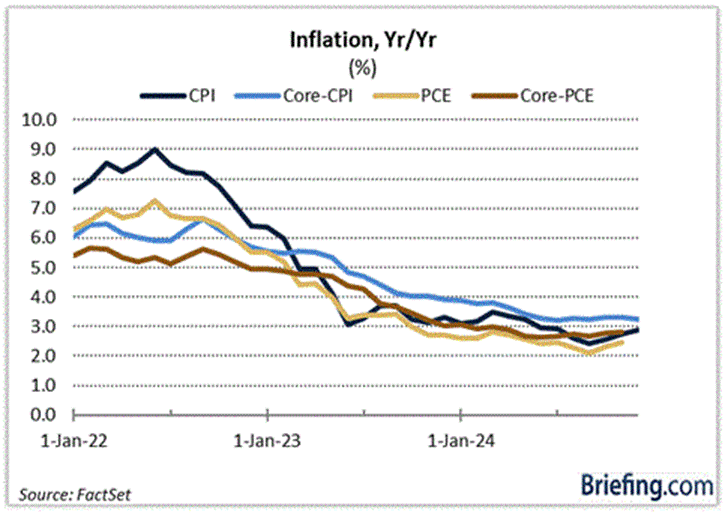
Core-PCE inflation was up 2.8% year-over-year in November; meanwhile, core-CPI, which market participants were reportedly thrilled to see, was up 3.2% year-over-year on an unadjusted basis in December.
The excitement over that core-CPI number is that it was down from 3.3% in November — no doubt moving in the preferred direction but also leaving no doubt that it isn’t progressing to 2.0% in a rapid way. It should be noted that the “3.2%” was a more generous headline presentation versus the unrounded 3.24% number.
It is also worth pointing out that core-CPI has been between 3.2% and 3.3% (rounded) for the last seven months, so it doesn’t compute that a market worried about sticky inflation over that same period was suddenly overjoyed by an inflation reading it has bemoaned for most of that time.
| Core CPI | Yr/Yr % |
| June | 3.27 |
| July | 3.17 |
| August | 3.20 |
| September | 3.31 |
| October | 3.33 |
| November | 3.32 |
| December | 3.24 |
Source: BLS
Some other tells that the market didn’t see any real inflation relief in that CPI report included the following:
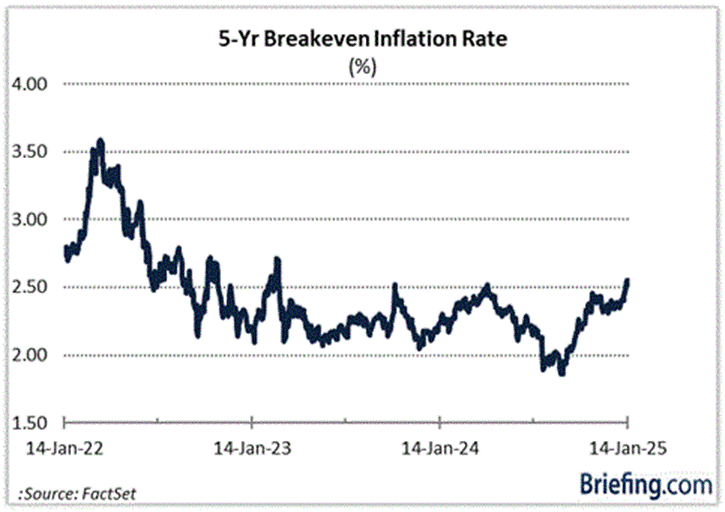
- The five-year breakeven inflation rate (a measure of what market participants expect inflation to be in the next five years, on average) barely budged the day of the report (Jan. 15). It settled at 2.52%, down three basis points from where it settled on the day of the PPI report (Jan. 14) but up one basis point from where it settled on Jan. 10 before all the “good inflation news” hit. It is essentially unchanged from where it was in October 2023.
- The fed funds futures market didn’t change its rate cut perspective. There is a 69.9% probability of the next rate cut happening at the June FOMC meeting (versus 72.8% a week ago) and a 54.2% probability of a second rate cut at the December FOMC meeting (versus 54.2% a week ago), according to the CME FedWatch Tool.
- Gold futures, which garner interest as an inflation hedge, increased 1.3% after the CPI report and were up 1.2% for the week as of this writing.
Countervailing Forces
The December CPI report was not devoid of encouraging information. Arguably, the most encouraging development was the disinflation in the lagging shelter index, which is the most heavily weighted component in the CPI report. It was up 4.6% year-over-year on an unadjusted basis, which is the lowest rate of inflation since January 2022.
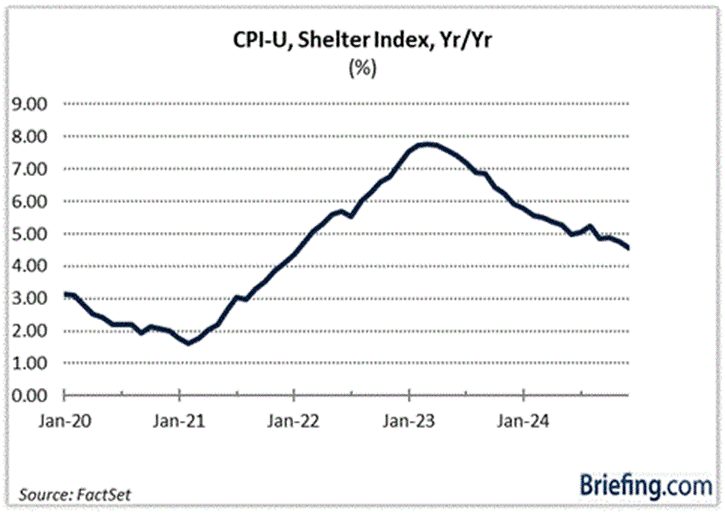
This component is definitely headed in the right direction but countervailing inflation forces are in play, namely rising oil and natural gas prices, the elevated prices-paid indexes in the ISM Manufacturing and Services PMI reports, President-elect Trump’s push to use tariffs to attack U.S. trade deficits with other countries, and policies aimed at deporting illegal immigrants.
The strong dollar will help temper some inflation pressures but, again, breakeven inflation rates haven’t adjusted yet in a manner that would suggest the market has confidence in inflation getting back to the Fed’s 2.0% target and staying there.
What It All Means
So, why did the stock market and Treasury market rally like they did after the December Consumer Price Index? Call it a relief trade for markets that had been fretting sticky inflation, particularly the Treasury market, which had already seen the yield on the 10-yr note increase 100 basis points since the Fed cut rates by 50 basis points last September when core-CPI and core-PCE were at 3.3% and 2.7%, respectively.
It was the opposite of good news being priced in. In effect, bad inflation news had been priced in, so it became a rallying point when the month-over-month change for CPI (+0.4%) was in-line and slightly better than expected for core-CPI (+0.2%).
Some pundits were quick to label the report better than expected. The better description in our humble opinion was “better than feared,” which was good enough to ignite a trading rally and short-covering activity that produced outsized gains for the Treasury market and the stock market.
The 10-yr note yield, which saw 4.80% on January 14, settled at 4.65% on January 15. The S&P 500, Nasdaq Composite, and Russell 2000 logged their best gains since November 6 (day after the election).
The summation is that both markets had gotten into a short-term oversold condition and were primed to bounce on any whiff of news that had a glint of positivity associated with it. The December CPI report fit that bill and, to be fair, had some marquis company with the better-than-expected earnings results from some of the nation’s largest financial institutions and the news of a ceasefire deal between Israel and Hamas.
The pacing in the Treasury market, though, made it clear that the CPI report was the primary catalyst for the relief rally given that stocks had been languishing in recent weeks as rates continued to rise.
They were going up at a time the market knew core-CPI was stuck between 3.2% and 3.3%. That didn’t change in December. The CPI report was better than feared, but with a 3-handle still on core-CPI, let’s not stretch the truth and call it good just yet.
—Patrick J. O’Hare, Briefing.com
(Editor’s Note: The Next installment of The Big Picture will be published the week of January 27)
Where will our markets end this week?
Higher
DJIA – Bullish
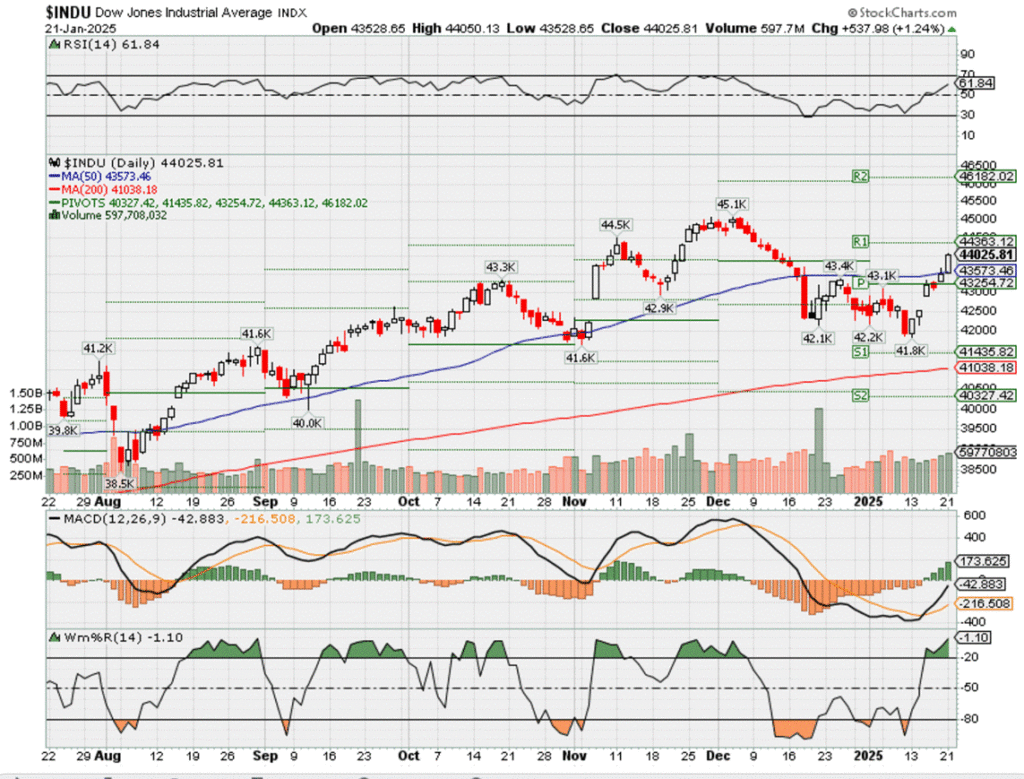
SPX – Bullish

COMP – Bullish

Where Will the SPX end January 2025?
01-06-2025 +2.4%
01-13-2025 -2.0%
01-21-2025 +2.0%
Earnings:
Mon: Martin Luther King Day
Tues: SCHW, DHI, KEY, UAL, NFLX, ZION
Wed: ABT, JNJ, PG, AA, DFS, KMI, HAL
Thur: ALK, AAL, FCX, UNP, ISRG
Fri: AXP, VZ
Econ Reports:
Mon:
Tue
Wed: MBA, Leading Indicators
Thur: Initial Claims, Continuing Claims,
Fri: Existing Home Sales, Michigan Sentiment
How am I looking to trade?
Now we are protecting for Q4 earnings in 2025
www.myhurleyinvestment.com = Blogsite
info@hurleyinvestments.com = Email
Questions???
I don’t care what anyone is politically speaking!!! ALL I care about is how political parties affect the stock market and myself/family
Fed Governor Waller sees potential for multiple interest rate cuts in 2025
Published Thu, Jan 16 202512:23 PM ESTUpdated Thu, Jan 16 20251:45 PM EST
Jeff Cox@jeff.cox.7528@JeffCoxCNBCcom
Key Points
- Fed Governor Christopher Waller told CNBC on Thursday that the central bank could lower interest rates multiple times this year if inflation eases as he is expecting.
- “As long as the data comes in good on inflation or continues on that path, then I can certainly see rate cuts happening sooner than maybe the markets are pricing in,” he said.
- Traders increased their bets for a slightly more aggressive pace of rate cuts following Waller’s remarks.
Fed’s Waller: Rates could fall in the first half of the year if data stays on trend
Federal Reserve Governor Christopher Waller said Thursday that the central bank could lower interest rates multiple times this year if inflation eases as he is expecting.
In a CNBC interview, the policymaker said he expects the first cut could come in the first half of the year, with others to follow so long as economic data on prices and unemployment cooperate.
“As long as the data comes in good on inflation or continues on that path, then I can certainly see rate cuts happening sooner than maybe the markets are pricing in,” Waller said during a “Squawk on the Street” interview with Sara Eisen.
Asked how many that could entail, he responded, “That’s all going to be driven by the data. I mean, if we make a lot of progress, you could do more,” which he said could mean three or four, assuming quarter percentage point increments.
“If the data doesn’t cooperate, then you’re going to be back to two and going maybe even one, if we just get a lot of sticky inflation,” he said.
Traders increased their bets for a slightly more aggressive pace of rate cuts following Waller’s remarks. Market-implied odds for a May move rose to about 50%, though June appeared to be the better bet, according to CME Group data. Expectations for a second reduction by the end of the year climbed to about 55%, or about 10 percentage points higher than before he spoke.
At the core of Waller’s hopes for easing is a belief that inflation will ease further as the year goes on, despite several months’ of data showing stickiness in some key prices. The consumer price index slowed to a 3.2% core reading, excluding food and energy, for December, down 0.1 percentage point from the prior month though still well above the Fed’s 2% target.
“Right now, I think inflation is going to continue to come in towards our target. The year over year, stickiness that we saw in 2024 I think will start to dissipate,” he said. “So I may be a little more optimistic about inflation coming down than the rest of my colleagues, and that’s what’s driving my outlook for the path for policy.”
At the December meeting, Federal Open Market Committee members penciled in two cuts for 2025, though commentary after the meeting has pointed toward a cautious and patient approach.
The FOMC next meets Jan. 28-29, with markets pricing in almost no chance of a move.
“Well, January, we need to kind of see what’s going to happen. … We’re in really no rush to do things,” Waller said.
Major winter storm threatens much of the U.S. with intense cold, snow and ice
Published Sun, Jan 5 20256:47 AM ESTUpdated Sun, Jan 5 20252:45 PM EST
Freddie Clayton
Tens of millions of Americans are bracing for a massive winter storm Sunday, forecast to bring the heaviest snowfall and coldest temperatures to parts of the country in over a decade.
Kansas, Arkansas, Kentucky and Virginia have declared states of emergency as the storm, driven by a polar vortex, moved east after striking the central United States. Southern states like Mississippi and Florida also warned of dangerous cold and treacherous conditions, according to the National Weather Service.
A polar vortex is an area of low pressure and cold air that swirls like a wheel around each of Earth’s two polar regions. Sometimes, the Arctic polar vortex wobbles and a lobe surges south, blanketing parts of North America with bitter temperatures.
As the storm moved east, around 60 million people across 30 states from the Plains to the mid-Atlantic were under weather alerts, with a developing low-pressure system threatening heavy snow and crippling ice over the next three days.
Video circulating on social media Sunday morning showed snow already falling in Shepherdsville and Monroe County, Kentucky.
Travel disruptions
Over 1,200 flights within, into and out of the U.S. have been delayed and more than 750 were canceled as of Sunday morning, according to FlightAware.com. The most impacted airports include Kansas City International, where almost 190 flights have been canceled, and St. Louis Lambert International Airport, which has had over 190 flight cancelations.
Chicago O’Hare International Airport has had 120 cancelations and over 60 delays. Southwest Airlines accounts for most of the cancelations and delays, with over 230 flights canceled and 250 delayed as of Sunday morning.
Kansas City International Airport briefly closed Saturday as crews cleared runways — delaying dozens of flights including a charter jet transporting the Kansas City Chiefs, according to The Associated Press.
And an 18-mile stretch of Interstate 70 in Kansas was shut down as blizzard conditions threatened up to 14 inches of snow and 40 mph wind gusts, with warnings in effect until early Sunday, according to the National Weather Service.
The service predicts historic precipitation for parts of Kansas and Missouri, forecasting over 15 inches of snow from northeastern Kansas into north-central Missouri — the region’s heaviest snowfall in a decade.
The weather service warned of “considerable disruptions to daily life,” including “dangerous or impossible driving conditions and widespread closures,” making travel “very difficult to impossible” through Sunday.
Cincinnati, Chicago and St. Louis have treated roads in advance of the storm and prepared warming centers.
Scattered snow showers developed across the northern Plains Saturday afternoon and through the evening. More than 2 million people were covered by a blizzard warning for most of Kansas and a large part of Missouri on Sunday morning, according to the weather service.
Such a warning alerts residents to a likelihood of reduced visibility of a quarter mile or less and sustained winds of at least 35 mph.
Sunday is expected to bring a severe weather risk across the lower Mississippi Valley, putting 7 million people at risk for tornadoes, damaging wind and hail in cities including Jackson, Mississippi; and Baton Rouge, Shreveport and Lake Charles, Louisiana.
As the storm advances east, millions more Americans are bracing for record-low temperatures, forecasters warn.
Snow will arrive in the mid-Atlantic and central Appalachians overnight into Monday morning. These showers will linger through Monday, ending by Tuesday morning as the system moves offshore.
Washington, D.C., Baltimore and Philadelphia are among the major cities preparing for snowy and icy conditions from Sunday into Monday, with parts of Virginia expecting 5-12 inches of snow.
Meanwhile, severe thunderstorms could hit Southern states that were unaccustomed to severe cold, including Arkansas, Louisiana, and Mississippi.
From coast to coast Saturday, weather-related flight delays were estimated at almost 7,000.
At the western end of the low-pressure system, Denver International Airport led the globe in delayed flights, with nearly half its departures on Saturday leaving late, according to FlightAware.com.
Major airlines, including American, Delta, Southwest and United, are waiving change fees ahead of likely flight disruptions.
In the wake of this system, a significant drop in temperatures is anticipated for the eastern two-thirds of the country. Highs will drop 10 to 25 degrees below average starting Sunday and lasting through Friday. Highs will range from the single digits and teens across the Plains and Midwest, and in the 20s to 30s in the mid-Atlantic and Northeast.
The most extreme temperatures will be in the northern Plains, where overnight lows will dip as low as minus 20, with wind chill values around minus 40. Cold weather advisories are in place from eastern Montana through Minnesota.
Over 40,000 utility customers across Missouri, North Carolina, Kansas, Texas and Oklahoma were without power Sunday morning, according to PowerOutage.US.
These five Republicans are ready to derail Trump’s tax cuts over the SALT cap
Published Thu, Jan 16 202512:14 PM ESTUpdated Thu, Jan 16 20251:46 PM EST
Key Points
- Five House Republicans plan to vote together in a bloc that could derail President-elect Donald Trump’s signature tax bill unless they get concessions on the current cap on state and local tax deductions.
- GOP Rep. Nick LaLota, of New York, told CNBC that doubling the SALT cap to $20,000 would be a “laughable” proposal.
- The SALT cap debate divides Republicans because lifting the limit is expensive and because it would largely benefit high-income households.
Rep. Frank Pallone: Trump is backtracking again on SALT Tax cap
WASHINGTON — An influential group of five House Republicans from high-tax states is threatening to hold up a major tax package that is a top priority for President-elect Donald Trump unless they get a significant boost to the amount that their constituents can deduct from federal income taxes to reflect state and local taxes already paid.
As negotiations over a major tax cuts bill get underway, they are also drawing a firm line: Simply doubling the maximum allowed deduction from the current $10,000 cap to $20,000, they say, is not enough.
“The $20,000 is a nonstarter,” Rep. Nick LaLota, R-N.Y., told CNBC. “It’s almost laughable. It’s way too low to earn our vote.”
LaLota is one of 16 members of a congressional state and local tax, or SALT, caucus who attended a recent meeting with Trump at his Florida resort, Mar-a-Lago. There, Trump promised the lawmakers that he would back their efforts to raise the SALT cap and told them to get back to him with a number that would ensure their support for his broader tax package, according to LaLota and his fellow New York GOP Rep. Andrew Garbarino.
The group plans to use House Republicans’ narrow, four-seat majority to increase its own leverage.
Specifically, LaLota is part of a bloc of five Republican House members who plan to stick together and oppose any broader Trump tax cut package unless it contains significant changes to the current SALT cap provisions.
Rounding out this group are Reps. Mike Lawler, of New York, Rep. Tom Kean Jr., of New Jersey, and Rep. Young Kim, of California, according to LaLota and Garbarino.
Under the current makeup of the House, Republican Speaker Mike Johnson, of Louisiana, can afford to lose only two GOP votes and still pass a piece of legislation along party lines. As a five-vote bloc, these SALT Republicans could effectively sink the tax cut bill that is expected to be Trump’s top legislative priority.
A spokesman for Johnson did not reply to a request for comment on the demands from the SALT bloc.
While the larger SALT caucus has secured support for a SALT cap hike from Trump, they still need to win over hundreds of their fellow Republicans who oppose lifting the cap.
One of the most common objections to raising the SALT cap above $10,000 is that the benefits of a higher cap would mostly accrue to wealthier Americans. Another is that lifting the current limit could add billions of dollars to the cost of any tax bill, depending upon how it is structured.
The Institute on Taxation and Economic Policy estimates that households with incomes in the top 20% would disproportionately benefit from any effort to raise the maximum allowable deductions for state and local taxes. That’s because these households are more likely to have higher state tax bills and to owe more in federal income taxes.
Garbarino said that while his constituents might have incomes that are high compared with the rest of the country, in the context of the high cost of living in their areas, these households are middle-class.
“I don’t have a very wealthy district,” he said in an interview with CNBC. “I’m mostly on the south shore of Long Island, mostly cops, firemen from New York City, teachers, other blue-collar workers, union guys. They all got hurt when this was put into place back in 2017, and we’re looking to right that wrong.”
The broader SALT caucus has yet to propose exactly what they think the cap should be, and they are looking at data to find a proposal that would ensure that the benefits go to the middle class, according to LaLota, Garbarino and Rep. Nicole Malliotakis, R-N.Y.
LaLota said there are two options he prefers. One is that Congress could raise the cap to a yet-to-be-determined amount, and then allow joint filers to deduct twice that.
Alternatively, Congress could remove the cap altogether but limit the deduction to those households with income below a specific threshold.
TikTok restoring U.S. service after Trump provided ‘assurance’
Published Sun, Jan 19 202512:40 PM ESTUpdated Sun, Jan 19 20259:55 PM EST
Hakyung Kim@in/hakyungkim/@hakyungkim_
Key Points
- TikTok was available to some users on Sunday after President-elect Donald Trump said that he would sign an executive order to delay a federal ban of the app.
- “I’m asking companies not to let TikTok stay dark!” Trump wrote in a post on his social media app Truth Social on Sunday morning.
TikTok was available to some U.S. users on Sunday after President-elect Donald Trump said that he would sign an executive order on Monday following his inauguration to delay a federal ban of the app.
In a statement on X, the company wrote that it would bring back access to its American users.
“In agreement with our service providers, TikTok is in the process of restoring service,” TikTok wrote. “We thank President Trump for providing the necessary clarity and assurance to our service providers that they will face no penalties providing TikTok to over 170 million Americans and allowing over 7 million small businesses to thrive.”
The decision is “a strong stand for the First Amendment and against arbitrary censorship,” the company added. “We will work with President Trump on a long-term solution that keeps TikTok in the United States.”
This came after Trump wrote on his social media app Truth Social he would “issue an executive order on Monday” to extend the period of time before the ban was set to take place.
“I’m asking companies not to let TikTok stay dark!” Trump wrote on Sunday morning.
Although TikTok was shut down for American users late Saturday night, and also removed from Apple and Google’s app stores, some were able to log on to the platform on Sunday through their mobile apps and desktops.
The law banning TikTok was set to take effect on Sunday as ByteDance, the China-based owner of TikTok, had not yet divested the company to a non-Chinese entity. The Supreme Court had ruled on Friday to uphold the law that would ban the app and penalize third-party internet service providers, such as Apple and Google, if they supported TikTok on their platforms after the ban went into effect.
Despite TikTok’s pledge to reinstate service in the U.S. following Trump’s statement, the company’s future remains unclear under the current law.
Trump has previously stated on Truth Social that he would like the U.S. to hold 50% ownership of TikTok in a joint venture to “keep it in good hands and allow it to stay up.” However, ByteDance has not changed its stance on having no plans to sell the company.
CNBC Daily Open: Markets are getting ready for Trump 2.0
Published Sun, Jan 19 20257:41 PM EST
In this article
- BARC-GB+4.10 (+1.40%)
- JPM-0.05 (-0.02%)
- GS-1.48 (-0.23%)
- .IXIC+126.58 (+0.64%)
- .DJI+537.98 (+1.24%)
- .SPX+52.58 (+0.88%)
- 2330-TWUNCH
- RIO-GB-68.00 (-1.34%)
- GLEN-GB-6.60 (-1.71%)
- .FTSE+27.75 (+0.33%)
- .STOXX+2.11 (+0.40%)
This report is from today’s CNBC Daily Open, our international markets newsletter. CNBC Daily Open brings investors up to speed on everything they need to know, no matter where they are. Like what you see? You can subscribe here.
What you need to know today
Clock restarted for TikTok
TikTok said in a statement on X that it’s restoring service in the U.S. after U.S. President-elect Donald Trump wrote on his social media app Truth Social he would “issue an executive order on Monday” to delay a ban on TikTok. On Saturday, Perplexity AI submitted a bid to TikTok’s parent company ByteDance to create a new merged entity combining Perplexity, TikTok U.S. and new capital partners, CNBC learned.
First winning week for U.S. stocks in 2025
Markets in the U.S. rose on Friday to end the week higher for the first time in 2025. The pan-European Stoxx 600 index climbed 0.69%. The U.K.’s FTSE 100 rose 1.35% to close at a record high. The index was lifted by mining stocks, which advanced on the news that Glencore reportedly considered a merger with Rio Tinto although talks are no longer active.
TSMC confident of continued funding under Trump
Taiwan Semiconductor Manufacturing Co expects that it’ll continue to receive the $6.6 billion it was promised under the Biden administration’s CHIPS and Science Act even after Trump takes office, TSMC Chief Financial Officer Wendell Huang told CNBC in an exclusive interview. On the campaign trail, Trump criticized the CHIPS Act and accused Taiwan of stealing the chip business from U.S.
Hamas and Israel exchange hostages and prisoners
The ceasefire between Israel and Hamas took effect on Sunday. Hamas released three women to Israel, its first batch of hostages, in exchange for Palestinians prisoners to be set free by Israel. The process will continue over the next weeks, during which, Hamas will release 33 of the 98 Israeli and foreign hostages as Israel returns Palestinian prisoners.
[PRO] Trump to determine direction of markets
The inauguration of Trump will happen later Monday. Investors will want to keep an eye on what executive orders Trump will sign beginning from the first day of his presidency, especially as they relate to tariffs and corporate policies. Those orders could chart the direction of stocks for much longer than just the near term.
The bottom line
The S&P 500 surged above the shiny 6,000 level following Trump’s election victory but has largely erased all its gains and reverted to its pre-election level in the past few weeks. As Trump prepares to enter the White House, however, it seems like investors are gearing up to play the market based on his agenda again.
Stocks finally ended the week on a positive note, their first weekly gain for the year. For the week, the S&P 500 advanced 2.9% and the Dow Jones Industrial Average jumped 3.7%, their best weekly performance since the week of the U.S. presidential election in November. The Nasdaq Composite added 2.5%, its best week since early December.
Banks largely contributed to the bump in the indexes as better-than-expected earnings reports from big banks lifted their shares higher. Shares of Goldman Sachs popped around 12% on the week and JPMorgan Chase climbed 8% in the same period. Overall, the financial sector rallied more than 6% last week, outperforming the S&P.
Trump’s term as president might provide more forward momentum for bank stocks. Rising business and consumer confidence, an extension of tax cuts, and deregulation of the finance industry are potential drivers of the sector, according to Chris Senyek, chief investment strategist at Wolfe Research.
“We still see Financials as the biggest sectoral winner under the Trump administration,” Senyek wrote in a note on Friday.
That said, apart from anticipation of Trump sitting in the Oval Office, muted back-to-back inflation readings for December also buoyed animal spirits in the markets: All sectors of the market ended the week in the green.
The better-than-expected economic data earlier this week has helped “revive the goldilocks narrative for equities, and likely prompted some re-risking,” Barclays strategist Emmanuel Cau wrote in a Friday note.
Typically, any change involves increased risks. That’s true with Trump 2.0 — but as the number “two” suggests, a change we’ve seen before might mitigate a tiny bit of that uncertainty.
— CNBC’s Alex Harring, Hakyung Kim and Sarah Min contributed to this report.
